Kim Jong-un Presents New Core Goal to Strengthen Defense Power
Prospects for Nuclear Force Enhancement... "Possibility of Drone Development"
Maintains Hostile Stance Toward South Korea... "Improvement Difficult to Expect"
[Asia Economy Reporter Jang Hee-jun] Kim Jong-un, Chairman of the State Affairs Commission of North Korea, presented a 'new core objective' for strengthening national defense at the Party plenary meeting that determines the direction of state administration for the new year. In particular, Chairman Kim specified a 'direction for anti-enemy struggle' targeting the South, expressing his intention to continue raising the level of military tension next year. Since South Korea was labeled as an 'enemy,' there are also assessments that improving inter-Korean relations will be difficult for the time being.
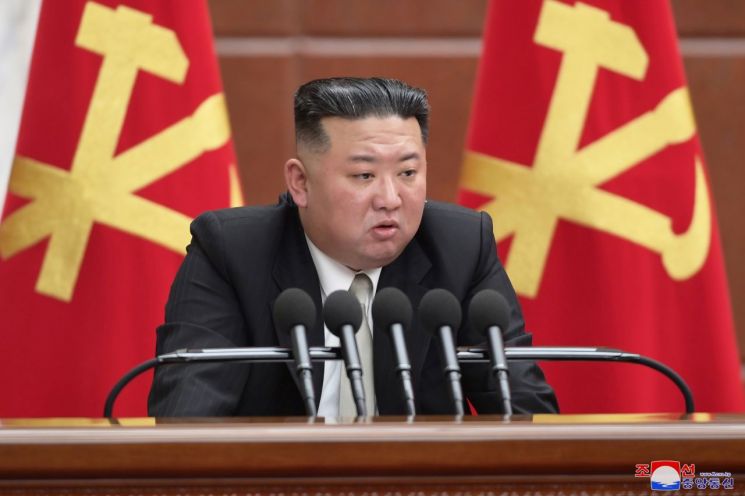 Kim Jong-un reports at the Party Plenary Meeting, "Presents new core goal to strengthen national defense next year" / Korean Central News Agency
 [Image source=Yonhap News]
On the 28th, the Korean Central News Agency reported that Chairman Kim Jong-un presented new core objectives for self-defensive national defense strengthening that must be vigorously pursued in 2023 in preparation for multifaceted geopolitical fluctuations during the second day of the expanded plenary meeting of the Central Committee of the Workers' Party.
The details of the core objectives presented by Chairman Kim have not been disclosed, but it is expected that intensive nuclear force enhancement measures were discussed.
North Korea presented five key tasks of the five-year plan for national defense development at the 8th Congress of the Workers' Party in January last year. The five tasks are ▲development of hypersonic weapons ▲production of super-large nuclear warheads ▲improvement of strike accuracy within a 15,000 km range ▲development of underwater and ground solid-fuel intercontinental ballistic missiles (ICBMs) ▲possession of nuclear submarines and underwater-launched nuclear strategic weapons.
Among these, super-large nuclear warhead production, solid-fuel intercontinental ballistic missiles (ICBMs), nuclear submarines, and underwater-launched nuclear strategic weapons have not yet been revealed in substance, so it is anticipated that specific plans regarding these were presented. It is also expected that there were mentions of the launch plan for the first military reconnaissance satellite, which North Korea said it would prepare by April next year, and the seventh nuclear test.
Hong Min, head of the North Korea Research Division at the Korea Institute for National Unification, analyzed, "They will actively pursue the parts that were presented at the Party Congress but remained incomplete," adding, "It is possible that they discussed diversifying tactical nuclear weapons, converting ICBMs to solid fuel, and strengthening the medium-range lineup through the development of strategic cruise missiles, hypersonic missiles, and submarine-launched ballistic missiles (SLBMs)."
Jung Sung-jang, director of the North Korea Research Center at the Sejong Institute, predicted, "North Korea visually confirmed our helplessness against unmanned aerial vehicle intrusions," and added, "Along with nuclear force enhancement measures, they may accelerate development plans for unmanned aerial vehicles."
'South → Enemy' Specified... "Improvement of Inter-Korean Relations Unlikely"
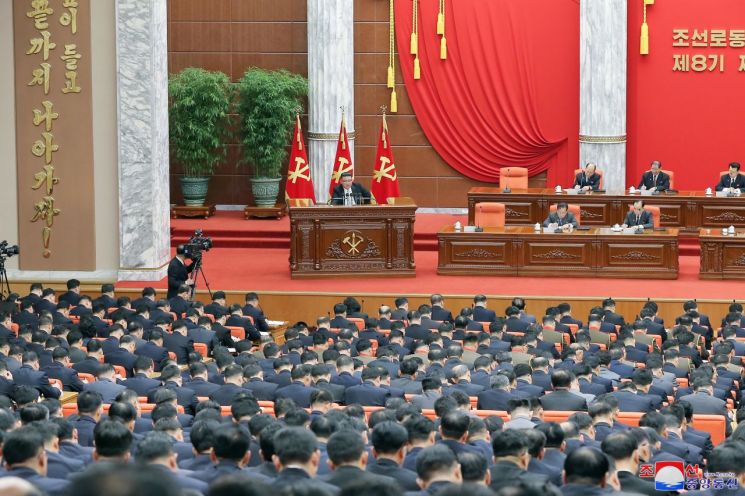 Kim Jong-un reports at the Party Plenary Meeting, "Presents new core goal to strengthen national defense next year" / Korean Central News Agency
 [Image source=Yonhap News]
In particular, the report explicitly mentioned a 'direction for anti-enemy struggle' targeting the South, interpreted as an intention to continue raising confrontation levels next year. Especially since the South was labeled as an 'enemy,' experts predict that improving inter-Korean relations will be difficult for the time being.
The news agency reported that in Chairman Kim's report, "The newly formed challenging situation on the Korean Peninsula and the international political situation were profoundly analyzed and evaluated, and the external affairs principles and anti-enemy struggle directions that our Party and the government of the Republic must thoroughly uphold to defend national sovereignty and safeguard national interests under the current circumstances were specified."
Since North Korea recently evaluates the international situation as a 'new Cold War' and 'multipolarization,' it is expected that the level of anti-South and anti-US denunciations will increase. Also, considering that North Korea has argued the 'necessity of nuclear force strengthening' based on the intensifying US-China hegemonic competition, mentions such as 'defense of national sovereignty' and 'safeguarding national interests' are interpreted as implying the advancement of nuclear capabilities.
Additionally, although North Korea usually did not separately address South Korea policy at plenary meetings, the 'anti-enemy struggle' mentioned in this report was a term mainly used targeting South Korea. Experts evaluate that since the South was explicitly labeled as an 'enemy,' it has become difficult to expect improvements in inter-Korean relations for the time being.
Director Jung expressed concern, saying, "The possibility of further deterioration in relations next year has increased," and added, "If North Korea realizes tactical nuclear miniaturization through the seventh nuclear test and forward-deploys tactical nuclear weapons, our security, which maintains a policy of responding only with non-nuclear weapons, will inevitably become more vulnerable."
© The Asia Business Daily(www.asiae.co.kr). All rights reserved.


















