"Half Reduction in Both Walk-in and Delivery Customers" Double Hardship
Small Business Association "Government Support Programs Must Be Expanded"
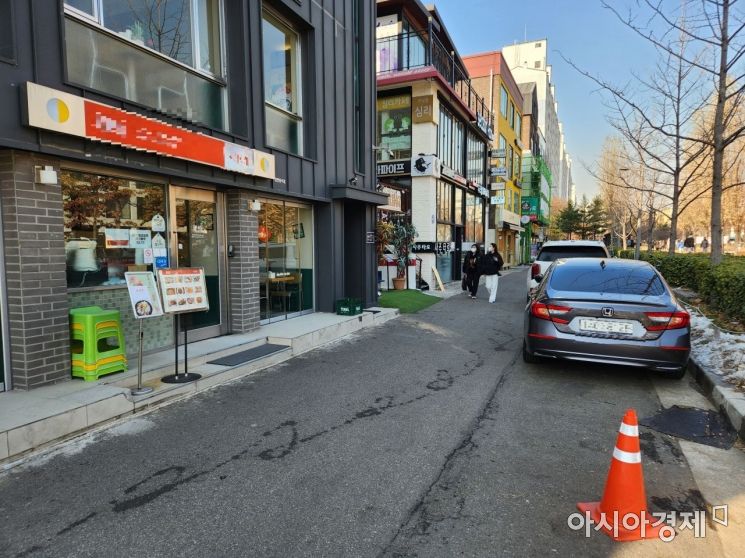 A quiet scene around 12:30 PM on the 27th in the restaurant alley next to Yeontral Park, Mapo-gu, Seoul.
 Photo by Taewon Choi skking@
[Asia Economy Reporter Choi Taewon] Mr. A (55), who runs a restaurant near the railway tracks in Yeonnam-dong, Seoul, known as ‘Yeontral Park,’ has fallen into a deficit. He had been operating at a loss for nearly two years due to the COVID-19 pandemic. Fortunately, increased delivery orders and government support such as the COVID-19 small business loans barely kept him afloat, but now he faces an economic recession and high interest rates. Mr. A lamented, “It’s harder than during COVID. Delivery orders have dropped to less than half compared to last winter. The interest rate on the COVID small business loan I’ve been paying off monthly surged from 1.47% in January to 6.32% in December. I’m spending nearly 1.7 million won every month just to repay the debt.”
Although winter seemed like it would bring a breeze of recovery after the COVID-19 crisis ended, merchants in Yeonnam-dong wore worried expressions due to the economic downturn and the burden of rising loan interest rates.
At 12:30 p.m. on the 27th, with just four days left in the year, it was a time when young citizens would usually be bustling around on year-end dates. However, that day, only small groups of office workers came out for lunch, and it was hard to find citizens who looked like they were out for dates or leisure.
Among the busy office workers, college student Mr. B (20), who was taking photos with Yeontral Park in the background, said, “I came out to the busy area with a friend for the first time in about two months,” expressing excitement but also bitterness, adding, “Nothing hasn’t gone up in price, starting with groceries. I live alone, so my expenses have increased, and I haven’t been visiting restaurants much lately.”
Due to rising prices, citizens’ purchasing power has sharply declined. According to Statistics Korea, the real income of households with regular workers in the third quarter of this year decreased by 5.0% compared to the previous year. During this period, nominal income increased by 0.5%, but the consumer price index rose by 5.9%, significantly lowering real income. Temporary and daily workers experienced even larger decreases in real income, at 5.1% and 5.6%, respectively.
Mr. C (in his 60s), who runs a Chinese restaurant, sighed as he pointed out that only three out of ten tables were occupied despite it being lunchtime. Mr. C explained, “Even considering the cold weather, the number of customers has dropped significantly. Both dine-in and delivery orders seem to have decreased by nearly half compared to last winter.”
Merchants in Yeonnam-dong also complained that while their income has decreased, their expenses have increased. They said the burden of loans has surged due to rising interest rates. Mr. D (41), who took out a low-interest loan last year during the height of the COVID-19 crisis to open his store, expressed regret, hoping for at least minimal support to help them survive despite the poor economy.
Mr. D said, “Customers have decreased, and I have barely managed to survive for nearly two years with loans. Now, it’s really tough to pay rent and principal and interest,” adding, “We have to survive so that we can pay taxes later and keep the country running. We’re not asking for a large sum, just enough help to get by.”
The Bank of Korea’s Financial Stability Report also highlights the heavy burden of loans on self-employed individuals. As of the end of the third quarter, self-employed loans totaled 1,014.2 trillion won. Self-employed loans were around 700 trillion won in the first quarter of 2020, at the start of the COVID-19 crisis. During this period, the base interest rate surged from the 0% range to 3.25%. If loan interest rates rise by 1 percentage point, the total interest burden on self-employed loans increases by 7.4 trillion won. The average increase in interest per self-employed person reaches 2.38 million won.
Namsoo Cha, head of the Small Business Association, said, “From the sharp minimum wage increase in 2018, the COVID-19 crisis in 2020, to the rapid rise in interest rates in 2022, the situation for small business owners has been worsening for years. They are practically like patients,” adding, “Moreover, with real income falling and sales plummeting, they have reached a state where they have no energy left to recover. Support is urgently needed.”
He continued, “Small businesses employ 7.2 million people and are a major pillar of the economy. The government should seek ways to rescue those in policy blind spots, such as expanding refinancing loan targets.”
© The Asia Business Daily(www.asiae.co.kr). All rights reserved.

















