Ahead of the Regular National Assembly, Controversial Personnel Cuts
'Double-Edged Sword'... Concerns Over Backlash from Cabinet Reshuffle
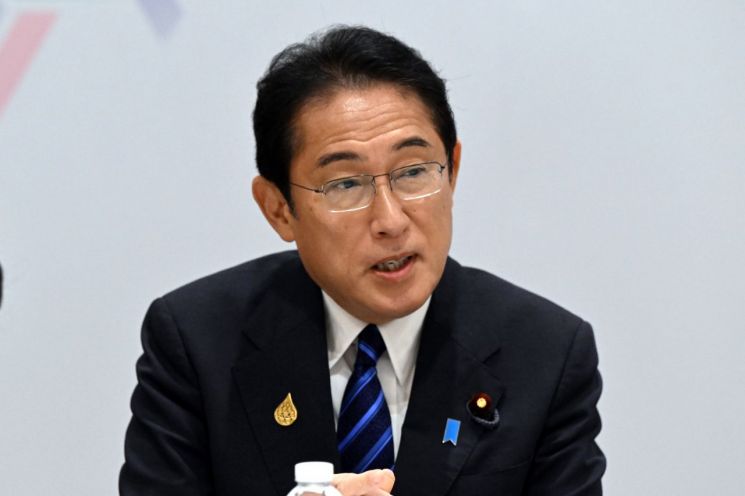
[Asia Economy Reporter Jeon Jinyoung] Japanese Prime Minister Fumio Kishida, who recorded the lowest approval rating in history, has pulled out the reshuffle card. Although it is a gamble thrown to rebound the approval rating, there are concerns that it could rather act as a "double-edged sword" targeting his own administration.
◆Lowest Approval Rating in History... Starting to Cut Controversial Figures
According to the Nihon Keizai Shimbun on the 26th, Prime Minister Kishida is expected to replace Reconstruction Minister Akiba Genya on the 27th. When asked about the replacement of Minister Akiba during a Q&A session with reporters that morning, Kishida replied, "What I can do now is to prepare for the regular Diet session next year." This practically hints at a cabinet reshuffle. If Minister Akiba, who is mentioned as the top candidate for replacement, remains in office, the Kishida administration will inevitably face opposition attacks at the regular Diet session convened in January next year.
Minister Akiba is suspected of spending membership fees on the Family Federation for World Peace and Unification (Unification Church) organization. Since the Unification Church-related issues have rapidly emerged as a social problem in Japan following the shooting incident of former Prime Minister Shinzo Abe, the controversy is unlikely to subside easily. He is also facing allegations of violating the Public Offices Election Law in last year's House of Representatives election.
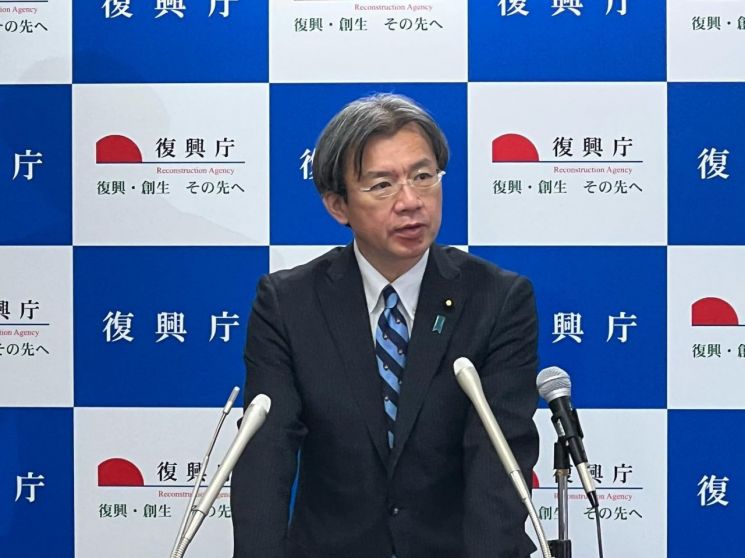 Akiba Kenya, Japan's Minister of Reconstruction, at a press conference. (Photo by Minister Akiba's Facebook)
With major agendas such as the review of next year's budget bill piling up, if opposition attacks continue, it may become even more difficult for Prime Minister Kishida to recover his approval rating. According to a survey conducted by Asahi Shimbun from the 17th to 18th targeting 1,357 voters nationwide, the approval rating of the Kishida Cabinet recorded the lowest ever at 31% since its launch. The percentage of those who do not support it was 57%, 6 percentage points higher than the previous week (51%). With the local elections scheduled for April next year, Prime Minister Kishida is in desperate need of a "big move" to turn the situation around.
Meanwhile, Administrative Vice-Minister Mio Sugita of the Ministry of Internal Affairs and Communications is also mentioned as a candidate for the reshuffle. This is because calls for her resignation have been raised mainly by civic groups as her past remarks have been reexamined. When she attended the United Nations (UN) Committee on the Elimination of Discrimination against Women in 2016, she described a woman dressed in hanbok on her social media (SNS) as a "cosplaying ajumma." In addition, her past remark that "sexual minorities are unproductive" also became controversial, leading her to retract the statement and apologize on the 2nd.
◆Concerns That 'The Reshuffle Could Backfire'
Some quarters express concerns that the reshuffle card pulled out by Prime Minister Kishida may not be of practical help. There is criticism that the reshuffle could rather acknowledge the administration's personnel mistakes and cause a backlash.
The Sankei Shimbun called this reshuffle rumor a "double-edged sword," stating, "The Prime Minister already conducted a reshuffle in August, so doing it again in a short period is tantamount to admitting his personnel failures," and "The reshuffle should not be carried out on a large scale. It should be minor, such as replacing Minister Akiba."
Earlier, Prime Minister Kishida conducted a large-scale reshuffle in August, replacing 14 out of 19 ministers. However, less than half a year later, three ministers fell due to controversies related to the Unification Church and inappropriate remarks, resulting in only a backlash. At that time, despite the large-scale reshuffle, Kishida was criticized for prioritizing factional balance over personnel reform by appointing four members of the Abe faction, the largest faction within the Liberal Democratic Party (LDP).
Former LDP Secretary-General Toshihiro Nikai also advised in a TBS interview on the 23rd, "A reshuffle can be tried as one way to overcome the approval rating," but warned, "However, if the reshuffle is done in the usual faction-bound manner, the public will easily see through it."
There was also a pessimistic analysis that Prime Minister Kishida is following the footsteps of failed administrations. Asahi Shimbun reported that during former Prime Minister Shinzo Abe's first term in 2006, the Ministers of Administrative Reform, Agriculture, Forestry and Fisheries, and Defense resigned one after another due to political funding issues and inappropriate remarks, and the cabinet resigned within a year of its launch.
During former Prime Minister Taro Aso's administration, the Ministers of Land, Infrastructure, Transport and Tourism, Finance, and Internal Affairs and Communications resigned within nine months, and the LDP had to hand over power to the Democratic Party in the subsequent general election. The reshuffle, conducted without sufficient personnel verification, ultimately hastened the downfall of the administration.
A senior LDP lawmaker also told Sankei Shimbun, "The possibility of approval ratings recovering just because of a reshuffle does not seem very high."
© The Asia Business Daily(www.asiae.co.kr). All rights reserved.
![Clutching a Stolen Dior Bag, Saying "I Hate Being Poor but Real"... The Grotesque Con of a "Human Knockoff" [Slate]](https://cwcontent.asiae.co.kr/asiaresize/183/2026021902243444107_1771435474.jpg)

















