Despite Securing 3.6 Years of Work in Joseon History, Labor Shortage Persists
Urgent Need for Support on 52-Hour Workweek and Improved Working Conditions
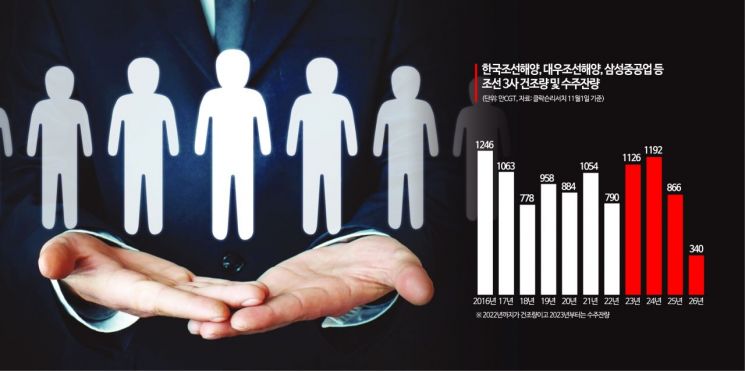
[Asia Economy Reporter Oh Hyung-gil] The shipbuilding industry, which has regained smiles after a long time due to a bumper year of orders, is being held back by a persistent labor shortage. There are even talks that more than 10,000 workers will be lacking next year. As many skilled workers leave shipyards, the proportion of inexperienced unskilled workers is increasing, and the remaining experienced workers are burdened with more tasks, suffering from high-intensity work.
The shipbuilding industry believes that simply raising wages cannot stop the outflow of workers, and the industry is appealing for urgent institutional support such as the 52-hour workweek and improvements in regional working conditions.
On the 26th, Clarkson Research announced that the backlog of orders for domestic shipbuilders stood at 36.57 million CGT as of November. Considering that the annual production is estimated at 10 million CGT, this means securing work for more than 3.6 years. At the beginning of the year, there were concerns that orders might decrease, but in reality, orders increased. Early this year, the Russia-Ukraine war led to the cancellation of some Russian projects, creating a sense of crisis.
However, Europe’s large orders for LNG (liquefied natural gas) carriers to replace Russian gas imports revitalized the domestic shipbuilding industry.
The three major shipbuilders?Korea Shipbuilding & Offshore Engineering, Daewoo Shipbuilding & Marine Engineering, and Samsung Heavy Industries?exceeded their order targets for two consecutive years, led by LNG carriers. Korea Shipbuilding & Offshore Engineering surpassed its target by 127.8%, Daewoo Shipbuilding & Marine Engineering by 117%, and Samsung Heavy Industries by 107%, accumulating orders. Specifically for LNG carriers, Daewoo Shipbuilding & Marine Engineering secured 19 vessels, Samsung Heavy Industries 18, and Hyundai Heavy Industries 17.
With orders piling up, shipbuilding volume is expected to increase sharply starting next year. Due to the impact of COVID-19, this year’s production volume is expected to be only 7.9 million CGT, but the scheduled deliveries for next year amount to 11.26 million CGT, a 42.5% increase over this year. In 2024, it is expected to rise further to 11.92 million CGT.
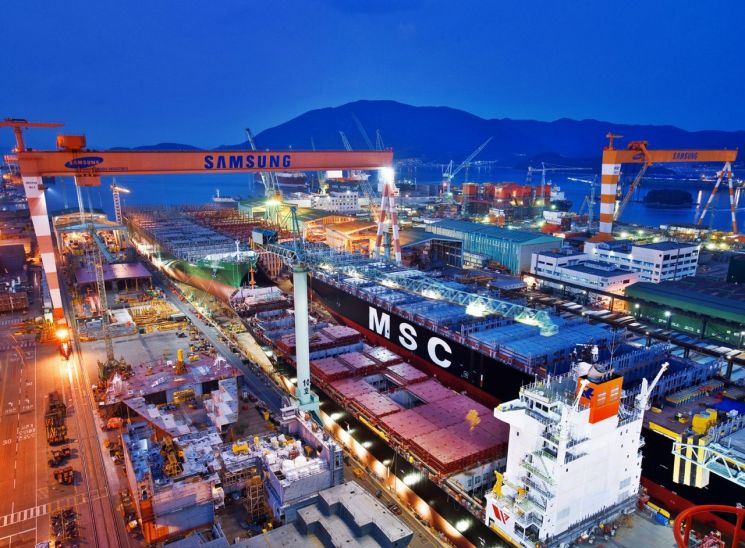
However, there are concerns that delivery delays could occur due to a lack of workers on site. The workforce in the shipbuilding industry has been declining for years. The number of employees (excluding fixed-term and short-term workers) at the three major domestic shipbuilders was 27,943 in the third quarter, down 5.9% from 29,683 a year earlier.
The Korea Offshore & Shipbuilding Association estimates that the labor shortage in the shipbuilding industry reached 9,500 as of the third quarter this year. Next year, the shortage is expected to increase to 11,000. In a recent survey on industrial labor supply and demand conducted by the Korea Employers Federation, 52.2% of companies in the shipbuilding sector reported a labor shortage. The shortage of production workers was reported by 96.6% of respondents.
Lee Eun-chang, a research fellow at the Korea Institute for Industrial Economics & Trade, pointed out, "Since the fourth quarter of 2020, large-scale orders have continued, and production activities have become active, but profitability has improved slowly, so wage increases have not been properly implemented, causing difficulties in recruiting workers or serious labor shortages due to strikes."
Securing labor is urgently needed, but the industry has no clear solution. It will inevitably take considerable time to wait for wages to rise as the profitability of shipbuilders improves.
The government and the shipbuilding industry are accelerating the deployment of foreign skilled workers, but the level is insufficient. This year, the government increased the quota for new foreign workers entering the country under the Employment Permit System (E-9) from 59,000 to 69,000, an increase of 10,000.
The Korea Offshore & Shipbuilding Association has dispatched verification teams to major countries such as Thailand, Indonesia, Sri Lanka, and Vietnam to assess the skills of about 4,000 workers, and is currently processing entry procedures for about 300 skilled workers, but this is insufficient to fill the jobs.
Additionally, the government designated Geoje City as an ‘Employment Crisis Area’ and plans to launch a support project worth 20 billion won starting next year. With this designation, workers receive support such as a maximum 8-year repayment period for living stabilization funds, 7 million won for children’s tuition, and up to 20 million won in loans for vocational training living expenses. Employers can also receive employment retention subsidies covering up to 90% of wages for paid leave or furloughs.
However, there are also calls for more fundamental solutions to prevent labor outflow in the shipbuilding industry by overcoming the employment insecurity and low-wage structure of subcontracted workers. Professor Jeong Heung-jun of Seoul National University of Science and Technology suggested, "It is difficult to secure labor with the existing subcontracting system. It is necessary to secure skilled workers through a win-win job model, improve the treatment of in-house subcontracted workers, and expand regular employment."
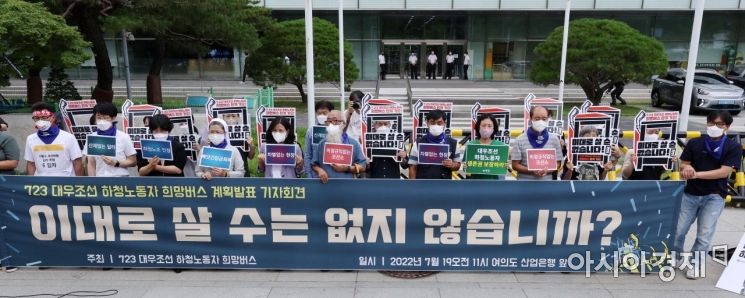 Officials of the '7.23 Daewoo Shipbuilding Subcontractor Workers Hope Bus' supporting the strike of the Daewoo Shipbuilding & Marine Engineering subcontractor labor union held a press conference announcing detailed plans for the Hope Bus on the 19th in front of the Korea Development Bank in Yeouido, Seoul. Photo by Kim Hyun-min kimhyun81@
© The Asia Business Daily(www.asiae.co.kr). All rights reserved.
!["I'd Rather Live as a Glamorous Fake Than as a Poor Real Me"...A Grotesque Success Story Shaking the Korean Psyche [Slate]](https://cwcontent.asiae.co.kr/asiaresize/183/2026021902243444107_1771435474.jpg)


















