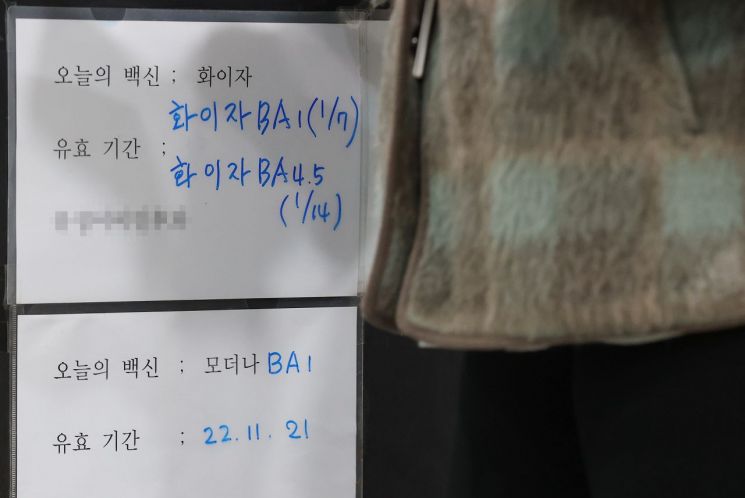
[Asia Economy Reporter Byeon Seon-jin] Moderna's bivalent vaccine (updated vaccine), developed to respond to the COVID-19 Omicron variants BA.4 and BA.5, will be additionally used for winter vaccinations starting from the 26th. The quarantine authorities strongly recommend the updated vaccine to reduce severe cases, especially as the number of critically ill patients remains high recently among high-risk groups aged 60 and above.
According to the COVID-19 Vaccination Response Promotion Team on the 26th, vaccinations with Moderna's BA.4/5-based updated vaccine will be available from that day. The vaccine, manufactured under contract by Samsung Biologics, received emergency use authorization from the Ministry of Food and Drug Safety on the 2nd. After the initial supply of approximately 640,000 doses was introduced on the 14th, pre-booking began on the 19th, and vaccinations for this batch will start from January 2nd next year.
The number of available updated vaccines has increased to four types: two from Moderna and two from Pfizer. Pfizer and Moderna's BA.1 updated vaccines and Pfizer's BA.4/5 updated vaccine entered pre-booking in October and have already been used for winter vaccinations. However, Moderna's bivalent vaccine is only available for adults aged 18 and older, so adolescents aged 12 to 17 can only choose one of the two Pfizer vaccines.
The number of deaths and severe cases has recently reached high levels due to the winter resurgence. As of midnight on the 25th, there were 592 critically ill patients, the highest in 118 days since August 29th (597 patients). On the 24th, 70 deaths were reported, marking the highest number in three months since September 25th (73 deaths). The number of critically ill patients and deaths reflects the scale of confirmed cases from two to three weeks prior, so with the recent increase in resurgence, these numbers may rise further.
The quarantine authorities stated that at least two out of four indicators for adjusting indoor mask mandates must be met to lift indoor mask requirements. The indicators are: ▲weekly cases decreasing for two consecutive weeks ▲weekly critically ill patients decreasing and weekly fatality rate below 0.10% ▲ICU bed availability above 50% within four weeks ▲vaccination rate of 50% for those aged 60 and above and 60% for infection-vulnerable facilities. Currently, only one indicator, 'stable medical response capacity' (68.7%), is being met.
The authorities believe that the remaining indicators can be met through vaccination with the updated vaccine, which prevents infection and reduces the rate of severe cases. According to a survey of domestic confirmed cases from April to December 10, the severe case rate of unvaccinated confirmed patients was 17.3 times and 3.1 times higher than those with three and two doses, respectively. The risk of severe illness for those with three doses was 94.2% and 67.4% lower compared to unvaccinated confirmed patients and those with two doses, respectively.
© The Asia Business Daily(www.asiae.co.kr). All rights reserved.
![Clutching a Stolen Dior Bag, Saying "I Hate Being Poor but Real"... The Grotesque Con of a "Human Knockoff" [Slate]](https://cwcontent.asiae.co.kr/asiaresize/183/2026021902243444107_1771435474.jpg)
















