[Asia Economy Reporter Cha Wanyong] The Ministry of Land, Infrastructure and Transport's budget for next year has been finalized at 55.7514 trillion KRW. This is 137.1 billion KRW less than the government's original proposal of 55.8885 trillion KRW. The government budget (22.5194 trillion KRW) was cut by 118.1 billion KRW, and the fund (33.3085 trillion KRW) was reduced by 19 billion KRW.
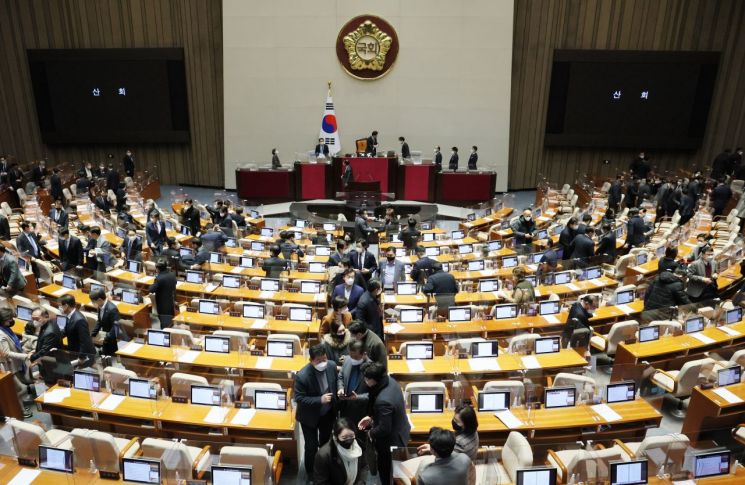
The Ministry of Land, Infrastructure and Transport announced that the 2023 budget and fund operation plan under its jurisdiction were finally approved by the National Assembly plenary session on the 24th. This reflects the government's strong expenditure restructuring policy. Accordingly, next year's budget decreased by 4.3167 trillion KRW compared to 2022.
Housing sector budget totals 35.8 trillion KRW... Public rental housing budget set at 17.5 trillion KRW
Specifically, the housing sector budget for next year is 35.8096 trillion KRW, down 1.6417 trillion KRW from this year's 37.4513 trillion KRW. Nearly half of this is allocated to public rental housing to ensure stable housing for homeless low-income and vulnerable groups. The public rental housing budget was increased by 663 billion KRW to 17.5 trillion KRW from the government's proposal of 16.9 trillion KRW.
The government plans to supply public rental housing next year with ▲construction type (4.7 trillion KRW, 35,000 units) ▲purchase type (6.1 trillion KRW, 35,000 units) ▲jeonse type (4.3 trillion KRW, 37,000 units), among others.
Additionally, to increase opportunities for youth and homeless low-income households to own homes, the government allocated a public sale housing loan budget of 1.3955 trillion KRW, more than triple this year's amount. It plans to supply 76,000 units this year.
To provide stable housing purchase and jeonse funds in the era of high interest rates, loans will be supported at an average interest rate 3.5 percentage points lower than the market rate. The housing purchase and jeonse fund (loan) budget is 10.38 trillion KRW, targeting about 105,000 households. The interest subsidy support (housing account) budget is 765.6 billion KRW, targeting about 103,000 households.
Housing benefits to support housing costs for low-income households will be expanded by 382.7 billion KRW, providing 2.5564 trillion KRW to a total of 1.356 million households. The support target will be expanded from 46% to 47% of the median income, and the maximum payment limit, the standard rent, will be raised from an average of 161,000 KRW to 179,000 KRW, considering the rise in housing rental prices.
Regarding disaster-vulnerable residences such as small rooms and semi-basements, a new budget was established to support 15,000 households with interest-free deposit loans (255 billion KRW) and moving expenses (3 billion KRW) to help residents escape disaster risks. To protect youth households vulnerable to jeonse fraud, 6.1 billion KRW was allocated to support guarantee fees when subscribing to jeonse deposit return guarantees, and 166 billion KRW was newly allocated to provide low-interest loans at about 1% for victims of jeonse fraud who lost their residences.
6.73 trillion KRW invested in GTX projects and increased support for transportation-disadvantaged
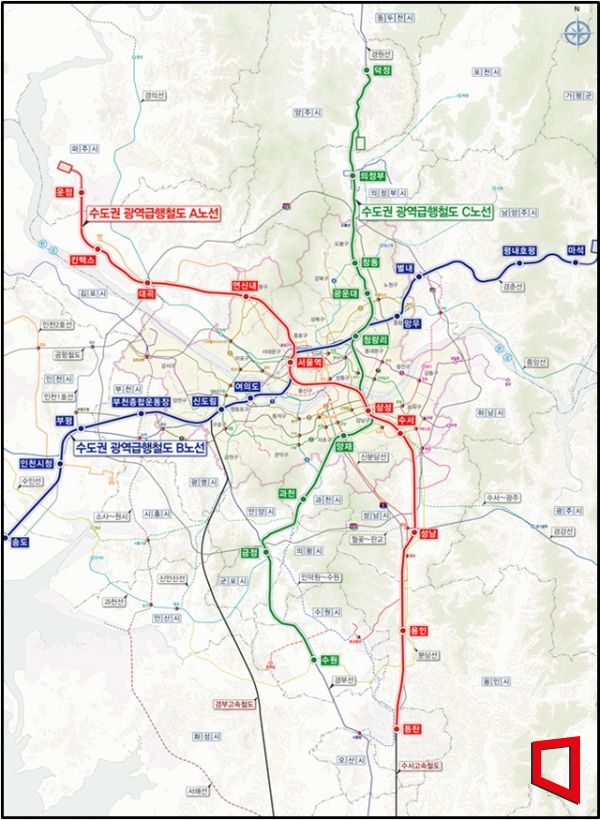
A large budget was also allocated to the transportation sector. First, 673 billion KRW was allocated for the metropolitan area express railroad (GTX) lines A to C project costs and new line planning budget. This includes ▲Line A 505.9 billion KRW ▲Line B 38.4 billion KRW ▲Line C 127.6 billion KRW ▲New line planning 1.1 billion KRW. Investment in Line A, scheduled to open sequentially from the first half of 2024, will be significantly increased by 45.1 billion KRW.
Outside the metropolitan area, investments will be increased in regional metropolitan and urban railroads and metropolitan congestion roads to actively support expanding travel demand centered on large metropolitan areas. The regional metropolitan and urban railroad sector includes 20.3 billion KRW for Daejeon Urban Railroad Line 2. Metropolitan congestion roads include 20 billion KRW for Joya-Dongmyeong Metropolitan Road, 24.1 billion KRW for Dalseo-gu Sanghwa Road congestion road, 15 billion KRW for Nongso-Gangdong congestion road, and 3.1 billion KRW for Gwangju Northern Ring Road.
Support for transportation-disadvantaged mobility projects such as low-floor buses, special transportation means, and wheelchair-accessible buses was more than doubled from 2022 to 224.6 billion KRW. To introduce 4,300 low-floor buses, 189.5 billion KRW will be supported. For 24-hour mobility of wheelchair users, 23.8 billion KRW will be provided for operating costs of special transportation means (disabled call taxis) for the first time.
The 'Affordable Transportation Card Mileage Plus' will also be introduced to reduce the burden of public transportation fares. The number of beneficiaries of the affordable mileage will be expanded from 500,000 to 640,000, with additional mileage support for low-income and youth groups to further reduce their burden. The additional 2.7 billion KRW reflected during the National Assembly review will be used to increase the monthly usage limit from 44 to 60 times; the implementation timing is under review.
Additionally, five metropolitan BRT lines (27.6 billion KRW), including a new line on Jeonju Girin-daero, will be constructed nationwide, and transfer centers (13.2 billion KRW) will be promoted at eight major transportation hubs.
To enhance safety on commuting routes, 58.1 billion KRW will be invested, an increase of 20.3 billion KRW, in projects such as the metropolitan bus quasi-public operation system. In particular, 5.3 billion KRW was increased during the National Assembly review to expand the deployment of double-decker electric buses by 22 units, bringing the total to 40 double-decker electric buses in operation.
The safety budget in the land and transportation sector was confirmed to increase from 5 trillion KRW in 2022 to 5.1 trillion KRW in 2023. Economic and emotional support for citizens affected by traffic accidents will continue (22.6 billion KRW), and the national scholarship support unit for low-income families with children will be raised from an average of 300,000 KRW to 350,000 KRW per quarter.
SOC budget 10.2 trillion KRW... 11% decrease compared to this year
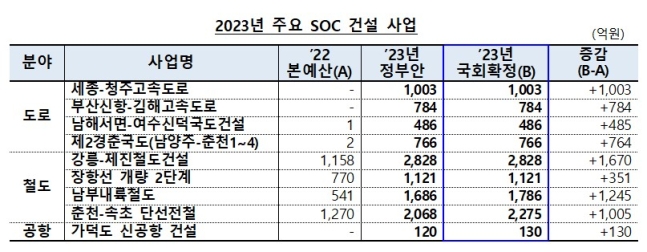
The SOC budget was finalized at 10.4179 trillion KRW, about 11% less than this year. In the road sector, four new expressway projects were newly included to build major arterial networks, including Sejong-Cheongju Expressway (100.3 billion KRW) and Busan New Port-Gimhae Expressway (78.4 billion KRW). To reflect the 5th national road and local road plan, the budget for general national road construction support (122.2 billion KRW) and local road construction support (29.4 billion KRW) was significantly expanded.
In the railway sector, new projects for 2023 include Susaek-Gwangmyeong High-Speed Railway and Saemangeum New Port Access Railway. Investments were also increased in major regional connecting lines such as the Southern Inland Railway, Gangneung-Jejin Railway, and Janghang Line Improvement Phase 2.
The new airport construction project will also proceed without delay. The basic survey and design costs for the construction of Gadeokdo New Airport, selected as a preliminary feasibility exemption project in 2022, were newly included to officially start the project. Appropriate budgets that can be executed immediately upon resolving difficulties were reflected for Saemangeum New Airport, Heuksando Small Airport, and Jeju 2nd Airport projects, which had some project implementation challenges.
1.5105 trillion KRW allocated to mobility industry to build foundation
A budget of 1.5105 trillion KRW was allocated to establish the foundation for the mobility industry, including autonomous vehicles and urban air mobility (UAM).
High-precision road map production (16 billion KRW) and digitalization of road registers (2 billion KRW) will be promoted to build the autonomous driving infrastructure. To realize the commercialization of urban air mobility (UAM) by 2025, demonstration equipment system construction in urban areas (8.8 billion KRW) will be promoted from 2023, along with support for two R&D projects (15.7 billion KRW) and other technology development.
A new project (Mobility Activation Support) reflecting the establishment of a comprehensive support system to prepare for the paradigm shift from 'transportation' to 'mobility' and the realization of mobility-specialized cities was allocated 300 million KRW.
A budget of 1 billion KRW was also allocated to promote future-type transfer centers (MaaS Station) that connect new mobility forms such as autonomous vehicles, PM, and UAM three-dimensionally beyond the flat connection of existing transportation modes.
A budget of 36.6 billion KRW was confirmed for the production of high-scale digital maps (1:1000) to realize digital twins of the national territory realistically and expand the possibilities of creative land space utilization.
A new national pilot project for climate change response industrial complexes applying smart green technologies such as energy self-sufficiency and smart infrastructure in new industrial complexes (500 million KRW) will also be promoted. Ninety-five R&D projects (557.1 billion KRW) supporting groundbreaking progress in future innovative technologies and public safety in the land and transportation sector will be carried out.
Kim Heungjin, Director of Planning and Coordination at the Ministry of Land, Infrastructure and Transport, said, "In 2023, the Ministry of Land, Infrastructure and Transport will invest boldly in establishing technical and institutional foundations that draw out the private sector's creative capabilities to add vitality to the stagnant economy through timely and flawless budget execution, firmly protect housing, livelihood, and safety at the forefront of citizens' daily lives, and accelerate an innovative future."
© The Asia Business Daily(www.asiae.co.kr). All rights reserved.
![Clutching a Stolen Dior Bag, Saying "I Hate Being Poor but Real"... The Grotesque Con of a "Human Knockoff" [Slate]](https://cwcontent.asiae.co.kr/asiaresize/183/2026021902243444107_1771435474.jpg)


















