Japan's "Prohibition of Religious Privileges" Constitutional Clause
Contrasted with Korea's Public Holidays Designated Since 1949
From Western cultures such as the United States and Europe to Asia, Christmas on December 25th is celebrated as a holiday every year. In South Korea, discussions have even arisen about extending the substitute holiday system, which was previously applied only to national holidays, to include Christmas, reflecting its growing significance. However, some countries treat this global holiday as just another weekday. One such neighbor is Japan.
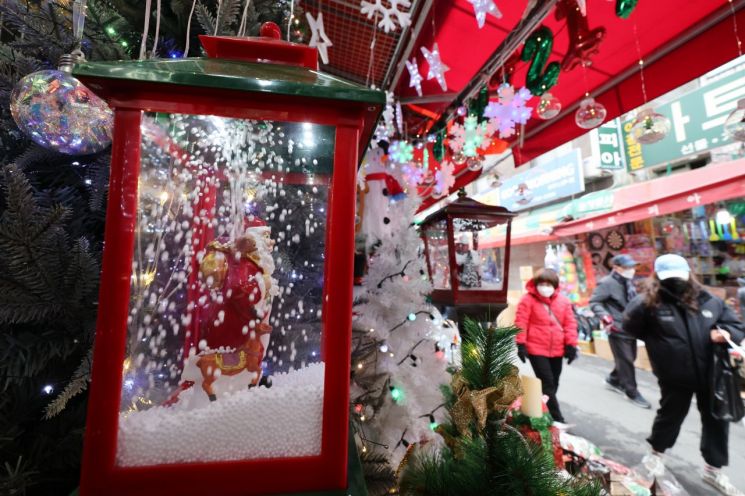 On the afternoon of the 13th, the Christmas atmosphere was vividly felt at the stationery and toy street in Dongdaemun, Seoul / Photo by Yonhap News
South Korea designates substitute holidays, but Christmas is a weekday in Japan
Earlier, on the 21st, Deputy Prime Minister and Minister of Economy and Finance Choo Kyung-ho announced at the '2023 Economic Policy Direction Joint Briefing' held at the government Seoul office, "In order to guarantee the right to rest for all citizens, we will add Buddha’s Birthday and Christmas to the list of holidays eligible for substitute holidays."
This year, Christmas falls on a Sunday. According to the 'Holiday Act,' if a public holiday coincides with a weekend, a substitute holiday can be applied, but Christmas and Buddha’s Birthday are excluded from this provision.
Currently, substitute holidays apply to traditional holidays such as Lunar New Year and Chuseok, as well as national holidays like Independence Movement Day, Liberation Day, National Foundation Day, and Hangul Day. The fact that Christmas is being considered for substitute holiday designation indicates the significant meaning Christmas holds in Korean society.
However, unlike South Korea, Christmas remains a regular weekday in neighboring Japan. While countries such as China and Israel also do not officially designate Christmas as a public holiday, these cases are generally due to clear ideological or religious reasons, making Japan’s case unique.
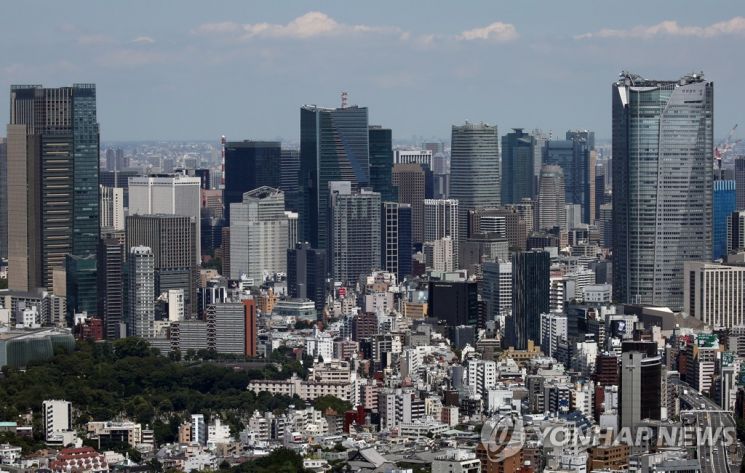 Unlike in Korea, Christmas is not a public holiday in Japan. The photo shows a scene from Tokyo, the capital of Japan. Photo by Yonhap News.
"No special privileges for specific religions" due to the Constitution
Why is Christmas not designated as a public holiday in Japan? First, Japan is known to have less than about 0.8?1% of its population as Christian believers. However, the reason Christmas remains a weekday in Japan is not solely because Christianity has little influence. Rather, it is more deeply related to Japan’s Constitution.
Article 20 of the 'Constitution of Japan' stipulates freedom of religion and the separation of religion and state, while also stating that "no religious organization shall receive privileges from the state or exercise political authority."

In other words, designating Christmas?a Christian cultural event?as a public holiday could be perceived as the government granting special privileges to Christianity. For this reason, Japan continues to treat Christmas as a regular weekday.
Although it is not a public holiday, Japanese society treats Christmas as a special event. Every year on Christmas, many Japanese order whole fried chicken from the American chicken brand 'KFC' or purchase 'Christmas cakes' made with fresh cream and strawberries.
Designated a public holiday four years after liberation in Korea
This background contrasts with that of South Korea. Christmas was designated a public holiday in Korea in 1949. At that time, Syngman Rhee, the first president and a devout Methodist Christian, enacted the 'Regulations on Public Holidays of Government Offices' by presidential decree, naming December 25th "Christian Birth Day" and designating it as a holiday. At that time, the Christian population in Korea was reportedly only about 3%.
Because of this, some voiced complaints that Christianity was receiving 'special treatment' compared to other religions. In fact, in 1973, a lawyer filed a lawsuit against the Minister of Government Administration and Home Affairs, requesting that Buddha’s Birthday be designated as a public holiday. The reason was that designating only Christmas as a legal public holiday while leaving Buddha’s Birthday out constituted religious discrimination.
This case went through continuous disputes and eventually reached the Supreme Court. Ultimately, in 1975, the Cabinet confirmed the designation of Buddha’s Birthday as a public holiday. Since then, Christmas and Buddha’s Birthday have been treated as equal public holidays in Korea.
© The Asia Business Daily(www.asiae.co.kr). All rights reserved.



















