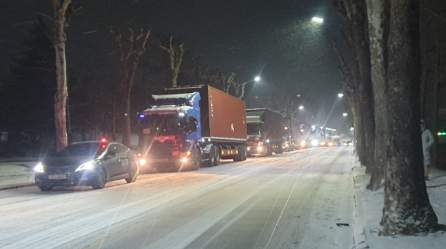
 In the early morning of the 23rd, 260 drums of intermediate and low-level radioactive waste stored by the Korea Atomic Energy Research Institute in Daejeon are being transported to the final disposal site in Gyeongju. Provided by Daejeon City
[Asia Economy (Daejeon) Reporter Jeong Il-woong] The Korea Atomic Energy Research Institute has transported 260 drums of low- and intermediate-level radioactive waste stored in Daejeon to the final disposal site in Gyeongju.
According to Daejeon City on the 23rd, the Atomic Energy Research Institute loaded the waste onto six transport vehicles around 2 a.m. and moved them to the final disposal site in Gyeongju.
During the transportation process, two escort vehicles were deployed before and after to ensure safety, one backup vehicle was prepared in case of transport vehicle breakdown, and one emergency response vehicle was also mobilized.
Previously, in August, the Atomic Energy Research Institute also transported 222 drums of radioactive waste from Daejeon to Gyeongju. The city explained that the total amount transported this year reached 482 drums, which is 82 drums more than the initially planned 400 drums.
Over the past three years, the amount of radioactive waste transported from Daejeon, including low- and intermediate-level waste, has increased: 465 drums in 2020, 475 drums in 2021, and 646 drums this year (including 164 drums transported by the Korea Radioactive Waste Agency).
However, there are still 31,154 drums of radioactive waste stored in Daejeon, which is understood to be the second largest amount nationwide.
As of the end of September this year, the amount of radioactive waste stored by institution is as follows: the Atomic Energy Research Institute holds the largest amount with 21,067 drums, followed by Korea Hydro & Nuclear Power Nuclear Fuel Co., Ltd. with 10,052 drums, and the Korea Radioactive Waste Agency with 35 drums.
In this regard, the city plans to gradually increase the amount of low- and intermediate-level radioactive waste transported out and continuously demand the introduction of an advanced radioactive waste disposal system to ensure the safety of citizens.
Han Sun-hee, Director of the Citizen Safety Office of the city, said, “To dispel citizens’ concerns and anxieties, we urge nuclear facilities to gradually increase the amount of low- and intermediate-level radioactive waste transported out from the region. The city will do its best to manage safety until all low- and intermediate-level radioactive waste in the region is completely transported out, with the cooperation of nuclear regulatory agencies.”
© The Asia Business Daily(www.asiae.co.kr). All rights reserved.

















