Indication of Additional Base Rate Hike Next Year
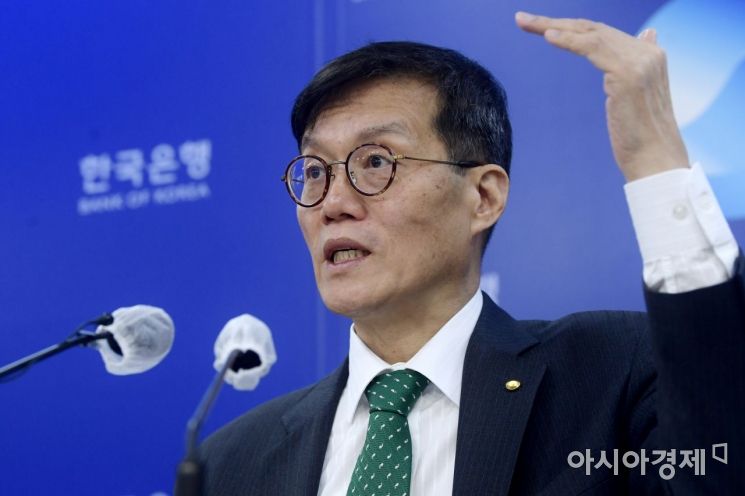 Bank of Korea Governor Lee Chang-yong is explaining the "2022 Second Half Inflation Target Operation Status" at the Bank of Korea press room in Jung-gu, Seoul, on the 20th. Photo by Joint Press Corps
[Asia Economy Reporter Seo So-jeong] The Bank of Korea indicated on the 23rd that "although the domestic economic growth rate is expected to decline next year, since the inflation rate exceeds the target, we will continue a policy stance focused on price stability," suggesting an additional base interest rate hike. However, it stated that the final base interest rate level and duration of maintenance will be comprehensively considered along with inflation trends, economic conditions, and financial and foreign exchange market situations, due to high uncertainties such as the extent of domestic and international economic slowdown and major countries' monetary policies.
In the '2023 Monetary and Credit Policy Operation Direction' released that day, the Bank of Korea said, "We expect the consumer price inflation rate, which significantly exceeds the target level (2%), to continue next year, and we will maintain a policy stance focused on price stability." This means that the Bank will continue its policy stance focused on price stability to ensure that the inflation rate converges toward the target level.
The Bank emphasized, "Although the consumer price inflation rate is expected to be in the mid-3% range next year, there is high uncertainty regarding forecasts related to the extent of domestic and international economic slowdown, major countries' monetary policies, exchange rates and international oil price movements, and the degree of pass-through of accumulated cost pressures."
Given the increased uncertainty, the Bank will strengthen information provision on economic outlooks and future policy directions so that economic agents can form reasonable expectations about the direction of monetary policy. The Bank said, "We will more thoroughly explain the background of policy decisions and future policy directions through improvements in the minutes and the contents of the Monetary and Credit Policy Report," adding, "We will analyze the effects of forward guidance by major countries and explore medium- to long-term utilization plans."
Efforts to enhance the effectiveness of open market operations will also continue to ensure smooth transmission of monetary and credit policies. The Bank is reviewing institutional improvements related to open market operations, such as expanding the securities eligible for early redemption of Monetary Stabilization Bonds (from 1- and 2-year bonds to 1-, 2-, and 3-year bonds) and expanding collateral securities for securities lending. It will also strengthen research and analysis on the transmission effects of monetary policy and potential changes in inflation dynamics under higher interest rates and debt burdens.
Pay Special Attention to Potential Risks Such as Economic Slowdown, Interest Rate Increases, and Real Estate Slump
The Bank of Korea stated that it will pay special attention to the possibility that potential risk factors may materialize due to changes in domestic and international conditions such as economic slowdown, rising domestic and foreign interest rates, and real estate market sluggishness. It will strengthen inspections of financial markets and the financial system and implement market stabilization measures promptly if necessary. While examining household debt risks, real estate project financing (PF) loan defaults, and increased liquidity and credit risks of non-bank financial institutions from multiple angles, the Bank will also seek measures for long-term structural improvements in household debt and soundness management of real estate exposure (risk exposure amounts).
To prepare for the possibility of renewed volatility in the foreign exchange market, the Bank will pursue extensions of maturing currency swaps and promote financial cooperation with major central banks. Additionally, to solidify the foundation for introducing central bank digital currency (CBDC), it will expand research on technical and institutional issues and strengthen domestic and international cooperation. Efforts to secure the safety of payment and settlement systems will continue, including establishing an effective monitoring system for new payment service providers such as big tech companies.
The Bank of Korea forecasted that global economic growth will significantly weaken next year, and global inflation will gradually ease but remain at a high level. It expects that as the year progresses into the second half, global economic downturns will ease due to the slowdown in monetary tightening by major countries and China's easing of quarantine policies, but uncertainties remain high.
Domestic economic growth is expected to weaken due to the global economic slowdown and rising interest rates, with employment numbers projected to increase only slightly. The consumer price inflation rate is expected to be in the mid-3% range next year, and the core inflation rate in the high 2% range. In financial and foreign exchange markets, domestic and international risk factors persist, leading to prolonged high volatility. If the real estate market downturn is larger than expected, there is a possibility of renewed instability in related funding markets such as real estate project financing (PF) loans. The Bank added, "The financial system will maintain stability, but liquidity risks in some non-bank financial institutions may increase."
© The Asia Business Daily(www.asiae.co.kr). All rights reserved.

















