The 1st Basic Plan for the Development of the Living Logistics Service Industry Confirmed
Ministry of Land, Infrastructure and Transport Proposes 18 Tasks Across 5 Major Strategies Including Regulatory Innovation
[Asia Economy Reporter Cha Wanyong] The government is set to actively promote the establishment of infrastructure for the advancement of logistics services by expanding everyday logistics transportation means such as parcel delivery to include robots and drones. To this end, it plans to transform the everyday logistics industry into a high value-added sector and provide systematic support for industry development. The goal is to grow the current industry, valued at 9.8 trillion won (as of 2020), to around 20 trillion won by 2026 and create an employment environment for 305,000 workers.
To achieve this, the government will innovate regulations that hinder industry development and allocate budgets for the development of cutting-edge technologies applicable to the logistics industry, such as autonomous driving and artificial intelligence (AI). Additionally, it will promote the expansion of infrastructure supply by mandating the securing of everyday logistics facilities within project sites during large-scale development projects such as urban development and housing site development.
The Ministry of Land, Infrastructure and Transport announced on the 23rd that it has finalized the “1st Basic Plan for the Development of the Everyday Logistics Service Industry” after review by the National Logistics Policy Committee. The basic plan presents five major strategies and 18 detailed tasks: ▲innovation of everyday logistics regulations ▲promotion of advanced technologies ▲expansion of infrastructure supply ▲creation of working conditions ▲strengthening consumer protection and building a service environment.
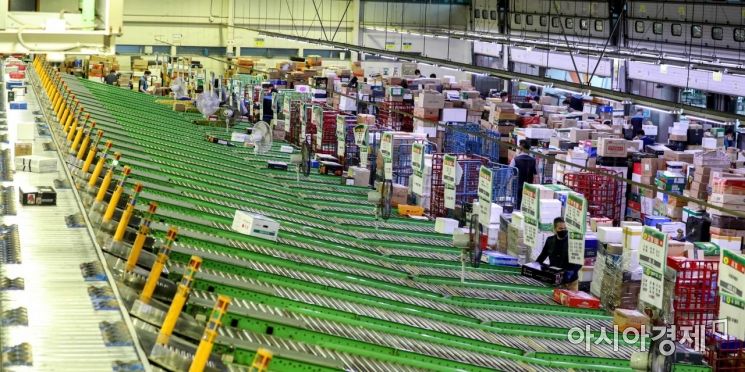 Workers sorting parcel mail at the Dong Seoul Postal Logistics Center in Gwangjin-gu, Seoul. Photo by Jinhyung Kang aymsdream@
◆Mobility Transformation... Deregulation and Budget Investment= First, the innovation of everyday logistics regulations is premised on a major mobility transformation. To expand everyday logistics transportation means, currently limited to freight trucks and two-wheelers, to advanced mobility such as robots and drones, the government plans to revise the Everyday Logistics Act in the first half of next year and review supply plans for small freight vehicles for dawn and same-day delivery.
Furthermore, to promote the distribution of eco-friendly delivery means, a budget of 11.5 billion won will be allocated by 2026 for the development of electric two-wheelers suited to domestic delivery environments and replacement battery charging systems. Development of smart trailers that follow workers or bicycles is also planned.
To strengthen support for everyday logistics policies considering regional characteristics, improvements will be made by 2024 to include matters related to the development of the everyday logistics industry in the establishment of regional logistics master plans. The government will also push to create a dedicated everyday logistics organization (tentatively named the Everyday Logistics Policy Division) to lead the mobility transformation and systematic industry support.
Second, to promote the advancement of the everyday logistics industry, the government will pursue the development of autonomous driving-based robot delivery systems and AI-based operational technologies operating within complex complexes such as apartment buildings. A budget of 8.63 billion won will be invested by 2027 for this purpose.
By 2025, a budget of 16.16 billion won will be allocated for the development and demonstration of underground delivery technologies within urban areas using underground transport infrastructure (such as urban railways) and underground spaces like utility tunnels.
To establish a blockchain-applied electronic document system and information management system usable in parcel delivery processes such as electronic receipts and waybills by 2025, a budget of 6.25 billion won will be prepared.
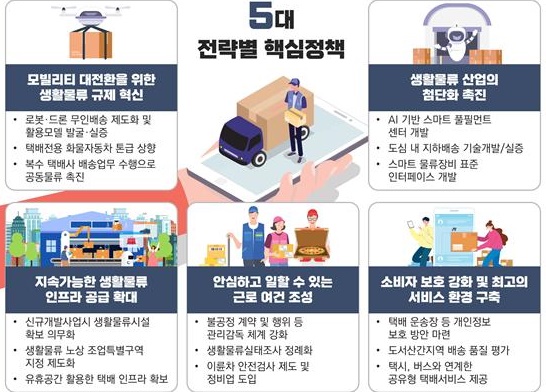
◆Mandatory Securing of Everyday Logistics Facilities in Development Projects= Third, to expand the supply of everyday logistics infrastructure, by 2024, developers will be required to secure everyday logistics facilities when undertaking large-scale development projects (urban development, housing site development, public housing district formation, etc.), and this must be reflected in project plans.
Additionally, the introduction of a “(tentative) Everyday Logistics Impact Assessment” requiring the provision of loading and unloading parking spaces during the construction of commercial buildings above a certain scale will be promoted by 2025.
Starting next year, micro-fulfillment centers and other order delivery facilities will be allowed to be located within neighborhood living facilities. To facilitate smooth everyday logistics delivery operations in urban areas, the government plans to institutionalize the designation of special on-street loading zones similar to the U.S. PUDO (Pick-up/Drop-Off) zones by 2024.
The government will expand permitted parking and stopping zones for everyday logistics vehicles and establish guidelines for allowed parking and stopping times next year. It will also promote the development and distribution of a loading and unloading parking information sharing system. Efforts will be made to secure parcel collection and delivery facilities by utilizing idle spaces such as public parking lots, parks, and vacant public institution sites (railroad corporations, road corporations, local governments, etc.).
Fourth, to create working conditions conducive to employment, the management and supervision system for unfair contracts and acts between operators and sales points, and between sales points and workers, will be strengthened. In particular, unfair trade practices such as white margins by large consignors will be strictly dealt with through collaboration with related agencies, including imposing fines and corrective measures.
To alleviate insurance premium burdens on delivery agents and increase insurance subscription rates, approval for the establishment of a small parcel mutual aid association will be completed next year, and support for the development of dedicated insurance products will be provided.
To ensure the safety and rest of workers, detailed standards such as installation and operation requirements for rest areas tailored to the characteristics of everyday logistics workers will be newly established next year.
A budget of 9.2 billion won will be invested by 2026 for the development of automation technologies for simple repetitive loading and unloading tasks and foldable loading assistance equipment. Development of lightweight wearable systems under 2 kg that can be worn and removed will also begin next year.
Fifth, measures to strengthen consumer protection and establish the best service environment will be prepared. By 2024, measures to protect consumer personal information (name, contact information, etc.) recorded on parcel waybills and the establishment of a continuous monitoring system to strengthen identity verification (criminal record) and qualification management (validity of driver’s licenses, etc.) for everyday logistics workers will be promoted.
High-density smart unmanned lockers enabling non-face-to-face parcel sending and receiving will be developed by 2027 with an investment of 7.3 billion won.
In the event of parcel delivery strikes, the government will also pursue the establishment of grounds for alternative delivery to minimize damage to consignors and consumers and ensure smooth parcel services. Revision of standard terms and conditions for parcel and quick services to strengthen consumer rights protection will also be considered.
Gu Heonsang, Director of Logistics Policy at the Ministry of Land, Infrastructure and Transport, said, “With the establishment of the 1st Basic Plan for the Development of the Everyday Logistics Service Industry, government policies for innovation and leap forward of the everyday logistics industry will be systematically promoted.” He added, “The government will continue to pursue policies for regulatory innovation, advanced technology development, and strengthening consumer rights protection for the development of the everyday logistics industry.”
© The Asia Business Daily(www.asiae.co.kr). All rights reserved.
![Clutching a Stolen Dior Bag, Saying "I Hate Being Poor but Real"... The Grotesque Con of a "Human Knockoff" [Slate]](https://cwcontent.asiae.co.kr/asiaresize/183/2026021902243444107_1771435474.jpg)

















