KCCI and Korea SMEs Central Association Announce Survey Results on Corporate Awareness of the Enforcement of the Fair Transactions in Subcontracting Act
 A survey revealed that most domestic companies have not yet developed the capability to respond to the Serious Accidents Punishment Act (SAPA) even though 300 days have passed since its enforcement.
[Asia Economy Reporter Oh Gyumin] A survey revealed that most domestic companies have not yet developed the capacity to respond to the Serious Accidents Punishment Act (SAP Act) even though 300 days have passed since its enforcement.
The Korea Employers Federation and the Korea Federation of Small and Medium Business announced the results of the "Corporate Awareness Survey on the Enforcement of the SAP Act" on the 22nd, conducted among 1,035 companies with five or more employees in Korea (based on responses).
The Serious Accidents Punishment Act has been in effect since January 27. It is a law that punishes those who fail to fulfill their obligations to prevent accidents when industrial accidents, including worker deaths, occur at workplaces with 50 or more regular employees. Business owners and management officials can face imprisonment for more than one year or fines up to 1 billion KRW.
While most companies are aware of the enforcement of the SAP Act, only 38.8% of them answered that they "know" all the mandatory requirements.
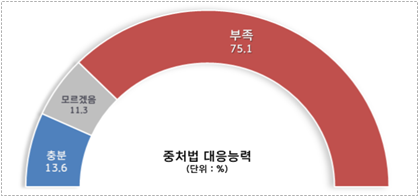
Additionally, only one out of ten companies (13.6%) responded that they have sufficient capacity to comply with the SAP Act obligations. Companies that answered they lack the capacity or are unsure accounted for 86.4%.
The reasons for insufficient response capacity were identified as a lack of professional personnel (46%), ambiguity of the law itself (26.8%), and excessive cost burden (24.5%), in that order.
Regarding the enforcement of the SAP Act, 61.7% of companies said it has a negative impact on business activities. Accordingly, 81.5% of companies responded that improvements to the SAP Act are necessary. Among workplaces with fewer than 50 employees, which are currently exempted for two years, 89.8% of companies argued that the exemption period should be extended or the application should be excluded.
Lim Woo-taek, head of the Safety and Health Division at the Korea Employers Federation, said, "Although many companies are interested in preventing industrial accidents and are actively investing, they feel limited in responding to the SAP Act," adding, "We hope that during the follow-up process of the government's 'Serious Accident Reduction Roadmap,' measures to improve the ambiguity of the SAP Act and excessive criminal penalties will be promptly prepared."
© The Asia Business Daily(www.asiae.co.kr). All rights reserved.
![A Woman Who Jumps Holding a Stolen Dior Bag... The Mind-Shaking, Bizarre Con of a "Human Knockoff" [Slate]](https://cwcontent.asiae.co.kr/asiaresize/183/2026021902243444107_1771435474.jpg)
















