Considering Sharing Restrictions Amid Performance Pressure Since Early This Year
Pilot Review in Some Countries... Measures to Minimize Withdrawal

[Asia Economy Reporter Hyunjin Jung] "Love is sharing a password." In March 2017, the world's largest online video service (OTT), Netflix, posted this phrase on Twitter. Netflix only began to recognize account sharing as a problem two years later, in 2019. This realization came as they identified the reason behind a decline in users in the U.S. during the second quarter of that year. It was not until three years later, earlier this year, that they seriously started considering solutions.
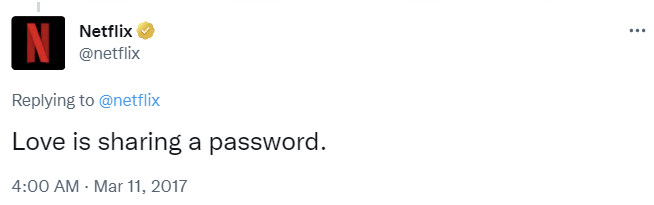 A post Netflix uploaded to its Twitter account in March 2017 (Photo by Netflix Twitter account capture)
On the 21st (local time), The Wall Street Journal (WSJ) reported in an article titled "Netflix's Password (Account) Sharing Crackdown Is Imminent" how Netflix has been preparing its account sharing restriction policy. Netflix had set aside this issue amid a surge in subscribers due to the pandemic but took action after confirming its first-ever subscriber decline earlier this year. Netflix CEO Reed Hastings told senior executives, "We have waited quite a long time to address this."
However, Netflix's shared accounts operate in various ways depending on each user's situation, making it difficult to find a blocking method. For example, when a user travels and logs in from a new device at a hotel, it is hard to distinguish whether this is account sharing with another person. Also, when children who shared an ID at home go to college or move out and live elsewhere but continue sharing the account with their parents, it is not easy to block such cases.
◆ Account Sharing Restrictions Likely to Be Fully Implemented Next Year... What Were the Concerns?
Netflix announced in April that it would charge additional fees for shared accounts and began pilot testing in some countries in October. From early next year, it plans to implement the policy widely across many regions. Netflix estimates that 100 million households worldwide share accounts with members outside their family. Netflix guides that account sharing is intended for people living together in one household. The restriction measures will be based on IP addresses, device IDs, and account activity.

According to the WSJ report, the first concern Netflix had after recognizing the need to block account sharing was to avoid making users feel alienated. Sudden blocking of account sharing could cause users to feel rejected and potentially cancel their subscriptions. Ted Sarandos, another Netflix CEO, recently acknowledged that "consumers will not like it," but added, "Nevertheless, we need to show viewers that it is worth watching."
Inside Netflix, there was a view that the measures to block account sharing should be gradually intensified. For example, in Latin American countries where the pilot was conducted this year, if account sharing was suspected, Netflix did not immediately block the account but sent a verification code that had to be entered within 15 minutes. Even those sharing accounts can continue using the service if they enter this code.
Additionally, in October, Netflix introduced a 'Profile Transfer Feature' to block shared accounts and encourage paid subscriptions. This feature was designed to allow easy transfer of personal viewing history and recommended content information when converting users who watch free content by registering as account sharers despite not living in the same household into paid users.
While seeking ways to smoothly implement account sharing restrictions, Netflix also appears to have conducted detailed internal analyses of the situations in which accounts are shared. Multiple sources reported that Netflix discussed solutions for problems arising when account owners log in while traveling or when children use Netflix at their parents' homes after moving out.
Some product executives at Netflix reportedly expressed concerns that the service should not become too complicated or unfriendly to consumers. Netflix also considered adopting a model similar to Amazon Prime Video, which allows renting movies for a certain period, but ultimately decided against it due to concerns that it might undermine the simplicity of Netflix's service.
◆ Account Sharing Restrictions: A Double-Edged Sword... Profitability Is the Issue
Despite these concerns, Netflix's reason for trying to block account sharing is profitability. They believe that converting users who enjoy content for free on a single account into paying customers is necessary to prevent a decline in profitability.
Since launching its service in 2011, Netflix experienced its first-ever subscriber decline in the first quarter of this year compared to the previous quarter. Subscriber numbers further decreased in the second quarter, causing stock price fluctuations. Although subscribers increased in the third quarter, there were criticisms that performance fluctuated depending on the content. Considering that the subscriber count surged by a record 37 million last year due to COVID-19, Netflix is facing a challenging year.
Market research firm Cowen estimated that if Netflix implements a $3 monthly fee for account sharing, it could generate an additional $721 million in revenue from the U.S. and Canada alone.

The WSJ stated, "Although Netflix, the industry leader, is the first to tackle the account sharing issue, investors and industry insiders believe this movement will not end with Netflix." It added, "Other streaming services like Disney+, HBO Max, and Paramount+ are also experiencing losses and are under pressure to closely examine account sharing issues to maintain growth while generating profits."
However, there are also views that Netflix's decision could negatively impact its long-term performance. Neil McCafferty, an analyst at U.S. financial services company Morningstar, said, "This is a stimulus and could certainly help, but it is only a temporary boost," pointing out that Netflix is underestimating the risk of widespread subscription cancellations due to policy changes.
© The Asia Business Daily(www.asiae.co.kr). All rights reserved.



















