IBS International Joint Research Results
Increased Productivity with Rising Water Temperature Enhances Ecosystem Sustainability
[Asia Economy Reporter Kim Bong-su] Marine plant plankton has been found to act as a protective barrier against disruptions in the marine ecosystem caused by global warming.
On the 22nd, the Institute for Basic Science (IBS) announced that a research team led by Axel Timmermann, head of the Climate Physics Research Division and adjunct professor at Pusan National University, confirmed through international collaborative research that despite habitat changes caused by climate change, the organic carbon production of marine plant plankton increases.
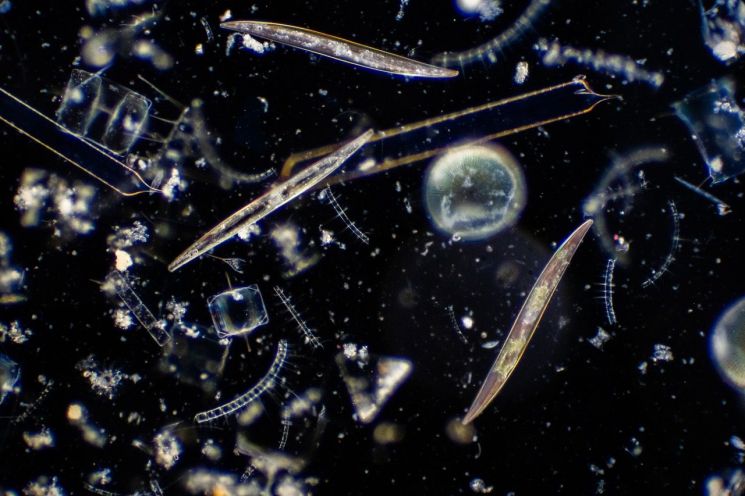
Plant plankton is the most important organism in the ocean. It mainly inhabits the sunlit surface layer of the sea, synthesizing organic carbon, which serves as food for marine life, through photosynthesis, and releasing oxygen necessary for human respiration.
Global warming heats the surface seawater more than the deep ocean. When surface water warms, its density becomes lighter, and the separation between the surface and deep layers becomes more distinct (stratification). Plant plankton uses nutrients and carbon dioxide for photosynthesis, but when the ocean stratifies, the nutrient-rich deep water reaches the surface less. In other words, global warming reduces the food supply for plant plankton.
Previous studies predicted that nutrient depletion in the surface layer would decrease plant plankton productivity, disrupting marine ecosystems and negatively impacting the climate.
However, a joint research team from IBS and the University of Hawaii in the United States combined observational data from the North Pacific Ocean Science Station and supercomputer-based climate simulations and concluded, contrary to previous studies, that plant plankton productivity increases despite the rise in surface water temperature. The team pointed out that earlier studies did not consider the ‘nutrient uptake regulation ability’ of plant plankton. According to data collected over the past 30 years as part of the Hawai’i Ocean Time-series (HOT) program, plant plankton productivity remained stable even during periods of severe surface nutrient depletion. Under harsh conditions, plant plankton adapts by using sulfur (S) instead of phosphorus (P) for photosynthesis, demonstrating nutrient uptake regulation ability.
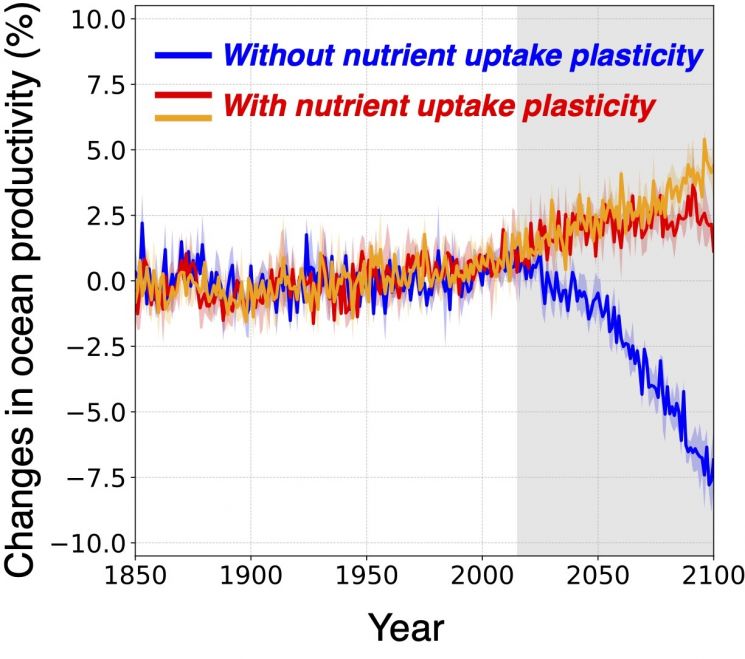 Changes in Global Ocean Net Primary Production Over Time
Climate simulation results assuming the nutrient uptake regulation ability of marine phytoplankton (red line, orange line) showed an increase in ocean net primary production, unlike previous projections (blue line).
David Karl, a professor at the University of Hawaii and co-founder of the HOT program and co-author of this study, explained, “It is a metabolic strategy change to adapt to climate change,” adding, “Species of plant plankton that require relatively less phosphorus have a survival advantage, so long-term changes in plankton species may occur.”
The IBS research team analyzed how the nutrient uptake regulation ability of plant plankton will affect global ocean productivity in the future using climate model simulations based on the supercomputer ‘Aleph.’
Simulations that did not consider nutrient uptake regulation ability showed an 8% global decrease in plant plankton productivity by 2100, consistent with previous studies. However, simulations incorporating nutrient uptake regulation ability showed significant differences. By 2100, when the global surface temperature is expected to rise by about 4°C, plankton productivity is projected to increase globally by approximately 5%.
Eunyoung Kwon, the first author and research fellow at the IBS Climate Physics Research Division, stated, “In the subtropical regions where nutrient depletion due to global warming is most severe, productivity differs by up to 200% compared to previous predictions,” and explained, “If plant plankton productivity strengthens, the ocean will absorb more carbon dioxide from the atmosphere, which can help mitigate climate change.”
This study shows that marine plant plankton acts as a buffer against disruptions in the global marine ecosystem caused by climate change. However, this does not mean that plant plankton is unaffected by human-induced climate change. While overall productivity is maintained, changes in the elemental composition of plankton cells or shifts in plankton species may occur, potentially altering the marine food chain structure.
Axel Timmermann, co-author and division head, said, “To more accurately predict the future of marine life, it is necessary to understand how plant plankton responds to multiple complex stresses, including rising water temperatures and ocean acidification.”
The research findings were published on the 22nd (Korean time) in the international academic journal Science Advances (IF 14.136).
© The Asia Business Daily(www.asiae.co.kr). All rights reserved.


















