Notice on Reporting and Disclosure Standards for Non-Covered Medical Fees
90% of Major Non-Covered Medical Services Must Be Reported by the Year After Next
Ministry of Health and Welfare: "Understanding Non-Covered Status and Public's Right to Know"
Medical Community Criticizes Uniform Control and Excessive Intervention
Concerns Over Restriction of Patient Choice and Privacy Invasion

[Asia Economy Reporter Lee Gwan-joo] The government and the medical community are currently in conflict over the implementation of the ‘Non-Covered Service Reporting System,’ which requires reporting of non-covered medical treatments and medications, such as nutritional injections and orthodontics, to health authorities. The government is pushing to establish a notification to formulate policies for managing non-covered services and to enhance information disclosure to medical consumers. On the other hand, the medical community is strongly opposing this, arguing that excessive control over non-covered services infringes on patient choice and could lead to serious violations of personal information protection.
According to the Ministry of Health and Welfare and the medical community on the 20th, the Ministry announced an administrative notice on the 15th detailing the ‘Standards for Reporting and Disclosure of Non-Covered Medical Costs, etc.,’ which specifies the details of the non-covered service reporting system. This system requires all medical institutions to periodically report non-covered items, standards, amounts, and treatment details to the Ministry of Health and Welfare.
The notification includes provisions requiring all medical institutions to periodically report the costs of non-covered items, the number of treatments, diseases treated, and the names of surgeries or procedures performed during treatment. The 672 non-covered medical costs currently disclosed by the Health Insurance Review and Assessment Service will be reported starting next year, and in 2024, the reporting will expand to include major non-covered services estimated to account for about 90% of the total non-covered scale. These non-covered services include approximately 100 medications and 436 therapeutic non-covered items, as well as nutritional injections, vaccinations, dental orthodontics, and herbal medicine, totaling 1,212 items.
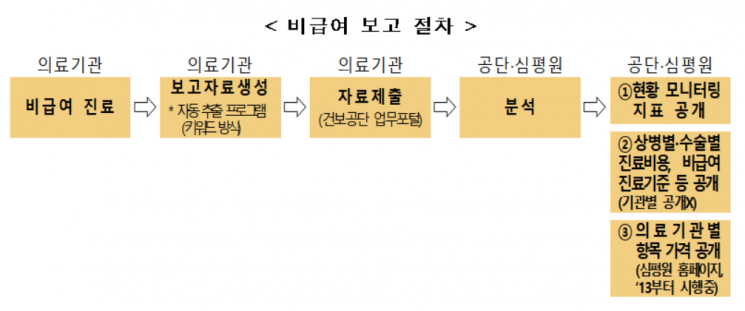
The Ministry of Health and Welfare expects that through the implementation of this system, it will be possible to grasp detailed treatment scales by non-covered item and diseases treated, supporting the establishment of evidence-based non-covered service management policies, and making it easier for patients to obtain various information such as non-covered medical costs. A ministry official explained, “The purpose is to understand the status of non-covered services and strengthen the public’s right to know and the choice of medical institutions.”
However, the medical community is strongly opposing this, seeing it as an attempt to uniformly control non-covered treatments. They argue that in the rush to increase health insurance coverage rates, non-covered services are being labeled as the ‘axis of evil’ and excessively interfered with. The Association of Presidents of Metropolitan and Provincial Medical Associations issued a statement saying, “Non-covered medical acts are decisions made autonomously between doctors and patients regarding treatments that are relatively non-essential medical care,” and criticized, “Collecting sensitive personal information despite sufficient notification to patients prioritizes control over non-covered services over fundamental rights.”
There are also concerns that this effectively restricts non-covered treatments and infringes on patients’ freedom to choose their treatment. Park Soo-hyun, spokesperson for the Korean Medical Association, said, “Not all treatments fit only the primary medication, and there are certainly parts missed by tests defined under coverage,” adding, “This could lead to controlling the choices of patients and doctors in all aspects of medication, treatment, and testing.”
Criticism has also been raised that the Medical Service Act, the higher law of this notification, lacks specific grounds for reporting medical usage classifications, exceeding legislative limits, and that requiring reporting of patient information such as birth year and gender infringes on personal information. The Ministry of Health and Welfare plans to operate the administrative notice period until the 25th of next month and finalize the notification after considering various submitted opinions. If the plan is finalized and promulgated, the non-covered service reporting system is expected to be implemented next year.
© The Asia Business Daily(www.asiae.co.kr). All rights reserved.
![User Who Sold Erroneously Deposited Bitcoins to Repay Debt and Fund Entertainment... What Did the Supreme Court Decide in 2021? [Legal Issue Check]](https://cwcontent.asiae.co.kr/asiaresize/183/2026020910431234020_1770601391.png)

















