GIST Research Team
[Asia Economy Reporter Kim Bong-su] Domestic researchers have developed a new polymer antibiotic substance capable of defeating bacteria resistant to existing antibiotics, such as super bacteria.
The Gwangju Institute of Science and Technology (GIST) announced on the 20th that it has developed a new polymer material mimicking the structure and function of antimicrobial peptides, proteins that fight bacteria inside our bodies. Antimicrobial peptides are typically peptides with amphipathic helical structures that disrupt phospholipid membranes, thereby destroying microorganisms such as bacteria.
This research achievement is expected to serve as an important foundation for follow-up studies developing new antibiotic substances to combat antibiotic-resistant bacteria through artificial polymer synthesis.
The development of antibiotics like penicillin has greatly contributed to humanity overcoming various diseases and increasing life expectancy. However, bacteria develop resistance to antibiotic substances the more they are exposed to them, so efforts to find new antibiotics continue. Artificial polymers, which are not naturally synthesized, are very unfamiliar to bacteria, making it difficult for bacteria to acquire resistance. Even if resistance is acquired, the polymer’s structure can be artificially adjusted to evade the resistance acquired by bacteria. For this reason, attempts to create new antibiotics using artificial polymers have continued.
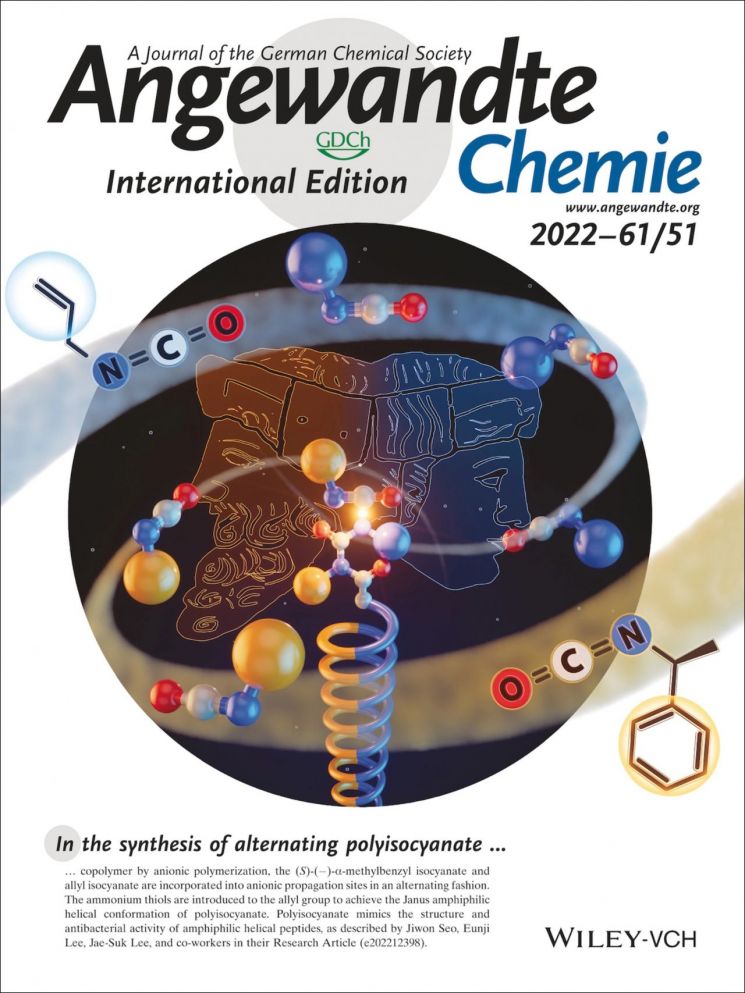
The research team developed a new artificial polymer material mimicking antimicrobial peptides from ‘polyisocyanate,’ a polymer with an amide structure similar to natural peptides, and successfully confirmed its antibacterial properties. Polyisocyanate is a rod-shaped polymer with a helical structure, noted for its high degradability, eco-friendliness, and peptide-like molecular structure, making it a bioactive material harmless to the human body. The ‘alternating sequence polyisocyanate’ copolymer synthesized by the research team has a structure very similar to natural antimicrobial peptides, enabling it to destroy the phospholipid bilayer that constitutes the surface of bacteria. The team confirmed the antibacterial properties of this material through antibacterial tests against Staphylococcus aureus and Escherichia coli.
Although there has been much research on the mechanism of antimicrobial peptides in the human body, clinical trials of antibiotics have repeatedly failed because human proteases immediately degrade antimicrobial peptides. Polyisocyanate is not exactly the same as the molecular structure of proteins, so it is expected not to be immediately degraded by proteases.
Professor Lee said, “We are attempting to synthesize antibiotic substances that function similarly to existing antibiotics but are artificial polymers that are difficult for proteases to attack,” adding, “This research is significant in that it can solve the antibiotic resistance problem with polymer-based materials through molecular structure optimization and enhance the antibacterial effect of polyisocyanate.”
The research results were published online on the 12th in the German Chemical Society’s journal ‘Angewandte Chemie International Ed.’ and were also selected as a cover paper.
© The Asia Business Daily(www.asiae.co.kr). All rights reserved.
!["The Woman Who Threw Herself into the Water Clutching a Stolen Dior Bag"...A Grotesque Success Story That Shakes the Korean Psyche [Slate]](https://cwcontent.asiae.co.kr/asiaresize/183/2026021902243444107_1771435474.jpg)
















