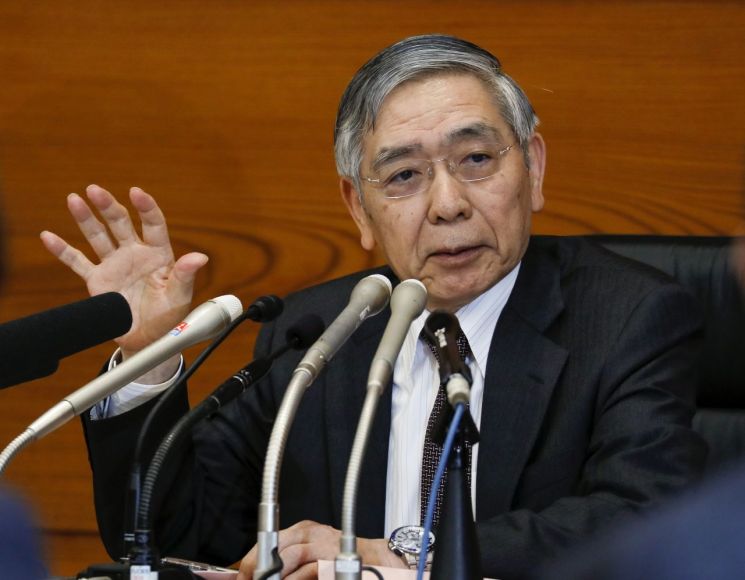
[Asia Economy Reporter Lee Ji-eun] The Bank of Japan (BOJ), which had maintained large-scale monetary easing policies and ultra-low interest rates to stimulate the economy, has decided to shift its monetary policy stance.
According to the Nihon Keizai Shimbun on the 20th, the BOJ announced after a two-day monetary policy meeting that it will revise its accommodative monetary policy.
On this day, the BOJ raised the allowable fluctuation range of long-term interest rates under the Yield Curve Control (YCC) policy from the previous 0.25% to 0.5%. The Nihon Keizai Shimbun explained that raising the upper limit of long-term interest rates to 0.5% is effectively equivalent to an interest rate hike. Since 2016, the BOJ has been implementing the YCC policy, purchasing government bonds unlimitedly to keep Japan’s 10-year government bond yields moving between 0% and 0.25%.
However, this does not mean that Japan’s monetary policy has fully shifted to tightening. Short-term interest rates were maintained at the previous negative (-) 0.1%. Additionally, the monthly bond purchase amount was expanded from 7.3 trillion yen to 9 trillion yen. The BOJ also maintained its policy of purchasing exchange-traded funds (ETFs) to increase the money supply in the market.
The BOJ described this policy decision as a measure to enhance the sustainability of monetary easing.
Meanwhile, as of this time, the yen surged more than 2%. The Tokyo stock market recorded a drop of more than 2%.
© The Asia Business Daily(www.asiae.co.kr). All rights reserved.

















