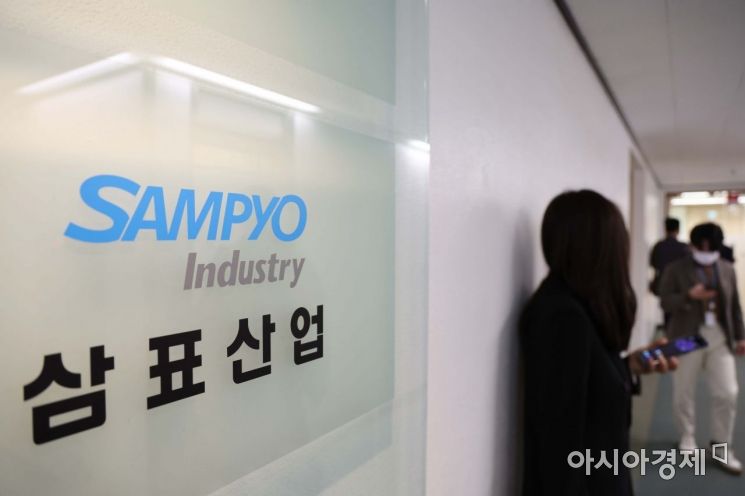
[Asia Economy Reporter Kim Hyung-min] To whom can the responsibility for a major disaster accident be attributed? The prosecution is expected to soon present its first guideline. Final adjustments are underway regarding the judicial handling of the Sampo Industry quarry collapse accident, the first case under the Serious Accidents Punishment Act.
According to the legal community on the 20th, the Public and Anti-Corruption Investigation Division of Uijeongbu District Prosecutors' Office (Chief Prosecutor Hong Yong-hwa) has virtually completed the investigation of this case and is exchanging opinions with the Supreme Prosecutors' Office on whether to indict the related parties. Since this is the first case applying the Serious Accidents Punishment Act, the applicable legal principles are being examined more carefully. The prosecution plans to reach a conclusion by the end of this month at the latest.
In particular, whether Chung Do-won, chairman of the Sampo Group, will be brought to trial is a key issue. The indictment of Chairman Chung would be interpreted as meaning that responsibility for a major disaster accident can extend beyond the affiliate company to the head of the group, which is expected to cause significant repercussions in both the business and legal communities. Initially, the Central Regional Employment and Labor Office of the Ministry of Employment and Labor conducted the investigation first and, in June, applied charges of violating the Serious Accidents Punishment Act only to Lee Jong-shin, CEO of Sampo Industry, the management responsible, and referred the case to the prosecution. However, the prosecution, after taking over the case and continuing the investigation, summoned Chairman Chung as a suspect at the end of last month, raising the possibility of indictment. If it is determined that Chairman Chung gave final approval to Sampo Industry’s safety management organization, budget, and operations, and that there were problems in this process, the prosecution may bring him to trial. The Sampo Group is known to have conveyed to the prosecution that "Chairman Chung, as chairman of the Sampo Group, is not involved in the decision-making of the affiliate company (Sampo Industry) where the accident occurred."
As the prosecution’s judicial handling of the Sampo Group approaches, the business community is closely monitoring the situation. This is the first judgment and interpretation from the prosecution regarding the scope of "business owners and management responsible persons" who are criminally liable under the Serious Accidents Punishment Act, and it is seen as a 'barometer' that will indicate how companies should legally respond when major disaster accidents occur in the future. Since the enforcement of the Serious Accidents Punishment Act on January 27, the business and legal communities have been divided over the interpretation of who should be considered the business owner or management responsible as specified in the law. Opinions have been sharply divided between those who believe that responsibility should be practically assigned to the Chief Safety Officer (CSO) and those who argue that the Chief Executive Officer (CEO) and the group head cannot be exempt from responsibility.
All of this is based on criticism that the law itself is ambiguous. The Serious Accidents Punishment Act stipulates that if an industrial accident such as a worker’s death occurs at a workplace with 50 or more regular employees (or construction projects with a contract amount of 5 billion KRW or more), business owners or management responsible persons who fail to fulfill their accident prevention duties can be sentenced to imprisonment for more than one year or fined up to 1 billion KRW. Two days after the law came into effect, the quarry in Yangju City, Gyeonggi Province, operated by Sampo Industry, collapsed, resulting in the deaths of three workers. This case was registered as the 'first' and has been under investigation.
© The Asia Business Daily(www.asiae.co.kr). All rights reserved.

















