Bank of Korea's 'Future Core Inflation Trend Review' Report
Concerns Over Economic Slowdown Grow but Inflation Instability Persists
Electricity and Gas Prices, Global Supply Disruption Issues
Cumulative Cost Increase Pressure Offsets Inflation Slowdown
Although the consumer price inflation rate peaked last July and has gradually slowed down since, core inflation has recently shown an expanding upward trend, indicating instability. The Bank of Korea (BOK) expects the upward trend in core inflation to ease due to economic slowdown caused by high interest rates and a decline in Jeonse prices. However, it also analyzed that inflationary pressures could increase further because cost-push pressures have accumulated significantly due to the continuous rise in raw material prices.
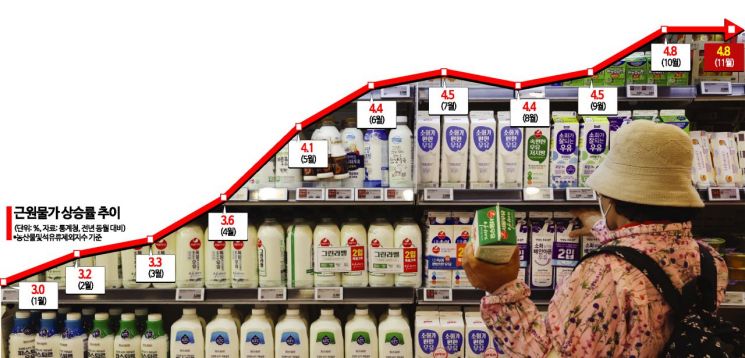
In the BOK Issue Note titled "Review of Future Core Inflation Trends" released on the 20th, the BOK explained, "If the accumulated cost-push pressures from rising raw material prices are reflected in prices, they will act as upward pressure on core inflation," adding, "Supply disruptions, particularly in some items, are slowly being resolved, which also remains an upward cost pressure."
According to the BOK, South Korea's core inflation rate has steadily increased from the 0% range to the low-to-mid 4% range over the past two years, recently showing a larger rate of increase compared to the past. This is interpreted as a result of a combination of factors including increased revenge consumption during the COVID-19 recovery process, supply bottlenecks caused by the Ukraine war, and the effects of rising raw material prices.
The BOK analyzed, "The price of personal services such as dining out, which has broadly spread upward, led the expansion of core inflation," and "Within core inflation, goods prices have also steadily increased this year, albeit moderately, due to secondary effects of supply disruptions and rising raw material prices."
Decline in Jeonse Prices... Factor for Inflation Slowdown
The BOK expects that the upward trend in core inflation may gradually shrink as domestic and international economic downside pressures increase. The benchmark interest rate has been raised by 2.75 percentage points from August last year to November this year, which is expected to worsen consumer sentiment. Moreover, rapid deterioration of overseas conditions due to global tightening makes domestic economic slowdown inevitable. In the past, core inflation also showed a slowdown with a time lag after economic peaks.
The decline in Jeonse prices due to rising loan interest rates and shrinking sales transactions since the second half of this year is also a factor slowing the core inflation rate. According to the Korea Real Estate Board, Jeonse prices have continued to decline this year, and monthly rents also showed a slight decrease in November. Since Jeonse and monthly rents have a large weight in consumer prices, a real estate market downturn significantly impacts price declines.
Cost-Side Upward Pressure on Core Inflation Remains
However, concerns remain that upward cost-side pressure on core inflation will persist. The BOK emphasized that price increases in non-core items such as food and energy could raise cost-push pressures on core items, acting as upward inflationary pressure, and that processed food prices, which affect dining out, continue to show a high upward trend.
In particular, if the increase in electricity and city gas rates, which broadly affect core inflation, expands, the upward cost pressure could significantly increase, offsetting the downward pressure on prices caused by economic slowdown. Since the accumulated cost-push pressures on electricity and city gas rates are substantial, significant rate hikes are expected next year.
Ongoing global supply disruptions are also problematic. South Korea is currently facing significant cost burdens due to rising logistics costs, exchange rates, and raw material prices, and supply disruptions in semiconductors are increasing price pressures on automobiles, mobile phones, and other products. Domestic container import freight rates remain high on intra-Asia routes, and this is gradually being passed on to consumer prices.
With the intensification of US-China conflicts and the prolonged Russia-Ukraine war, economic zones and supply chains are being reorganized around allied countries, weakening global supply chains and increasing the possibility of expanded production and price volatility. If the international division of labor system weakens due to continued US restrictions on China, especially in advanced technologies like semiconductors, inflationary pressures could increase in the medium to long term.
The BOK explained, "Going forward, core inflation is expected to gradually slow due to interest rate hikes, increased downside economic pressures, and declines in housing costs," but added, "The high persistence of core inflation, secondary effects of accumulated cost-push pressures from rising raw material prices, and delayed resolution of supply disruptions in some items will limit the extent of the slowdown."
© The Asia Business Daily(www.asiae.co.kr). All rights reserved.
![Clutching a Stolen Dior Bag, Saying "I Hate Being Poor but Real"... The Grotesque Con of a "Human Knockoff" [Slate]](https://cwcontent.asiae.co.kr/asiaresize/183/2026021902243444107_1771435474.jpg)

















