SKT Analyzes Major Business District Statistics with Location-Based Data Technology 'Litmus'
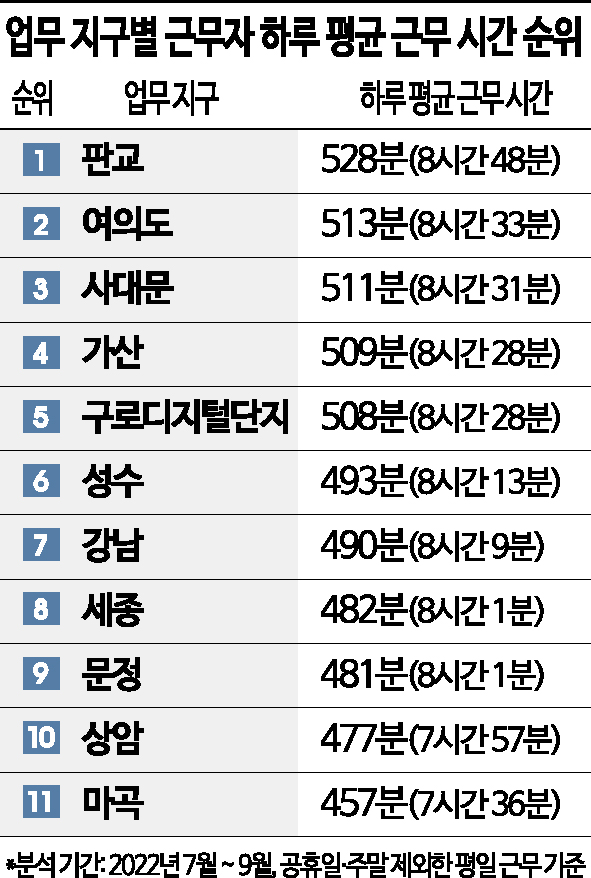
Pangyo Area Works 8 Hours 48 Minutes Daily, 1 Hour More Than Magok
Commute Times Latest in Pangyo, Earliest Leaving Area is Yeouido
[Asia Economy Reporter Lim Hye-sun] Pangyo Techno Valley in Seongnam-si, Gyeonggi-do, once nicknamed the "Squid Fishing Boat" for its office lights burning late into the night. Pangyo Techno Valley, densely populated with information technology (IT) and gaming companies, still ranks as the business district with the longest working hours and latest leaving times.
The region with the most work nationwide is 'Pangyo'
On the 20th, SK Telecom analyzed demographic, commuting, and movement data of 11 representative business districts in South Korea this year using Litmus, a location-based data analysis technology. The business district with the longest average daily working hours was Pangyo (8 hours 48 minutes). Considering the average working time excluding lunch as 8 hours (480 minutes), this means an average of 48 minutes of overtime per day. Following Pangyo were Yeouido (8 hours 33 minutes), Sadaemun (8 hours 31 minutes), Gasan and Guro Digital Complex (8 hours 28 minutes), Seongsu (8 hours 13 minutes), Gangnam (8 hours 9 minutes), Sejong and Munjang (8 hours 1 minute), Sangam (7 hours 57 minutes), and Magok (7 hours 36 minutes). Magok's working hours were 1 hour 11 minutes less than Pangyo's.
The earliest arrival time for workers was in Yeouido. 42.8% of workers arrived at 8 a.m. Following that, 26.7% of workers arrived at 7 a.m., meaning nearly 70% of workers arrived before 8 a.m. In Sejong, 61.5% arrived at 8 a.m., while in Pangyo it was 36.3%. The standard leaving time was 6 p.m. However, in Yeouido, 35% left at 5 p.m., making it the earliest commuting district nationwide. In Sejong, 59% left at 6 p.m., showing a general tendency for workers to arrive at 9 a.m. and leave at 6 p.m. In Pangyo, 22% and 12% left at 7 p.m. and 8 p.m. respectively, totaling about 34%, making it the district with the most overtime work.
During September, the average age of workers in each business district was between 41 and 45 years. Pangyo recorded an average worker age of 39, the only district with an average age in the 30s.
The longest commuting time region is 'Sejong'
Examining the average commuting times of workers from the top 15 regions for each business district, Sadaemun had the shortest commute with 42 minutes in the morning and 44 minutes in the evening. Except for Sejong, most business districts had evening commutes about 5 minutes longer than morning commutes. Sejong's commuting time exceeded 80 minutes compared to other districts. This was due to workers residing in Seoul's Gangnam, Songpa, and Seocho districts, which raised the average.
The district with the highest number of workers was Sadaemun. Following were Gangnam and Yeouido, where workers were concentrated. Seongsu ranked fifth, having more workers than Pangyo, Guro, and Sangam. The Litmus research team explained, "Recently, many IT companies have moved into knowledge industry centers in Seongsu, and large companies like Hyundai Mobis and SM have chosen Seongsu as their office location."
SKT 'Litmus' solves 'social issues' through location-based statistics
'Litmus' is a location intelligence system developed by SK Telecom that analyzes location-based data to infer and specify people's stories embedded in 'movement' and 'stay.' It analyzes people's journeys based on location data and distinguishes the purpose of stay and mode of transportation when people remain at specific locations. Using SKT's deep learning technology, it comprehensively analyzes travel routes, transportation modes, and stay locations. Currently, Litmus provides a service with T map and Korea Expressway Corporation that alerts vehicles behind about highway accidents. SKT analyzes accident sign data collected on the Litmus platform, detects accidents, and notifies the Korea Expressway Corporation. The corporation verifies accidents via CCTV and then sends alerts to T map on vehicles within 2 km behind the accident through the Litmus platform. SKT plans to expand the use of this technology into various fields in the future.
© The Asia Business Daily(www.asiae.co.kr). All rights reserved.