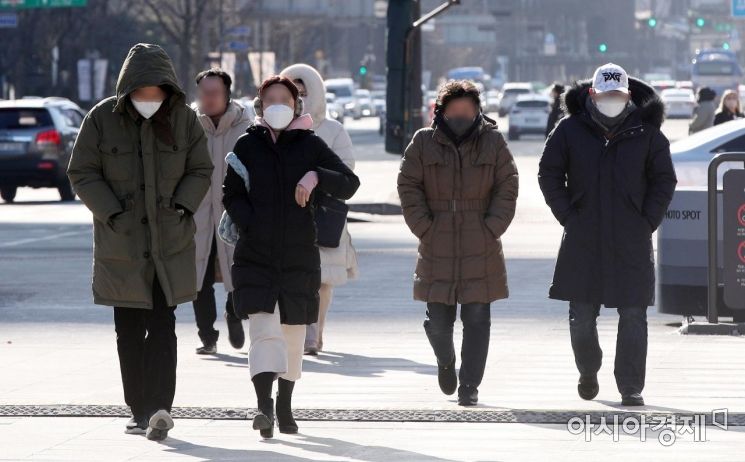
 On the 18th, when the strongest cold wave of this winter hit, citizens dressed in thick clothing hurried their steps at Gwanghwamun Square in Seoul. Photo by Kim Hyun-min kimhyun81@
[Asia Economy Reporter Oh Su-yeon] On the 18th, cold waves, strong winds, and heavy snowfall continued across the country, leading to a series of incidents and accidents.
At Jeju Airport, as of 3 PM, a total of 100 flights (50 departures and 50 arrivals) departing from and arriving at Jeju were canceled. Gwangju Airport canceled 12 flights in total, including 6 departing flights until 10:30 AM and 6 arriving flights until 11:40 PM. Muan International Airport is experiencing delays in international flights, and 4 domestic flights (departures and arrivals) were canceled. In Jeollanam-do, all passenger ferry routes (54 routes with 88 vessels) were suspended, and in Jeollabuk-do, 4 routes including Gunsan?Eocheongdo and Gunsan?Seokdo were controlled for the second consecutive day. Four passenger ferries connecting Jeju, Jindo, and Sangchujado were also canceled.
In Jeju, a total of 33 reports were received from the afternoon of the previous day until 2 PM on the same day. Drivers experienced inconvenience as snow removal work was not carried out on some roads in Gwangju, Jeollanam-do, and Jeonju where snow had been falling since the previous day.
Halla Mountain hiking is currently completely restricted. The mountain road 1100, connecting Jeju City and Seogwipo City, from Eoseungsaeng Samgeori to the old Tamna University intersection, is closed to both large and small vehicles. Twelve hiking trails with 133 routes in Jirisan and Deogyusan National Parks are fully closed.
Gwangju administrative and educational authorities are considering adjusting work and school start times on Monday, the 19th. The start time for public officials is expected to be delayed by about one hour.
Gyeonggi-do and Gangwon-do are experiencing the strongest cold wave with temperatures dropping to minus 20 degrees Celsius. Around 1:10 PM, electricity supply was cut off to about 3,400 apartment units in the Wirye New Town area of Songpa-gu, Seoul.
Seoul City raised its alert to ‘Frozen Pipe Warning’ (Level 3) starting at 7 AM that day. When the ‘Frozen Pipe Warning’ level is issued, the ‘Frozen Pipe Countermeasure Situation Room’ operates 24 hours a day. Previously, the city had issued a ‘Frozen Pipe Caution’ (Level 2) from the 14th and has been working to prevent frozen water meters and restore damage.
The first frozen water meter report in Seoul this winter was received on November 30, a week earlier than last year, and from November 15, when the frozen pipe countermeasure period began, to December 16, a total of 408 frozen pipe reports were received in Seoul.
© The Asia Business Daily(www.asiae.co.kr). All rights reserved.

















