KCCI Publishes Policy Report on Employment of Older Workers
Many Older Workers Wish to Work, but Face Challenges in Reemployment and Entrepreneurship
[Asia Economy Reporter Kiho Sung] It has been revealed that the labor market participation and employment rate of the elderly are rapidly increasing. However, although many elderly people wish to work after retirement, reemployment and entrepreneurship are difficult, highlighting the urgent need for countermeasures.
The Korea Employers Federation (KEF) published a report titled "Three Characteristics and Policy Tasks of Recent Elderly Employment Trends" on the 16th. The report identified the characteristics of recent elderly employment trends as ▲ rapid increase in labor market participation and employment rate of the elderly ▲ scars from the legislation of mandatory retirement at age 60 ▲ increase in the number of elderly wishing to work after retirement and difficulties in reemployment and entrepreneurship.
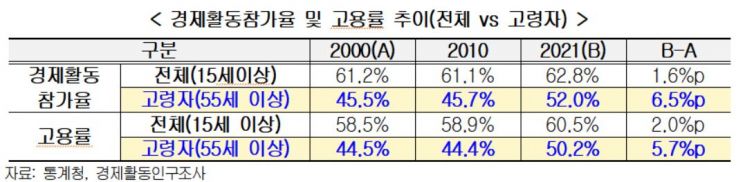
First, looking at the labor market participation of the elderly, from 2000 to 2021, the economic activity participation rate of the elderly (aged 55 and over) increased by 6.5 percentage points, and the employment rate increased by 5.7 percentage points. This is 4.1 times and 2.9 times higher, respectively, compared to the overall age group (aged 15 and over) during the same period.
The proportion of regular workers among elderly employees was 33.6%, which is lower than the proportion of regular workers among all employees (54.6%). The proportions of temporary/daily workers (28.2%) and self-employed without employees (32.7%) among elderly employees were higher than those of all employees, indicating that the quality of jobs for the elderly is relatively lower.
In particular, the legislation of mandatory retirement at age 60 is estimated to have reduced companies' capacity for new hires, negatively affecting youth employment. This is presumed to be due to a decrease in youth employment mainly in companies that bore a heavy burden from the mandatory retirement at age 60 legislation.
The proportion of elderly people who wish to continue working in the future increased from 60.1% in 2013 to 68.5% this year. The age of those wishing to work also increased from 71.5 years in 2013 to 72.9 years this year. However, it was analyzed that when elderly people are reemployed after retiring from their main jobs, they tend to move downward in terms of skills and working conditions.
The total hourly wage of elderly workers with less than five years of continuous service, who can be considered reemployed elderly workers, was 15,726 won, which is only 57.3% of the total hourly wage of elderly workers with long-term service of 10 years or more (27,441 won). Although many start businesses after retirement, they tend to focus on livelihood-type startups such as real estate, wholesale and retail, and accommodation and food services, where it is difficult to utilize the skills and experience acquired in the labor market.
Lim Young-tae, head of the Employment Policy Team at KEF, emphasized, "In order to respond to the serious low birthrate and aging population, it is most important to create an environment where elderly people who want to work longer can continue to participate in the labor market," adding, "Through legal and institutional reforms to ease labor market rigidity, elderly people should be able to easily participate in the labor market in various ways."
He also pointed out, "It is necessary to increase tax support and subsidies that can increase the demand for elderly labor itself, and to support the rapid reemployment of elderly workers through strengthening vocational training and improving employment support services for the elderly."
© The Asia Business Daily(www.asiae.co.kr). All rights reserved.

















