Japanese Travelers Recover 78% Compared to Pre-COVID Levels
Jeju Air and Others Rise Over 10%
[Asia Economy Reporter Myung-Hwan Lee] Low-cost carrier (LCC) stocks listed on the domestic stock market are taking off again. This is due to a surge in passenger demand as neighboring countries such as Japan have started accepting individual tourists again. Securities firms have diagnosed that the earnings improvement trend of LCCs, which mainly operate short-haul routes, will be prominent.
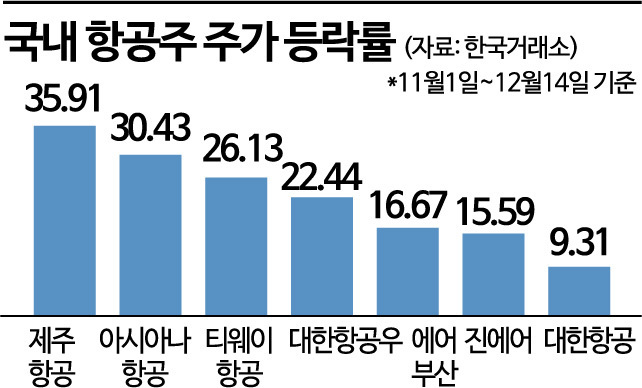
According to the Korea Exchange on the 15th, the stock price of Jeju Air, which was 9,970 won on the 1st of last month, closed at 13,550 won on the 14th. The stock price increase rate during this period reached 35.91%. During this period, not only Jeju Air but also other LCC stocks such as T'way Air (26.13%), Air Busan (16.67%), and Jin Air (15.59%) showed stock price increases of over 10%. The stock prices of major full-service carriers (FSC) such as Asiana Airlines (30.43%), Korean Air Preferred (22.44%), and Korean Air (9.31%) also showed an upward trend.
This was largely influenced by Japan starting to accept overseas independent travelers again in October. The Japanese authorities announced that from October 11, they would abolish the daily entry cap of 50,000 people and fully allow visa-free individual travel for foreigners. As Japan reopened its skies like this, investor expectations seemed to focus on LCCs, which specialize in short-haul routes.
In fact, the number of passengers on flights to Japan also surged. According to the Ministry of Land, Infrastructure and Transport’s aviation information portal system ‘Air Portal,’ the number of passengers to Japan last month was 820,079. Compared to the same period last year, when Japan strictly restricted overseas entries due to COVID-19 quarantine measures and the number of passengers was only 16,320, this is an increase of more than 50 times. Even compared to before the COVID-19 pandemic, the recovery of passengers to Japan is remarkable. The number of travelers to Japan last month recovered to 77.78% of the 1.05 million in November 2019.
As air passengers to Japan show a recovery trend like this, securities firms predict that it will play a significant role in increasing the earnings of LCCs. Choi Go-Woon, a researcher at Korea Investment & Securities, said, "Unlike last summer, the Japan effect is added, and an earnings surprise centered on LCCs is expected," adding, "With the allowance of individual tourism in October, deferred demand for three years, including the 2019 Japan boycott, is exploding." He also evaluated, "Japan is an important route that accounts for as much as half or more of the operating profit of LCCs."
Not only Japan but also the recovery of routes to China, which recently virtually abolished the ‘zero COVID’ measures, is expected, according to evaluations. Bae Ki-Yeon, a researcher at Meritz Securities, diagnosed, "Following China’s virtual abolition of zero COVID measures, expectations are spreading that foreign entry restrictions will also be eased."
However, there are also opinions that a neutral view should be maintained on the entire aviation industry, including passengers and air cargo. Ryu Je-Hyun, a researcher at Mirae Asset Securities, analyzed, "The recovery of short-haul routes excluding China is certainly positive," but added, "Cargo volume, which is a barometer of the economy, has somewhat decreased, so additional confirmation is needed."
© The Asia Business Daily(www.asiae.co.kr). All rights reserved.
![Clutching a Stolen Dior Bag, Saying "I Hate Being Poor but Real"... The Grotesque Con of a "Human Knockoff" [Slate]](https://cwcontent.asiae.co.kr/asiaresize/183/2026021902243444107_1771435474.jpg)
















