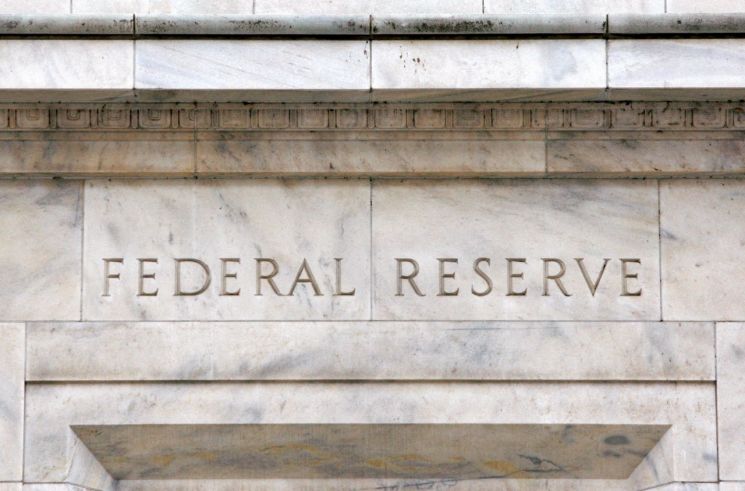
[Asia Economy New York=Special Correspondent Joselgina] The U.S. central bank, the Federal Reserve (Fed), has implemented a so-called 'big step' by raising the benchmark interest rate by 0.5 percentage points at once. As initially announced, it stepped back from the unusual four consecutive giant steps (0.75 percentage point increases) and began to adjust the pace of tightening. However, it also confirmed its policy to raise the terminal rate to 5.1% next year and maintain higher rates for a longer period, according to the dot plot.
On the 14th (local time), the Fed announced after the Federal Open Market Committee (FOMC) regular meeting that it would raise the federal funds rate by 0.5 percentage points from the previous 3.75-4.0% to 4.25-4.5%.
The FOMC stated, "Sustained increases in the interest rate are necessary to maintain a sufficiently restrictive policy stance to bring inflation back to the 2% target." It also mentioned that in determining the pace of rate hikes, it would "consider the cumulative tightening of monetary policy, the lagged effects of monetary policy on economic activity and inflation, and economic and financial developments."
Furthermore, it added, "We will continue to monitor incoming information on the economic outlook," and "We are prepared to adjust monetary policy appropriately if risks arise," indicating the possibility of future policy adjustments.
This 0.5 percentage point increase was a decision anticipated by the market. Fed Chair Jerome Powell had hinted at slowing the pace as early as December, and recent inflation data confirmed signals that the worst phase has passed. This is interpreted as cautious voices within the Fed gaining strength, suggesting it is time to evaluate the cumulative tightening effects and avoid unnecessary recession.
The Consumer Price Index (CPI) for November, released the day before, rose 7.1% year-on-year, below the market expectation of 7.3%, bolstering hopes for a peak in inflation. This is the lowest monthly increase since December last year.
However, the Fed raised the median terminal rate for next year to 5.1% in the dot plot released simultaneously. Earlier, Chair Powell had effectively signaled an era of a 5% benchmark rate by stating that the terminal rate would be higher than previously expected. The dot plot released in September projected the terminal rate for next year at 4.5-4.75% (median 4.6%).
Accordingly, the interest rate gap between South Korea (3.25%) and the U.S. has widened to 1-1.25 percentage points. This is close to the largest historical U.S.-Korea rate inversion of 1.50 percentage points. Concerns about foreign capital outflows and depreciation of the Korean won are being raised.
Meanwhile, since entering the rate hike cycle by raising rates by 0.25 percentage points in March this year, the Fed has continued its tightening path with increases of 0.5 percentage points in May, 0.75 percentage points in June, 0.75 percentage points in July, 0.75 percentage points in September, and 0.75 percentage points in November.
© The Asia Business Daily(www.asiae.co.kr). All rights reserved.

















