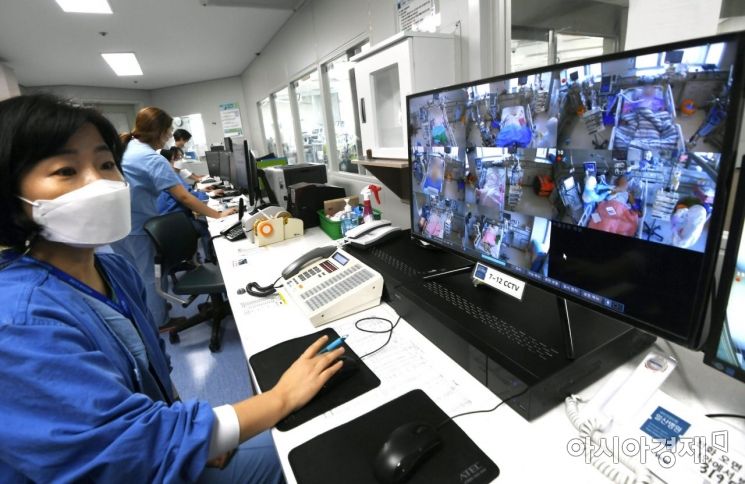
[Asia Economy Reporter Kim Young-won] The occupancy rate of severe care beds in some areas, including Seoul, has exceeded 50%. As social distancing and the outdoor mask mandate have been lifted, respiratory infectious diseases are spreading during the winter season, raising concerns about a potential bed shortage crisis.
According to the Ministry of Health and Welfare on the 15th, as of 5 p.m. on the 13th, the nationwide occupancy rate of critical care beds was around 35.0%, but in Seoul, 119 out of 215 critical care beds were in use, reaching an occupancy rate of 53.3%. In Gangwon Province, 22 out of 44 critical care beds, or half, were occupied. Among Seoul’s 426 semi-critical care beds, 240 (56.3%) were in use.
The occupancy rate of severe care beds in Seoul surpassed 50% starting from the 4th. Until last month, there were more available severe care beds than those in use, but as of 5 p.m. on the 4th, the occupancy rate of critical care beds reached 50%. During this period, the occupancy rate of semi-critical care beds was 59.3%, filling up faster than critical care beds.
Experts have been warning of a "bed shortage crisis" due to the ongoing spread of respiratory viruses such as influenza this year, following the lifting of outdoor mask mandates and social distancing measures. In September, the Korea Disease Control and Prevention Agency (KDCA) issued an influenza epidemic advisory for the first time in three years since 2019. According to the KDCA, the number of influenza-like illness patients has increased for seven consecutive weeks.
In preparation, health authorities have secured beds capable of handling up to 200,000 daily confirmed cases. The Central Disaster and Safety Countermeasures Headquarters announced on the 28th of last month that they would gradually reactivate 330 moderate and semi-critical care beds to be able to respond to up to 200,000 daily confirmed cases, which is the predicted peak of the 7th wave. As of the 13th, the number of severe and semi-critical care beds increased by 300 since the 27th of last month.
Despite these measures, the high occupancy rates in some regions are due to the steady occurrence of critically ill patients and deaths. The average daily number of critically ill patients hospitalized in the first week of this month decreased by 4.9% compared to the previous week but has remained in the 400s for three consecutive weeks. The average daily number of deaths increased by three to 51 during the same period. The proportion of patients aged 60 and over relative to intensive care unit medical capacity also continuously increased, recording 24.0% in the fourth week of last month, 25.4% in the fifth week, and 25.9% in the first week of this month.
The number of patients in infection-vulnerable facilities such as nursing hospitals, where the risk of severe illness and death is high, is also on the rise. Last week, the proportion of members of infection-vulnerable facilities among all confirmed cases was 4.4%, up 0.2 percentage points from the previous week. In particular, nursing hospitals, where elderly people are concentrated, accounted for 41.3% of confirmed cases in infection-vulnerable facilities, and nursing homes accounted for 34.1%, making up the majority.
While health authorities assess that the bed occupancy rate is still stable, they have urged caution as the risk of severe illness is increasing. Lim Sook-young, head of the Central Disease Control Headquarters Situation Management Team, said, "Although confirmed cases, hospitalized patients, and deaths have all increased, considering that the occupancy rates of intensive and semi-intensive care beds remain stable, the weekly risk level has been maintained at 'medium'." Lim added, "As the reinfection rate is rising and the risk of severe illness due to reinfection is increasing, special caution is required for the elderly and those with underlying health conditions."
© The Asia Business Daily(www.asiae.co.kr). All rights reserved.

















