Seoul National University-Korea University Research Team Publishes Paper in International Journal 'Nature'
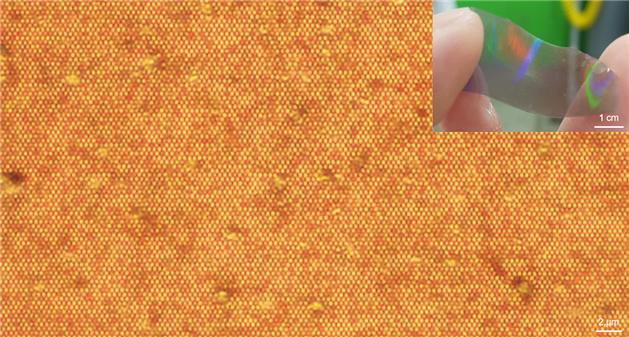 Dark-field microscopy image of the regularly assembled structure of chiral gold nanoparticles and a photo of the actual device
[Asia Economy Reporter Kim Bong-su] A domestic research team has developed an ultra-high sensitivity molecular chirality measurement technology.
According to the Ministry of Science and ICT on the 15th, a domestic joint research team including Professor Nam Ki-tae of Seoul National University, Professors Lee Seung-hoo and Park Kyu-hwan of Korea University discovered a new physical phenomenon related to light-matter interaction based on chiral nanoparticles and successfully applied it to the analysis of biomolecules and their chirality. Chirality refers to the property where the three-dimensional structures of the right and left hands look identical but cannot be superimposed, like how a left-hand glove cannot be worn on the right hand, being mirror images but non-superimposable.
The research results were published on the 15th in the international journal Nature (IF 69.504).
All living organisms in nature have specific interactions with light depending on their structures and the materials that compose them. Here, the research team conducted a study on the molecule’s circularly polarized light-specific interaction caused by ‘chirality’ among the light-matter interactions due to the structural characteristics of various biomolecules. Polarization refers to light whose electromagnetic wave vibration direction (e.g., the up-and-down movement of waves) is adjusted to a specific direction, and circular polarization refers to light in which the electromagnetic wave rotates circularly as it propagates.
Molecular chirality can be analyzed through differences in interactions with two circular polarizations rotating in opposite directions (left circular polarization and right circular polarization). However, due to the size mismatch between molecules and light, the light-matter interaction is not sufficiently large, requiring high-concentration samples and long measurement times, presenting significant limitations.
The research team found a breakthrough to this problem in a new physical phenomenon observed in the two-dimensional assembled structure of chiral gold nanoparticles. The chiral gold nanoparticles used by the team resonate with incident circularly polarized light due to their unique geometric structure, allowing efficient control of circular polarization near the nanoparticles.
By introducing chiral molecules onto the two-dimensional array of nanoparticles, they successfully maximized the interaction between circularly polarized light and chiral molecules, achieving chirality sensitivity that surpasses the detection limits of existing optical systems.
Furthermore, focusing on the fact that the chirality signal amplification caused by the arrangement of chiral gold nanoparticles exists in the visible light range, they succeeded in proposing a naked-eye-based chirality sensor capable of distinguishing molecular chirality without special equipment.
The ultra-high sensitivity molecular chirality analysis based on chiral gold nanoparticle arrays can be used for chirality analysis of various biomolecules, chemical substances, and pharmaceuticals. It is expected to have a significant impact not only on various industries such as analytical science, diagnostics, and pharmacy, where biomaterial synthesis and material analysis are important, but also on fundamental academic fields such as chemistry, biology, and physics.
© The Asia Business Daily(www.asiae.co.kr). All rights reserved.

![Clutching a Stolen Dior Bag, Saying "I Hate Being Poor but Real"... The Grotesque Con of a "Human Knockoff" [Slate]](https://cwcontent.asiae.co.kr/asiaresize/183/2026021902243444107_1771435474.jpg)















