Daewoong Pharmaceutical Halts Phase 3 Clinical Trial of COVID-19 Treatment
Cellid Focuses on Omicron Booster Vaccine
Genome & Company Ends Strategic Clinical Trial Early
Resources Allocated to High-Potential Pipelines

[Asia Economy Reporter Lee Gwan-joo] The domestic pharmaceutical and bio industry is drawing attention to the background behind the consecutive halts in new drug research and development clinical trials. Amid a continuing market downturn, it is interpreted that companies are engaging in ‘selection and concentration’ for efficient clinical trials by considering factors such as declining future value, development strategies, and other ongoing clinical trials.
According to the industry on the 15th, Daewoong Pharmaceutical recently decided to voluntarily halt the Phase 3 clinical trial of ‘DWJ1248’ in combination with remdesivir for severe COVID-19 patients. This clinical trial was approved by the Ministry of Food and Drug Safety on December 31, 2020, during the early days of the COVID-19 pandemic, and had been ongoing for nearly two years. However, with the spread of the Omicron variant changing the epidemic pattern and the expansion of vaccination reducing the progression rate to severe cases, the company concluded that securing clinical results would be difficult and made the decision to stop the trial.
Daewoong Pharmaceutical demonstrated its new drug development capabilities by obtaining approval for the 34th domestic new drug, the gastroesophageal reflux disease treatment ‘Pexuclu’, last year, and the 37th domestic new drug, the diabetes treatment ‘Enbolo’, this year. By halting the COVID-19 treatment clinical trial, the company is expected to focus on research and development of existing pipelines and market entry of approved new drugs. A Daewoong Pharmaceutical official explained, “Changes in the clinical environment made it inevitable to change the development strategy. After considering expert opinions and business feasibility relative to investment, we decided to halt the clinical trial.”
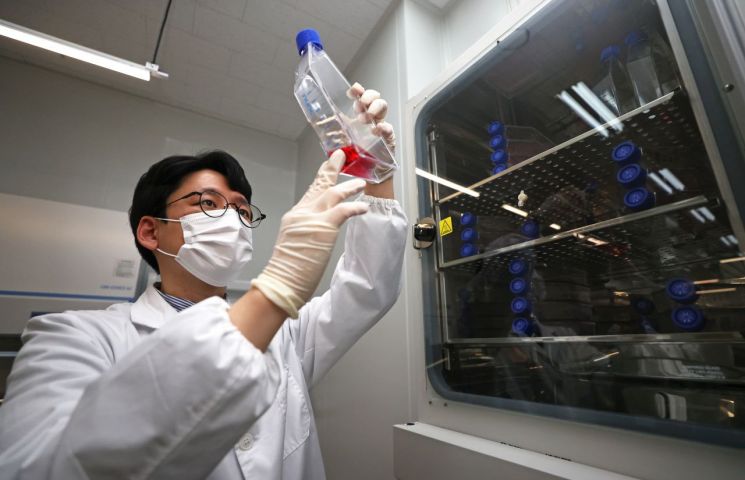 A researcher is conducting research related to COVID-19 vaccine development at the Cellid Cell Gene Therapy GMP Center.
 [Photo by Yonhap News]
Cellid decided to prematurely terminate the Phase 2b clinical trial of its COVID-19 vaccine candidate ‘AdCLD-CoV19-1’. This vaccine uses an adenovirus vector platform and was approved in January this year for basic vaccination targeting unvaccinated and uninfected individuals. However, due to the spread of the Omicron variant and the increase in antibody prevalence and vaccination domestically and internationally, recruiting clinical trial participants became difficult. It was also judged that developing a vaccine for unvaccinated individuals would not be economically advantageous compared to booster shot vaccines, leading to this decision. Since Cellid is conducting a Phase 2 clinical trial for the Omicron variant-targeting booster shot vaccine ‘AdCLD-CoV19-1 OMI’, it is expected to focus on the development and commercialization of this vaccine.
Genome & Company prematurely terminated the Phase 1/1b clinical trial for solid tumors (non-small cell lung cancer, head and neck cancer, urothelial carcinoma) using its core pipeline microbiome immuno-oncology drug ‘GEN-001’ in combination with Merck’s Bavencio (active ingredient avelumab). Currently, Genome & Company is conducting a Phase 2 clinical trial for gastric cancer using the same combination therapy and an additional Phase 2 clinical trial for cholangiocarcinoma in combination with MSD’s Keytruda (active ingredient pembrolizumab). This clinical trial termination is interpreted as a strategic decision considering these ongoing trials. A Genome & Company official explained, “Through strategic consultation, we decided to focus on the Phase 2 clinical trial for gastric cancer to streamline clinical operations and concentrate development capabilities, and to prematurely terminate the solid tumor clinical trial.”
Typically, early termination of clinical trials is regarded as a clinical failure and considered a major ‘negative factor’ in the pharmaceutical and bio industry. However, recently, perceptions have been changing despite this. Rather than conducting multiple clinical trials simultaneously, it is better to invest research and development capabilities in candidates with higher chances of success and quickly adapt to environmental changes to improve efficiency. An industry insider said, “Now is the time for ‘selection and concentration’ even in the new drug development process. In a continuing market downturn, making bold decisions when necessary and focusing capabilities in new directions will also help enhance corporate value.”
© The Asia Business Daily(www.asiae.co.kr). All rights reserved.

![Clutching a Stolen Dior Bag, Saying "I Hate Being Poor but Real"... The Grotesque Con of a "Human Knockoff" [Slate]](https://cwcontent.asiae.co.kr/asiaresize/183/2026021902243444107_1771435474.jpg)















