Average Annual Temperature Rises Due to Climate Change... Increased Frequency of Sandstorms
Less Snow Accumulation at Source Makes Yellow Dust Occurrence Easier
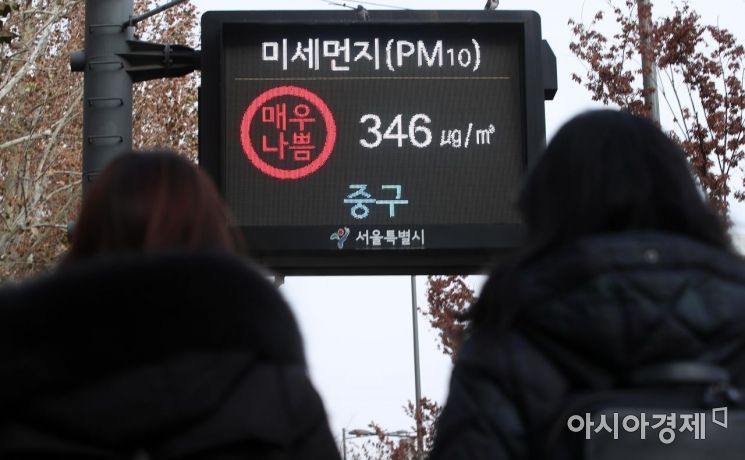 Due to the influence of yellow dust, fine dust concentration in the Seoul metropolitan area reached a 'Very Bad' level on the 13th, and a related notice was displayed on an electronic billboard near Seoul City Hall. Photo by Kim Hyun-min kimhyun81@
[Asia Economy Reporter Yoon Seul-gi] Winter yellow dust, accompanied by snow and rain, has covered the entire country. The source of this winter yellow dust is the Gobi Desert and the Inner Mongolian Plateau in China. The cause of the yellow dust occurrence is attributed to the increased frequency of sandstorms due to rising annual average temperatures caused by climate change.
On the 13th, as the whole country came under the influence of yellow dust, the Ministry of Environment issued the first yellow dust crisis alert of the year. At 10 a.m. that day, the yellow dust crisis alert level in Seoul was raised from 'Interest' to 'Caution,' and by noon, the alert level in Gangwon was also raised to 'Caution.' Many areas outside Seoul recorded 'Very Bad' (daily average concentration exceeding 150㎍/㎥). The recorded concentrations were Incheon (312㎍/㎥), Gwangju (228㎍/㎥), Daejeon (178㎍/㎥), Gyeonggi (293㎍/㎥), Gangwon (234㎍/㎥), Chungnam (177㎍/㎥), Jeonbuk (223㎍/㎥), and Jeonnam (180㎍/㎥).
The yellow dust crisis alert is divided into four levels: Interest, Caution, Warning, and Severe. The caution alert is issued when a fine dust (PM10) alert is issued due to yellow dust and the hourly average concentration remains above 300㎍/㎥ for more than two hours, indicating the possibility of a large-scale disaster. The interest level alert is issued when fine dust levels are expected to be very bad due to yellow dust.
Earlier, on the 11th at 10 a.m., the Ministry of Environment issued a yellow dust crisis alert for Seoul, Incheon, and Gyeonggi areas. This is the first time in 1 year and 7 months since May last year that a yellow dust crisis alert has been issued.
This yellow dust originated on the 11th from the Gobi Desert and Inner Mongolian Plateau in China. According to the Korea Meteorological Administration, the 1-hour average concentration of fine dust (PM10) in Urad Middle Banner, Neimenggu, near the Inner Mongolian Plateau, soared to 4143㎍/㎥ at 11 p.m. on the 11th. Due to the influence of the low-pressure system that caused the yellow dust, snow and rain fell mainly in the central region on the evening of the 12th.
When yellow dust occurred in the Inner Mongolian Plateau and Gobi Desert, a cold northwesterly wind blew into the upper atmosphere, which then moved southeastward and entered the Korean Peninsula. Cold air is heavier than warm air and tends to sink, and the northwesterly wind carrying yellow dust increased the fine dust concentration in Korea.
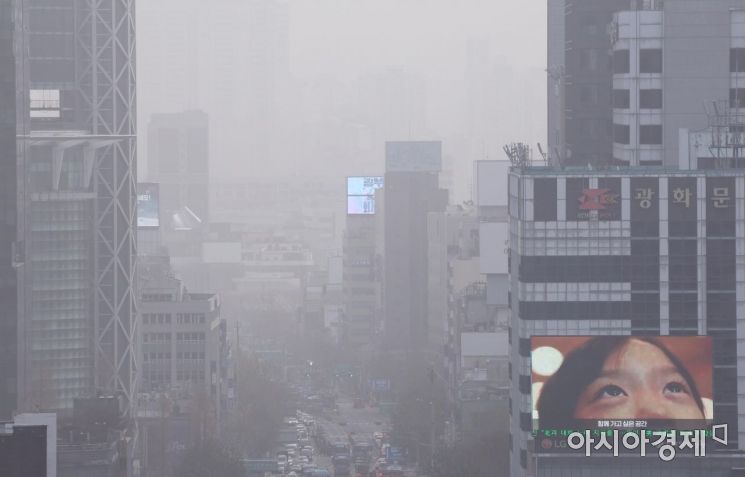 On the 13th, when the fine dust concentration in Seoul reached a 'very bad' level, the Jongno area in Seoul appeared hazy. Photo by Kim Hyun-min kimhyun81@
It is unusual for dense yellow dust to cover the entire country in December. In Seoul, this is the first time since 2009 that the 1-hour average concentration of fine dust caused by yellow dust in December has approached or exceeded 500㎍/㎥. On December 25-26, 2009, the highest 1-hour average fine dust concentration in Seoul due to yellow dust reached 963㎍/㎥. At that time, the highest fine dust concentration in Suwon, Gyeonggi was 1132㎍/㎥.
Yellow dust mostly occurs in spring, with 80% of the yellow dust entering Korea occurring in spring and the remaining 20% in winter. In East Asia, yellow dust originates from the Gobi Desert, Inner Mongolian Plateau, Manchuria, deserts west of the Hexi Corridor, the Loess Plateau, and the Taklamakan Desert. However, yellow dust originating from the Taklamakan Desert has little impact on Korea.
The National Institute of Environmental Research explained the cause of this yellow dust occurrence as "due to climate change, the annual average temperature in Mongolia and northern China has risen recently, causing sandstorms to occur more frequently in these areas." Additionally, although the temperatures in the Gobi Desert and Inner Mongolian Plateau were similar to average years, less snow accumulated around these areas than usual, creating conditions favorable for yellow dust generation when the wind blows.
Meanwhile, when the concentration of fine dust or ultrafine dust in the air is high, children, the elderly, and those with respiratory diseases should refrain from outdoor activities. If going outside is unavoidable, it is recommended to wear health masks such as KF94 or KF80 that can protect the respiratory system from particulate harmful substances.
© The Asia Business Daily(www.asiae.co.kr). All rights reserved.


















