Overcoming This Winter's Energy Crisis, but Russia May Reduce Supply
IEA Urges Efforts to Expand Use of Renewable Energy
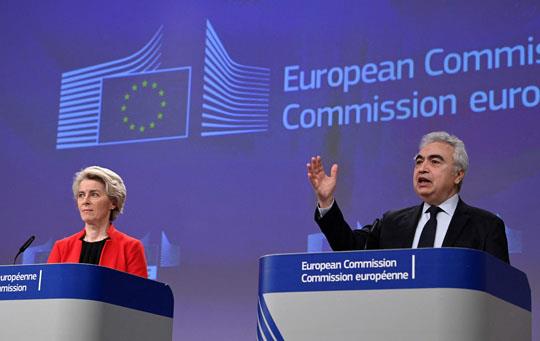 Ursula von der Leyen (left), President of the European Union (EU) Commission, and Fatih Birol, Executive Director of the International Energy Agency (IEA), are holding a press conference on the 12th (local time) at the EU Council building in Brussels, Belgium. Photo by Yonhap News
[Asia Economy Culture Young Intern Reporter] Since Russia's invasion of Ukraine, Europe has faced an energy crisis, and there are forecasts that natural gas may be in short supply next year.
On the 12th (local time), Fatih Birol, Executive Director of the International Energy Agency (IEA), and Ursula von der Leyen, President of the European Union (EU) Commission, held a joint press conference. They warned, "The EU has sufficient natural gas this winter, but if Russia further reduces supply, there could be shortages next year."
As of 2021, the EU's annual natural gas consumption was 412 billion cubic meters, and according to the IEA, Europe will face a shortage of 27 billion cubic meters of natural gas next year, equivalent to 7% of annual consumption.
Russia supplied 60 billion cubic meters of natural gas to the EU this year. However, there is a possibility that Russia will completely cut off natural gas supply next year, and with China's economy picking up speed again after lifting COVID-19 lockdowns, the natural gas market could become unstable.
In response, voices are calling for "action to save energy and expand renewable energy." The IEA urged additional efforts to improve energy efficiency by expanding the use of renewable energy, such as retrofitting natural gas buildings and replacing fossil fuel-based heating with heat pumps. To achieve this, the EU is expected to invest 100 billion euros (approximately 137.253 trillion KRW).
Meanwhile, although there were major concerns about a European energy crisis due to Russia weaponizing energy, this winter the crisis was avoided. European countries have been trying to find alternative resources or reduce demand to lower dependence on Russian energy, and the warmer-than-expected European autumn weather also helped.
© The Asia Business Daily(www.asiae.co.kr). All rights reserved.

















