Lifestyle Brand Established in Japan in 1980
Grew Despite the 'Lost Decade' but Faces 'Complete Capital Erosion' This Year
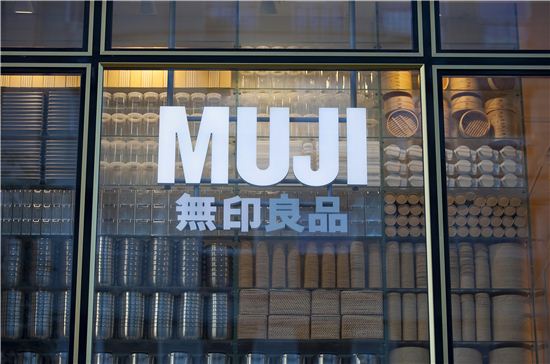 The interior of a Muji store. [Image source=Bloomberg]
[Asia Economy Reporter Lee Hyunjung] Muji is a lifestyle company established in Japan in 1980. It plans, develops, manufactures, distributes, and sells everyday items such as clothing, household goods, and food. As the name 'Muji' suggests, the brand has no brand (Muji means "no brand") but offers good quality products (Yohin). It started by collecting shiitake mushrooms that were slightly damaged and unsellable in supermarkets and offering them at reasonable prices for soups and stews, then expanded its product range and developed into a brand.
Muji has controlled both price and design by simplifying the manufacturing process with simple forms without brand imprints, as seen in product names like 'Flat Notebook' or 'Stackable Storage Box.' It is evaluated as having introduced modern and simple design to the crude level of Japanese industrial products, raising Japan's design standards to a new level. Muji led the minimalism trend in the home furnishing market and succeeded in capturing single-person households.
Despite the long-term recession in Japan from 1991 to the early 2000s, known as the "Lost Decade," Muji continued its growth trajectory. During this period, Muji's sales grew by 440%, and ordinary profit (operating profit plus non-operating income minus non-operating expenses) increased by 10,700%.
Muji entered the domestic market in December 2004 when Yohin Keikaku and Lotte Sangsa established Mujikorea with a 60:40 shareholding ratio. Most domestic stores are located within subsidiaries of Lotte Distribution.
Following Japan's semiconductor core material export restrictions in 2019 and the ensuing boycott of Japanese products, Muji recorded an operating loss of 4.3 billion KRW from September last year to August 30 this year. The cumulative deficit over the past three years is about 25 billion KRW. In September last year, Muji also closed its first store in Bundang, Seongnam, Gyeonggi Province, after five years of operation.
Due to business deterioration, Muji's capital has also fallen into an erosion state. The total capital in the previous fiscal year was about 1.8 billion KRW, but it sharply declined to a loss of 4.3 billion KRW in the current fiscal year, reaching a state of "complete capital erosion." When capital is less than capital stock, it is called "partial capital erosion," and when "partial capital erosion" worsens and capital becomes negative, it is called "complete capital erosion." The deficit, which indicates negative retained earnings, also increased from about 18.4 billion KRW in the previous fiscal year to about 24.5 billion KRW in the current fiscal year. However, since Muji is not a listed company, there is no direct impact from this.
During the boycott of Japanese products, consumers who turned to the domestic alternative brand Jaju have solidified their purchasing habits, and Muji's performance has not recovered. The distribution industry sees urgent needs for changes in pricing policies to respond to Jaju's aggressive expansion and growth of online stores.
© The Asia Business Daily(www.asiae.co.kr). All rights reserved.

![Clutching a Stolen Dior Bag, Saying "I Hate Being Poor but Real"... The Grotesque Con of a "Human Knockoff" [Slate]](https://cwcontent.asiae.co.kr/asiaresize/183/2026021902243444107_1771435474.jpg)














