Partial Amendment to the Enforcement Decree of the Act on the Operation of Public Institutions Passed at the Cabinet Meeting... Effective from January Next Year
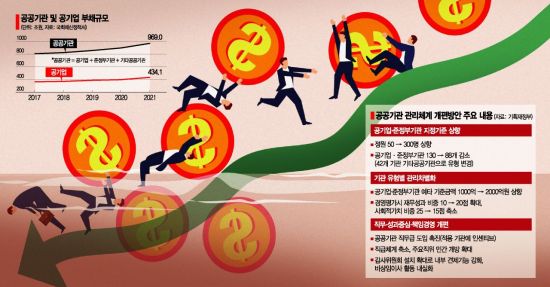
[Asia Economy Sejong=Reporter Kim Hyewon] The number of public enterprises and quasi-governmental institutions, currently at 130, will be reduced to 88. This is due to the government raising the classification criteria for public enterprises and quasi-governmental institutions to 300 employees, 20 billion KRW in revenue, and 3 billion KRW in assets, respectively. The criteria for preliminary feasibility study targets for public institutions will also change to a total project cost of 200 billion KRW and a government and public institution burden amount of 100 billion KRW or more.
On the 13th, the government reviewed and approved the "Partial Amendment to the Enforcement Decree of the Act on the Management of Public Institutions" containing these details at the 55th Cabinet Meeting. This amendment is a follow-up measure to the "Public Institution Management System Reform Plan" confirmed at the 10th Public Institution Management Committee on August 18 and is scheduled to take effect from January 1 next year.
First, the classification criteria for public enterprises and quasi-governmental institutions have been raised from 50 to 300 employees, revenue from 3 billion KRW to 20 billion KRW, and assets from 1 billion KRW to 3 billion KRW. This is the first time since the enactment of the Act on the Management of Public Institutions (Public Institution Act) in 2007 that the government has adjusted classification criteria such as employee numbers.
Existing public enterprises and quasi-governmental institutions will be reclassified as other public institutions according to the new criteria. Applying this, four public enterprises including Busan, Incheon, Yeosu Gwangyang, and Ulsan Port Authorities, and 38 quasi-governmental institutions including the Private School Teachers' Pension Service, Korea Press Foundation, and Korea Creative Content Agency will be classified as other public institutions. The management authority will also shift from the Ministry of Economy and Finance to the relevant ministries. Instead of management evaluations by the Ministry of Economy and Finance, evaluations will be conducted by the relevant ministries, and the appointment procedures for executives under the Public Institution Act will no longer apply. They will also be excluded from preliminary feasibility studies and prior consultations on investments and contributions. However, the Ministry of Economy and Finance stated, "Since matters such as employee numbers, total personnel expenses, and innovation still require consultation with the Ministry of Economy and Finance, joint supervision and management by the Ministry of Economy and Finance and the relevant ministries will continue."
The criteria amount for preliminary feasibility studies of public institutions has been raised for the first time since its legalization in 2016. The government explained that this measure reflects the reality of steadily increasing total project costs for feasibility study target projects and aims to enhance the speed and autonomy of project implementation. The average total project cost for public institution feasibility study projects increased more than twofold from 600 billion KRW in 2017 to 1.27 trillion KRW last year. The Ministry of Economy and Finance said, "As a result of raising the criteria amount for feasibility study targets, to prevent public institutions from undertaking an excessive number of projects and weakening their financial soundness, we will strengthen management through management evaluations by increasing the weight of financial performance from 10 points to 20 points."
The government will revise budget operation and executive compensation guidelines for public enterprises and quasi-governmental institutions within this month. As an incentive to expand and enhance the introduction of job-based pay, a basis will be established for additional total personnel expenses payments to excellent institutions that adopt job-based pay. Additionally, to enable public medical institutions to respond swiftly to crises and disasters such as infectious diseases, overtime and dispatch allowances incurred until overcoming the crisis will be recognized as exceptions from total personnel expenses. The government also plans to link the payment method of non-standing directors' compensation to board activity performance to revitalize board functions.
According to the amended enforcement decree, the government will designate the "2023 Public Institutions" in January next year.
© The Asia Business Daily(www.asiae.co.kr). All rights reserved.












![The Special Connection Between the Statue of Martyr Lee Jun in Jangchungdan Park and Mayor Oh Sehoon ③ [Current Affairs Show]](https://cwcontent.asiae.co.kr/asiaresize/319/2026012110001599450_1768957215.jpg)