December 12 National Tourism Strategy Meeting, Approval of 6th Basic Tourism Promotion Plan
Declaration of 2023-2024 Visit Korea Year for Tourism Industry Recovery
Promotion of K-Culture, Deregulation, and Blue House Korea Tourism Landmark Development
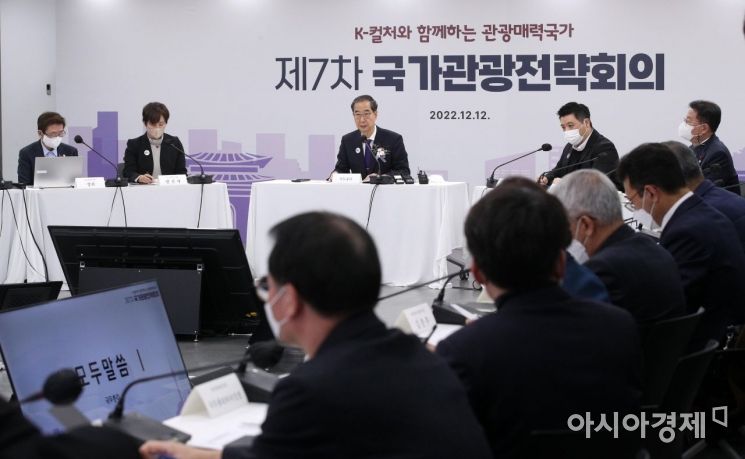 Prime Minister Han Duck-soo is presiding over the 7th National Tourism Strategy Meeting held on the 12th at High Ground in Jung-gu, Seoul. Photo by Kim Hyun-min kimhyun81@
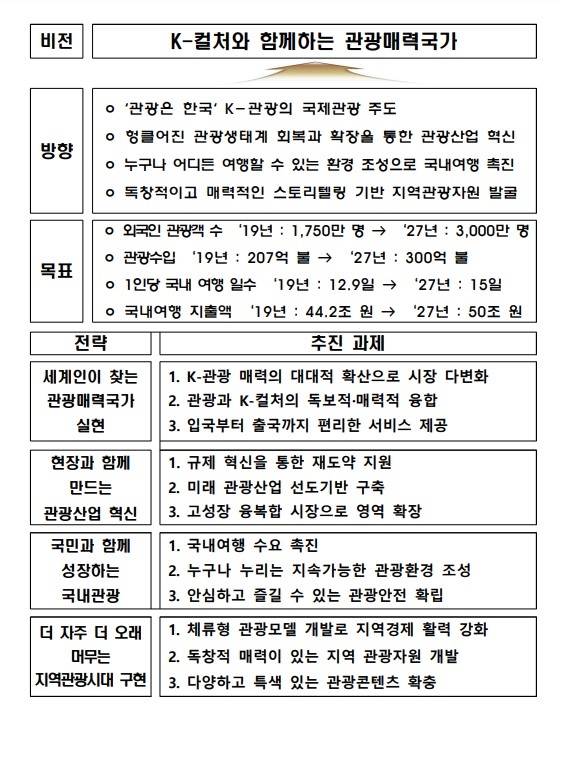
[Asia Economy Reporter Kim Heeyoon] The government is launching support measures through K-Culture and regulatory reforms to revive the tourism industry, which has been stagnant due to COVID-19. Leveraging K-Culture, which is at the center of a global craze, the government aims to restore the inbound tourism market by attracting 30 million foreign tourists and generating $30 billion in tourism revenue by 2027.
On the 12th, the government held the 7th National Tourism Strategy Meeting chaired by Prime Minister Han Duck-soo at ‘Hiker Ground’ located in Cheonggyecheon, Seoul, where it deliberated and approved the ‘6th Basic Plan for Tourism Promotion (2023?2027)’ including these measures.
The basic plan focuses on the convergence of the tourism industry with K-Culture and regulatory easing. To this end, a new visa system will be introduced and employment regulations for foreign workers will be relaxed.
The government declared ‘2023-2024 Visit Korea Year’ to secure international tourism demand in the post-endemic era. In 2023, the goal is to increase foreign tourists to 10 million, and in 2024, to fully recover to pre-COVID-19 pandemic levels. By 2027, the plan is to achieve 30 million inbound tourists and $30 billion in tourism revenue.
Under the slogan ‘K-Culture’s homeland, Korea,’ ‘K-Tourism Roadshows’ will be held in 50 cities worldwide including New York and Tokyo. Special campaigns to fully resume Korean tourism will target Japan and Taiwan, the second and third largest markets, while efforts to attract loyal Hallyu fans in Southeast Asia will be expanded. For Europe and the Americas, participatory events and customized products themed around ‘K-Music’ and ‘K-Food’ will be developed to diversify the market.
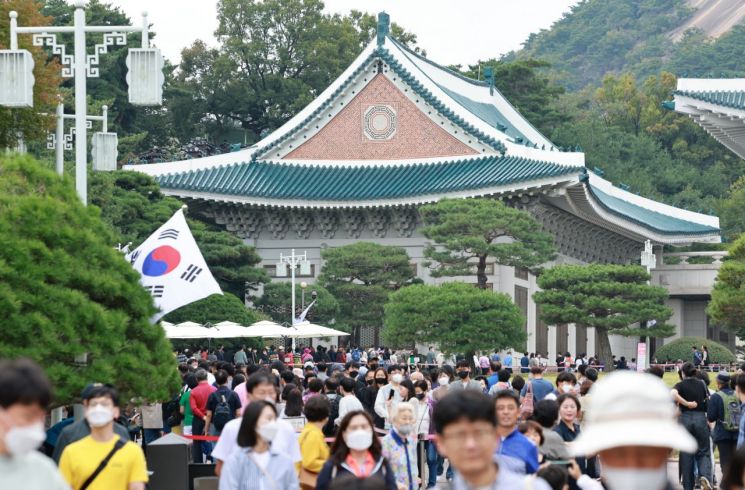
Convergence of K-Culture and Tourism, Blue House as a Korean Tourism Landmark
The government will promote the convergence of K-Culture and tourism and develop premium content such as meetings with masters and celebrities, and Korean cuisine experiences.
Based on the recognition of Korean professional golfers, specialized tourism products linked to golfers, tournaments, and academies (such as one-point lessons, joint tee shots, tournament viewing and experiences) will be newly expanded and developed. The establishment of a private jet terminal at Incheon Airport will also be pursued to build a foundation for luxury tourism.
The Blue House, Gyeongbokgung Palace, Gwanghwamun, and the Bukchon and Seochon areas, which have become new landmarks of Korean tourism, will be connected through storytelling to create a historical and cultural tourism cluster.
Improvements in Tourism Entry and Exit Including Workation and K-Culture Training Visas
The government will enhance convenience throughout the travel process from entry to exit for tourists. The group e-visa for Southeast Asian countries, currently limited to corporate incentive tours and school trips, will be expanded to general groups to shorten issuance periods. Additionally, a visa-free entry exception will be newly introduced for Muan Airport targeting Vietnam, the Philippines, and Indonesia.
Through the ‘Workation Visa,’ global talents will be able to stay in Korea for up to 1?2 years while maintaining employment and work activities in their home countries. In response to the global Hallyu craze, a ‘K-Culture Training Visa’ will also be introduced to allow youth visiting Korea for K-content education to stay.
Furthermore, the number of immediate refund post-tax refund shops will increase from about 3,600 currently to 4,600 by 2027.
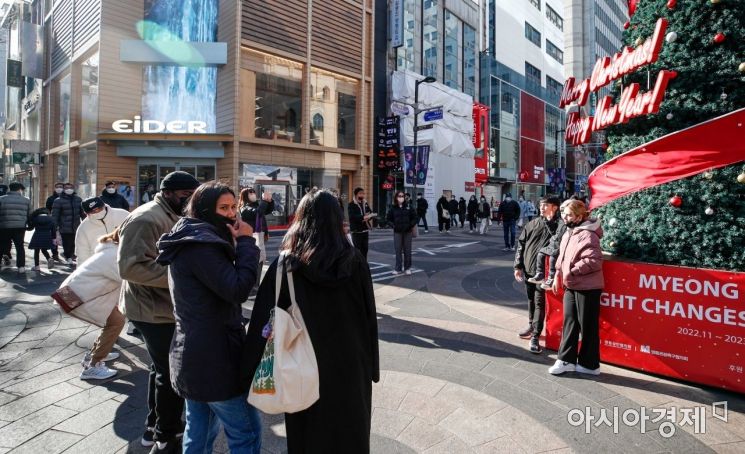 On the 11th, Myeongdong in Jung-gu, Seoul, was crowded with foreign tourists. According to the Korea Tourism Organization's statistics, the number of foreign visitors to Korea in October was 476,097, an increase of 415.2% compared to the previous year (92,416) and 41% compared to September (337,638). Photo by Jinhyung Kang aymsdream@
Reduction of Traffic Inducement Charges and Relaxation of Employment Regulations... Significant Expansion of Support
To revive the tourism industry, the government will adjust traffic inducement charges for the hotel industry and ease employment regulations for foreign workers to alleviate the severe labor shortage faced by the sector.
First, for foreign workers, the number of foreign hires per hotel under the professional employment visa (E-7) will be expanded from the current 2 to 5, and restrictions on part-time work hours for international students (D-2) will be relaxed (from the current 10?25 hours per week for bachelor’s degree students to 30 hours).
To establish a leading foundation for the future tourism industry, a 500 billion KRW tourism enterprise development fund will be formed by 2027 to invest in the growth of tourism companies. To promote digital transformation in the tourism sector, support for innovation activity vouchers will be expanded for small and medium tourism companies (from 147 companies in 2022 to a total of 1,000 companies by 2027), and customized support models considering the digital transformation level and technological characteristics by industry will also be established.
Development of High Value-Added Converged Tourism Industry and Expansion of Travel Benefits
To attract high value-added medical tourists, the government will ease the selection criteria for excellent medical tourism institutions and improve visa issuance convenience, while activating a non-face-to-face cooperative medical system for pre- and post-management of foreign patients.
To nurture the promising wellness tourism market, a ‘Wellness-Medical Tourism Convergence Cluster’ (6 sites selected in 2023) linking medical treatment with spas and diets will be established.
The government, local governments, and private companies will integrate travel-related benefits such as discounts on tourist sites and products, and introduce a ‘Travel Connection Card’ (in 2024) that accumulates mileage usable for domestic travel based on usage performance. This will provide tangible benefits directly felt by the public.
Expansion of Workation and Development of New Nature-Centered Tourism Resources
The spread of ‘travel-friendly work systems’ (workation), which can increase regional tourism demand, lengthen stays, and disperse travel periods, will also be supported. In particular, the development of stay-type tourism models such as living tourism (experiencing life like a local) and night tourism will revitalize local economies.
Efforts will also be made to develop islands with unique natural, ecological, and cultural tourism content into new tourism resources through multidimensional collaboration among related ministries. About 50 billion KRW will be invested over four years to expand accommodation facilities and improve village landscapes on five selected islands through a public contest, nurturing them as ‘K-Tourism Islands You Want to Visit.’
The number of international conference complex districts will increase from the current five to ten by 2027 to disperse foreign tourists concentrated in the metropolitan area to other regions. Additionally, special conference facilities linked to various tourism resources such as culture and leisure will be discovered to strengthen regional competitiveness in attracting international conferences.
Prime Minister Han Duck-soo said, “Through ‘2023-2024 Visit Korea Year,’ I hope our tourism industry overcomes the difficulties caused by COVID-19 and takes another leap forward,” adding, “Korea has richer tourism resources than ever before, combining its long-standing cultural heritage with Hallyu such as K-pop and films. I ask the public and private sectors to join forces to create a ‘Korea you want to visit’ and a ‘Korea you want to experience.’”
© The Asia Business Daily(www.asiae.co.kr). All rights reserved.
![Clutching a Stolen Dior Bag, Saying "I Hate Being Poor but Real"... The Grotesque Con of a "Human Knockoff" [Slate]](https://cwcontent.asiae.co.kr/asiaresize/183/2026021902243444107_1771435474.jpg)


















