Argentina Advances to Semifinals After Penalty Shootout Battle Against Netherlands
Heated Match Fueled by Mind Games and Physical Fights... 18 Yellow Cards Issued
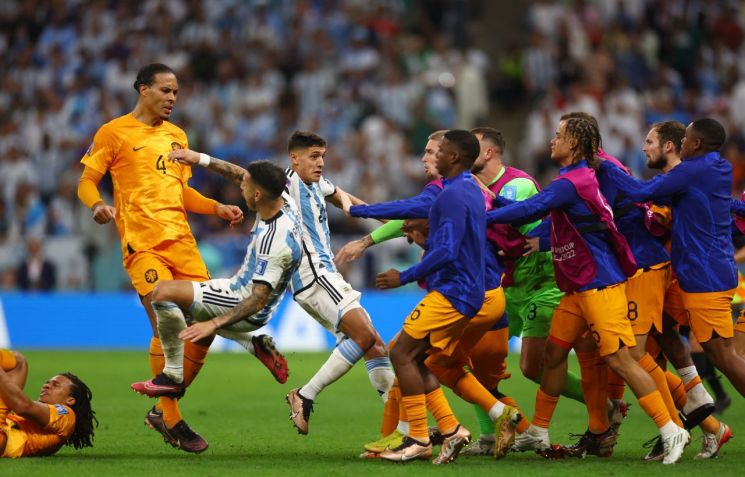 On the 10th at 4 a.m., a tense exchange occurred between Argentina and Netherlands players during the 2022 Qatar World Cup quarterfinal match held at Lusail Stadium in Qatar. Photo by Reuters
[Asia Economy Reporter Hwang Sumi] A total of 18 yellow cards, indicating warnings, were issued during the 2022 FIFA Qatar World Cup. This is the highest number of cautions ever recorded in a single World Cup match.
The record was set during the World Cup quarterfinal match between Argentina and the Netherlands, held at Qatar's Lusail Stadium at 4 a.m. Korean time on the 10th. In this match, Argentina and the Netherlands were tied 2-2 through extra time, with Argentina winning 4-3 in the penalty shootout. Argentina's advancement to the semifinals is their first in eight years since the 2014 Brazil World Cup.
The content of the match has drawn as much attention as the result. Referee Antonio Mateu Lahoz (Spain) issued a staggering 18 yellow cards during the game, which lasted over 120 minutes.
First, five yellow cards were given in the first half alone. Referee Lahoz issued warnings not only to players on the field but also to Walter Samuel, Argentina's coach, who protested from the bench, and Dutch forward Wout Weghorst.
The number of cautions increased even more in the second half. The closely contested match led to several tense confrontations between the two teams. In the middle of the second half, a heated exchange occurred centered around Dutch forward Luuk de Jong and Argentina goalkeeper Emiliano Mart?nez amid intense clashes in midfield.
At the 44th minute of the second half, a physical altercation broke out. At that time, Dutch player Nathan Ak? was brought down by a tackle from Argentine midfielder Leandro Paredes while dribbling the ball. The referee called a foul, and the Dutch bench was unsettled by the rough tackle.
At this moment, Paredes kicked the ball forcefully toward the Dutch bench. Kicking the ball toward the opposing bench is considered a highly provocative act. Dutch players on the bench immediately rushed out, and a fight ensued. During this incident, Dutch captain Virgil van Dijk even knocked Paredes down.
The clashes between the two teams continued even after the second half ended. Tensions persisted during extra time and the penalty shootout, resulting in three more yellow cards.
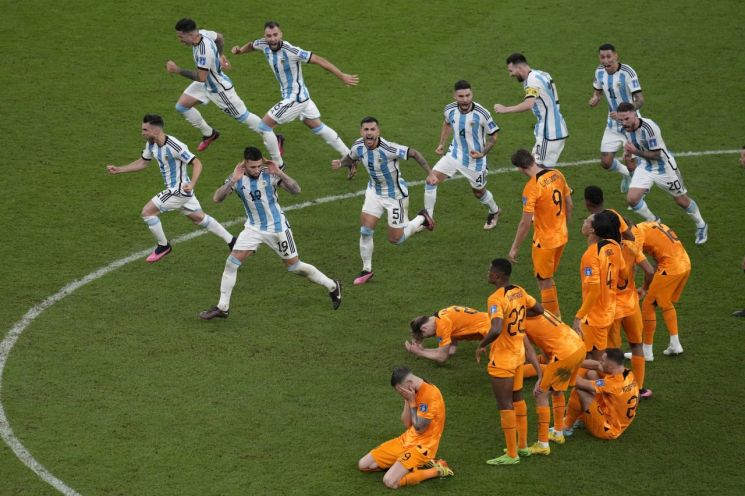 At 4 a.m. KST on the 10th, Argentina defeated the Netherlands in the quarterfinals of the 2022 Qatar World Cup held at Lusail Stadium in Qatar, advancing to the semifinals. Photo by AP Yonhap News
A total of 18 yellow cards were issued in this single match. On Argentina's side, nine players including captain Lionel Messi received cautions, while seven players from the Netherlands, including Virgil van Dijk, were booked. Excluding the two yellow cards given to Argentina's coach Lionel Scaloni and coach Samuel on the bench, players alone received 16 cards.
According to the British BBC, this is the match with the most yellow cards ever issued in World Cup history. Counting all yellow cards issued even after the match, the total of 18 is the highest overall, and according to FIFA's official statistics, it is a tied record.
The previous record was set during the 2006 Germany World Cup round of 16 match between the Netherlands and Portugal. That match ended in a brawl with 16 yellow cards issued, four of which were followed by red cards. In the 2002 Korea-Japan tournament group stage match between Germany and Cameroon, both teams received eight cautions each.
Immediately after the match, Messi expressed dissatisfaction with the referee's decisions. In an interview with local Argentine media, he said, "I won't go into detail about the referee because I could be punished," but added, "After 120 minutes of a draw, I felt a lot of anger." He also criticized, "Referees who do not meet the required standards should not be assigned to important matches," and urged, "FIFA must take action."
© The Asia Business Daily(www.asiae.co.kr). All rights reserved.


















