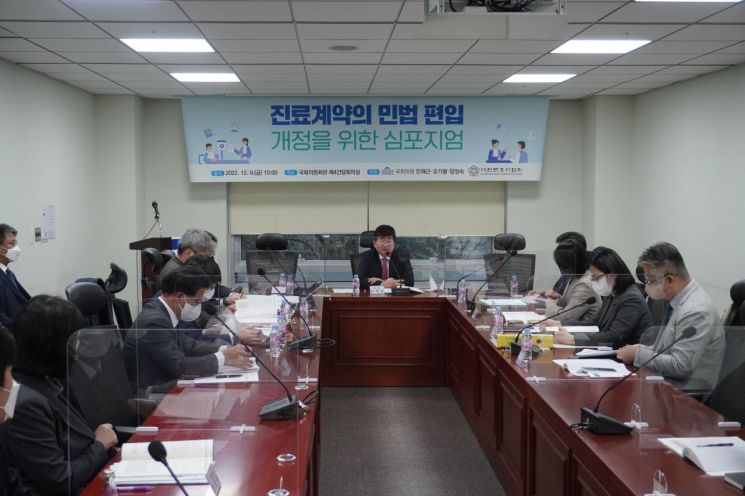
 On the 9th, the 'Symposium for the Amendment of Incorporating Medical Treatment Contracts into Civil Law' was held at the 4th Conference Room of the National Assembly Members' Office Building in Yeouido, Seoul. Photo by the organizer
[Asia Economy Reporter Choi Seok-jin, Legal Affairs Specialist] A symposium was held on the 9th to discuss the legislative amendment to incorporate medical treatment (healthcare) contracts into the typical contracts under the Civil Act.
The Korean Bar Association (President Lee Jong-yeop) held the "Symposium for the Amendment to Incorporate Medical Treatment Contracts into the Civil Act" on the morning of the same day at the 4th Conference Room of the National Assembly Members' Office Building in Yeouido, Seoul.
This symposium was co-hosted by three members of the National Assembly: Democratic Party members In Jae-geun and Oh Ki-hyung, and independent member Yang Jeong-sook, together with the Bar Association.
In his opening remarks, Representative Oh said, "Medical contracts are one of the types of contracts commonly concluded in the process of receiving medical services," adding, "According to the '2021 Health Insurance Statistical Yearbook' published by the Health Insurance Review and Assessment Service and the National Health Insurance Service on November 9 last year, there were approximately 1.26 billion claims for nursing care benefits in 2021 alone."
He continued, "There is a certain legal doctrine formed regarding medical malpractice lawsuits based on various court rulings," emphasizing, "If these doctrines can be organized and provisions related to medical contracts can be incorporated into the Civil Act as typical contracts, it is expected to significantly contribute to the convenience of citizens' daily lives."
Representative Yang stated, "The issue of incorporating medical treatment contracts into typical contracts under the Civil Act was deeply discussed over ten years ago but has not yet been reflected in legislation," and noted, "Germany has regulated medical treatment contracts as typical contracts under the Civil Act since 2013."
He added, "If medical treatment contracts gain a contractual legal basis, procedural transparency will be secured, and the parties to the medical contract will be provided with legal stability," emphasizing, "Patients and medical professionals are not adversaries but partners with a common goal to resolve issues of life, death, and the suffering caused by illness. I hope that related legislation will be improved to provide clear standards for all parties involved in medical disputes."
Representative Yang also said, "This symposium is a place where the legal community, academia, and government ministries deeply contemplate the nature of medical contracts and issues of proof," and pledged, "I will carefully review the valuable opinions discussed today and make legislative efforts to ultimately achieve the goal of legal amendments that benefit the public."
President Lee of the Bar Association pointed out, "Medical contracts frequently occur in our daily lives and are closely related to life and health, so many disputes arise in this field," adding, "However, in reality, data is concentrated on the medical providers' side, and many patients complain about the difficulty of proving negligence and causation."
He said, "In response to these issues, the Supreme Court has established legal doctrines that ease the burden of proof on the patient side or recognize partial shifts in the burden of proof, but there have been criticisms that the legal status of the parties to medical contracts is not sufficiently protected due to differing judgments by judges," and continued, "There was an attempt to amend the Civil Act to incorporate medical contracts as typical contracts to clarify the basis for the burden of proof easing doctrine accumulated through precedents, but unfortunately, the amendment failed, and related discussions have not been seen since."
President Lee added, "The Korean Bar Association formed a task force (TF) in June to continue the halted discussions on incorporating medical contracts into the Civil Act and has been conducting research to prepare related amendment bills. Today’s symposium was organized to propose the Civil Act amendment bill that has been studied so far," expressing hope that "this will be an opportunity to thoroughly review the proposed amendment from various perspectives and seek ways to more strongly protect the parties to medical contracts while ensuring legal stability."
Following the opening remarks, Park Ho-gyun, a lawyer and chair of the Bar Association’s Medical Contract TF, gave a keynote presentation titled "The Necessity of Incorporating Medical Contracts into the Civil Act and Directions for Amendment."
Lawyer Park pointed out, "Except in special cases, obligations under medical contracts are not result obligations aimed at achieving 'complete cure of disease' but are means obligations requiring the best possible medical care for curing the disease. Therefore, it is necessary to prove not only non-performance according to the content of the obligation but also incomplete performance. Whether incomplete performance of medical obligations exists depends on whether there was a breach of duty of care, i.e., negligence. Consequently, as in tort liability, the patient bears the burden of proof regarding the 'abstract requirement' of 'negligence' in contractual liability."
He explained, "Thus, in medical lawsuits, whether tort liability or contractual liability, the main legal requirements are usually negligence and causation for the occurrence of a bad result due to negligence. In particular, the existence of medical civil liability depends on the presence or absence of negligence. Due to the abstract nature of the concept of negligence, whether negligence is recognized largely depends on the discretion of individual judges," adding, "This is a major cause of undermining legal stability in the field of medical liability."
Lawyer Park stated, "One way to bridge this gap is through typification of precedents, but although medical lawsuits in Korea began to become active around the 1990s and have continued for over 30 years, it is difficult to say that legal stability has been secured in the medical accident field through typified precedent groups."
He further noted, "In medical accidents, fact-finding and duty of care investigations are conducted through medical expert opinions, but often the experts responsible for medical opinions provide biased opinions favoring doctors or medical institutions, and it is common for opinions on legal requirements such as negligence to be openly presented," pointing out, "Non-expert individual judges sometimes dismiss patients' claims based on these medical expert opinions, which is problematic."
Lawyer Park emphasized, "Introducing medical contracts as typical contracts under the Civil Act to at least clearly define important duties of care for medical providers and ease the patient's burden of proof will significantly improve the burden of proof issues arising from the abstractness of legal requirements and grant legal recognition."
On this day, the Bar Association’s Medical Human Rights Subcommittee’s Medical Contract TF proposed a draft amendment to the Civil Act. The TF prepared the amendment bill by referring to accumulated Supreme Court precedents and German Civil Code provisions.
The Bar Association stated, "When incorporating medical contracts into the Civil Act, basic provisions should include the definition of medical contracts, obligations of medical providers such as duty to provide information, prior consent, and duty to explain, as well as provisions presuming negligence and causation. Furthermore, although there may be overlaps with the Medical Service Act, obligations such as medical record creation and preservation, and confidentiality should also be incorporated into the medical contract provisions. Like Germany, it is necessary to consider introducing provisions that include a function to guarantee proof of certain facts related to medical record creation and preservation."
The proposed amendment to the Civil Act by the Bar Association includes adding Chapter 11-2 "Medical Contracts" after Chapter 11 "Mandate" in Chapter 2 "Contracts," which regulates various types of typical contracts.
Specifically, new articles such as Article 692-2 (Definition of Medical Contract), Article 692-3 (Duty to Provide Information), Article 692-4 (Consent), Article 692-5 (Duty to Explain), Article 692-6 (Medical Records), and Article 692-7 (Obligation to Compensate Damages) are to be established. Additionally, Article 738 (Application Provisions), which currently applies Articles 683 to 685 on mandate mutatis mutandis to management of affairs, will be amended to state, "Articles 683 to 685 and Articles 692-2 to 692-7 shall apply mutatis mutandis to management of affairs."
After the keynote presentation, Shin Hyun-ho, a lawyer at Haul Law Firm and chair of the Bar Association’s Medical Human Rights Subcommittee, served as the moderator for the open discussion.
Discussants included Professor Park Soo-gon of Kyung Hee University Law School, Professor Kim Ki-young of Kyung Hee University Graduate School of Public Administration, Professor Baek Kyung-hee of Inha University Law School, Lawyer Lee Jeong-min of Hippocrates Law Firm, Lawyer Nam Min-ji of Lee Won Law Office, Chief Judge Park Young-ho of Suwon District Court (Judicial Medical Law Research Association), and Professor Song Ki-min of Hanyang University (Citizens' Coalition for Economic Justice).
© The Asia Business Daily(www.asiae.co.kr). All rights reserved.
!["The Woman Who Threw Herself into the Water Clutching a Stolen Dior Bag"...A Grotesque Success Story That Shakes the Korean Psyche [Slate]](https://cwcontent.asiae.co.kr/asiaresize/183/2026021902243444107_1771435474.jpg)
















