Medical Staff: "Women Mainly Suffer Gunshot Wounds to Chest and Thighs"
Gunshot Wounds to Men and Children Also Common... "Lifelong Aftereffects Expected"
Guardian: "Asked Iran Foreign Ministry for Comment but No Response"
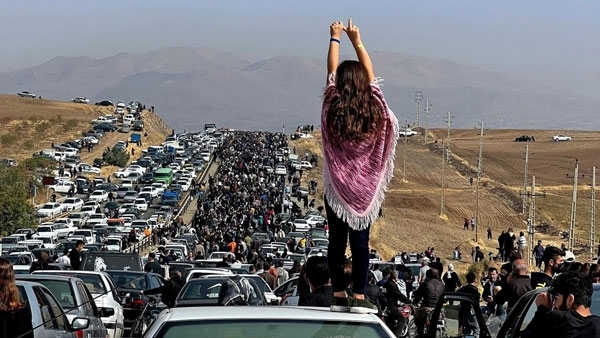
[Asia Economy Culture Young Intern Reporter] There are testimonies that Iranian security forces are deliberately shooting women participating in anti-government protests in the face, chest, and genitals.
The British daily The Guardian reported this on the 8th (local time) after interviewing 10 medical personnel treating the injured who were avoiding arrest by authorities. According to the report, the medical staff said, "Unlike men who are shot in the legs, buttocks, or back, women were shot in the chest and genitals," and revealed images of people grievously injured by security forces firing shotguns at protesters.
A doctor from central Isfahan said, "The security forces wanted to destroy the beauty of women, so they shot women differently from men." A woman in her 20s treated by this doctor revealed, "About 10 military police surrounded me and shot my genitals and inner thighs. Two of the bullets are in my genitals, making removal difficult."
The medical personnel pointed out that the military police are ignoring the practice of shooting at feet or legs to avoid vital organs during riot control and expressed concern, saying, "Many women are ashamed to go to the hospital and are receiving treatment at home," which is very dangerous.
Currently, Iranian authorities are blocking the internet to conceal the reality of the bloody crackdown and claim that the West is manipulating and inciting protests to destabilize society. Medical personnel said that not only women but also men and children often suffer eye injuries from gunshots, and young Iranians participating in the protests may suffer lifelong aftereffects.
A surgical specialist in Tehran shared an experience of treating a 25-year-old injured person who was shot in the face while passing by the protest site on September 16. He explained, "Fragments were embedded in his eyes, head, and face," and "Both eyes are almost blind, able only to detect light and brightness."
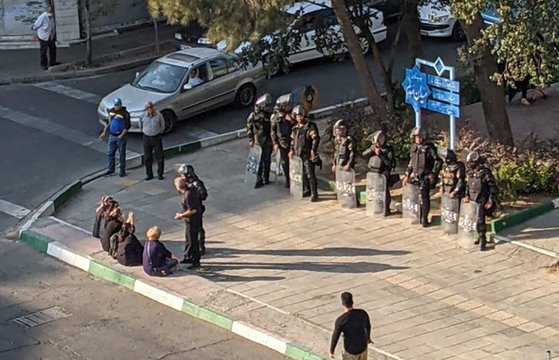 A photo known for showing Iranian women sitting opposite the security forces in a square in Tehran last October without wearing hijabs. Photo by AFP Yonhap News
As the situation worsened, more than 400 Iranian ophthalmologists recently signed a letter warning about the blindness caused by security forces' gunfire at protesters and sent it to the Secretary-General of the Iranian Ophthalmological Society. As eye injuries increased, Iranian authorities strengthened hospital surveillance. A doctor at a hospital in Shiraz, Fars Province, said, "At the end of last month, a new security guard was stationed outside the ophthalmology emergency room, controlling who came in and out and checking IDs every time."
Meanwhile, in Iran, university student Mahsa Amini was arrested by police for not wearing her hijab properly in September and died under suspicious circumstances, sparking anti-government protests that have continued for three months. The UN High Commissioner for Human Rights announced at the end of last month that at least 300 people, including more than 40 children, have died due to these protests.
The Guardian predicted, "The UN Human Rights Council decided to form an investigative team to look into human rights violations during the protest crackdown, but the team is unlikely to receive entry permission from Iranian authorities." It also added that it asked the Iranian Ministry of Foreign Affairs for a response to the medical personnel's statements but received no reply.
© The Asia Business Daily(www.asiae.co.kr). All rights reserved.
![Clutching a Stolen Dior Bag, Saying "I Hate Being Poor but Real"... The Grotesque Con of a "Human Knockoff" [Slate]](https://cwcontent.asiae.co.kr/asiaresize/183/2026021902243444107_1771435474.jpg)

















