Agreement Reached to Raise Basic Deduction Amount for Comprehensive Real Estate Tax per Individual from 600 Million to 900 Million Won
[Asia Economy Sejong=Reporter Kwon Haeyoung] The two-year postponement of the financial investment income tax (Geumtu Tax) scheduled to be implemented next year and the corporate tax cut have been blocked by the opposition Democratic Party. Regarding the easing of the comprehensive real estate tax, the ruling and opposition parties have narrowed their differences.
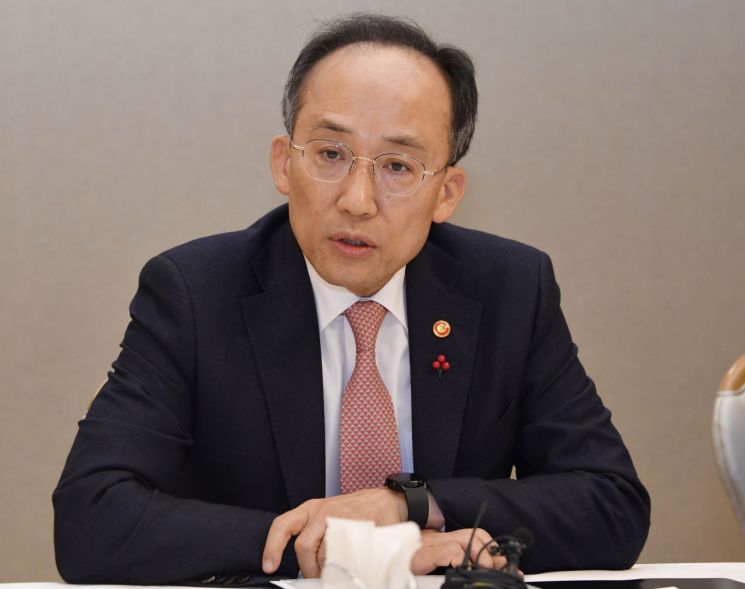
On the 9th, Deputy Prime Minister and Minister of Economy and Finance Choo Kyung-ho held an emergency press briefing at the Government Seoul Office regarding the 2023 budget bill and stated, "We said we could make significant concessions on adjusting the major shareholder target during the postponement period of the Geumtu Tax, but the opposition party holds a very firm stance."
Earlier, the government submitted a tax law amendment bill to the National Assembly that postpones the introduction of the Geumtu Tax for two years until 2025 and raises the major shareholder requirement for stock capital gains tax from the current 1 billion KRW per stock to 10 billion KRW. Initially, the Geumtu Tax, which requires investors who earn more than 50 million KRW in profits from listed stocks to pay taxes, was scheduled to be introduced from next year.
However, the opposition party has opposed it as a "tax cut for the rich" as their party stance. Subsequently, the government retreated from its original position and proposed adjusting the major shareholder standard between 1 billion and 10 billion KRW, but the Democratic Party still maintained its opposition.
Deputy Prime Minister Choo explained, "The Democratic Party expressed great reluctance to move the standard from the current 1 billion KRW," adding, "The opposition party has not yet made a decision on this matter and insists on maintaining the 1 billion KRW standard."
Regarding the securities transaction tax rate, he said, "We are discussing it much more flexibly compared to the high-value investor standard," and added, "We are narrowing the differences in views considerably and are approaching some level of agreement."
This is based on the view that considering next year's fiscal situation, lowering the transaction tax rate to 0.15% would be difficult. Previously, the Democratic Party had argued that to postpone the Geumtu Tax, the major shareholder standard during the postponement period should be maintained at the current 1 billion KRW, and the securities transaction tax should be lowered to 0.15% from next year.
The ruling and opposition parties are still at an impasse regarding corporate tax as well. Although National Assembly Speaker Kim Jin-pyo proposed a two-year postponement plan (cutting the top tax rate to 22% and postponing for two years), the opposition party has not agreed.
Deputy Prime Minister Choo urged the passage of the corporate tax amendment bill, saying, "The perception that corporate tax cuts are tax cuts for the rich, dividing companies into rich or not rich, is fundamentally wrong. I ask the new government to help revive the economy even a little and evaluate the merits and demerits a few years later."
On the other hand, the ruling and opposition parties have narrowed their differences regarding the comprehensive real estate tax, which the Democratic Party has also opposed as a tax cut for the rich.
Deputy Prime Minister Choo said, "The ruling and opposition parties have tentatively agreed on imposing a heavy comprehensive real estate tax on multi-homeowners who own three or more high-priced houses," adding, "We will also consider as a concession compromise plan to apply a heavier tax system than for a single homeowner only for three homes priced at 1.2 billion KRW or more."
Regarding the basic deduction, which is the exemption threshold for the comprehensive real estate tax, it was agreed to raise it from 1.1 billion KRW to 1.2 billion KRW for single homeowners. For individual single homeowners excluding one household one home and for those owning two or more homes, the basic deduction amount was agreed to be raised from 600 million KRW to 900 million KRW. The limit on tax burden was also narrowed to reduce from 300% to 150% for multi-homeowners.
© The Asia Business Daily(www.asiae.co.kr). All rights reserved.

















