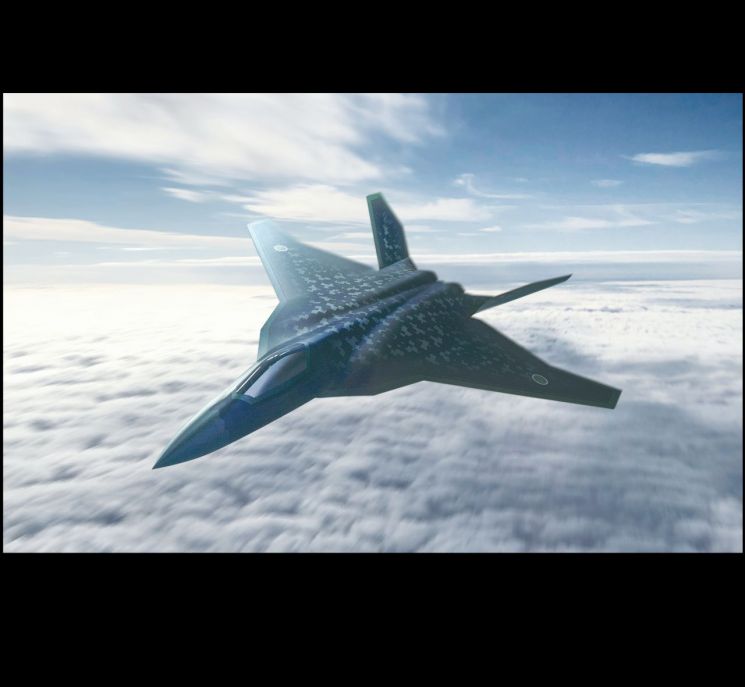
[Asia Economy Reporter Lee Ji-eun] Japan has officially announced that it will collaborate with the United Kingdom and Italy to develop the next-generation fighter jet for its Air Self-Defense Force. This marks the first time since World War II that Japan has cooperated with countries other than the United States on a military development project.
According to the Nihon Keizai Shimbun (Nikkei) on the 9th, the governments of Japan, the UK, and Italy issued a joint statement through their leaders, announcing the launch of the Global Combat Air Program (GCAP) to jointly develop the next-generation fighter jet by 2035. The development costs, expected to reach hundreds of billions of dollars, will be shared among the three countries.
If the development proceeds as planned and the next-generation fighter jet is completed by 2035, Japan is reported to plan to deploy 100 units as the successor model to the Air Self-Defense Force’s existing F2 fighter jets.
The development will be led by Japan’s Mitsubishi Heavy Industries and the UK’s BAE Systems, with Italy’s aerospace and defense company Leonardo also participating. Sweden’s Saab is also mentioned as a potential participant.
The Japanese government plans to acquire independent defense technology by collaborating with European countries other than the United States on fighter jet development. Major foreign media, citing anonymous sources, explained that "the Japanese government decided on this course because it believes it cannot rely solely on the US for the development of the latest weapons and national defense," and that "Japan’s joint development effort is partly focused on securing advanced foreign technologies."
The US government is also reported to support the plan. The Japanese Ministry of Defense emphasized in a separate statement that "the US supports the three-country joint development plan."
However, some view that since interoperability of the fighter jets must be enhanced to conduct joint operations with the US, there is a high possibility that the US government will intervene in the plan later. Major foreign media stated, "While the US will not oppose strengthening Japan’s defense capabilities to expand its influence in the Indo-Pacific region, if the UK shares sensitive technology with Japan, there is a possibility of US intervention."
© The Asia Business Daily(www.asiae.co.kr). All rights reserved.

















