Demand Deposit Accounts Decreased by 136 Trillion Won Since June
Money Move to Fixed Deposits Continues Amid High Interest Rates
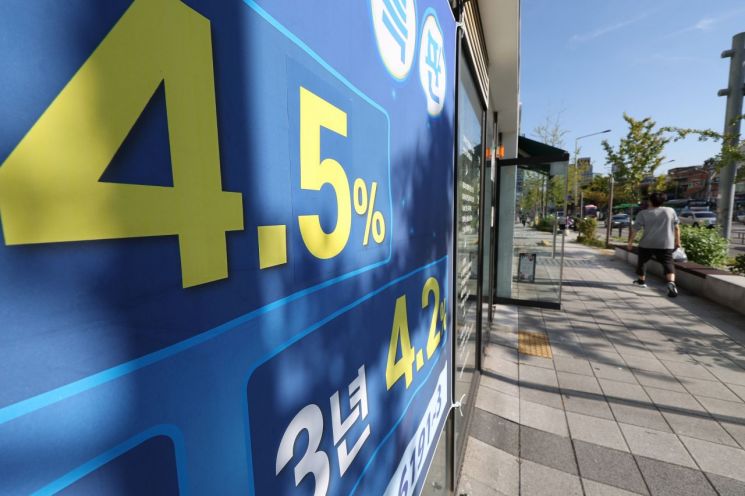
[Asia Economy Reporter Minwoo Lee] In the high-interest rate environment, low-cost deposits in the banking sector are rapidly declining. Approximately 20 trillion won flowed out in just one month, widening the gap between the proportion of low-cost deposits and time deposits.
According to the Bank of Korea on the 10th, total deposits at deposit banks last month amounted to 2,258.6 trillion won, an increase of 6.5 trillion won compared to the previous month. This is attributed to the rapid increase in demand for time deposits as the high-interest rate era began. On a year-on-year growth rate basis, deposits have exceeded loans for 17 consecutive months.
In particular, bank time deposits increased by 27.7 trillion won in just this month. This was the result of efforts to attract funds and the inflow of household and corporate funds due to rising deposit interest rates. On the other hand, low-cost deposits such as demand deposits have continued to decline at a record pace. They decreased by 19.6 trillion won compared to the previous month. After five consecutive months of decline, they have dropped by about 136 trillion won compared to the end of June. As a result, the proportion of low-cost deposits fell to 39%, down 8 percentage points from the end of last year. The proportion of time deposits was 42%.
The outstanding loan balance at deposit banks was 2,238 trillion won, an increase of about 9.5 trillion won compared to the previous month. Corporate loans increased by more than 10 trillion won, which was the main factor. Household loans decreased by 1 trillion won, continuing the downward trend throughout the year. In particular, general loans including credit loans fell by about 2 trillion won compared to the previous month, marking 12 consecutive months of decline.
Mortgage loans increased by 1 trillion won compared to the previous month, but the year-on-year growth rate was 2.4%, the lowest level since September 2013. Jeonse (key money deposit) loans decreased by 1 trillion won compared to the previous month. This is the first time since the Bank of Korea began compiling related statistics in January 2016 that Jeonse loans have turned to a decline. Hwang Young-woong, Deputy Head of the Market General Team at the Bank of Korea’s Financial Market Department, said, "This is due to a decrease in demand for related funds caused by a slowdown in Jeonse transactions," adding, "We will monitor whether Jeonse demand will revive ahead of the new school term."
Kim Do-ha, a researcher at Hanwha Investment & Securities, explained, "The current phase is a critical time when managing funding costs and soundness is important to respond to rapid portfolio structural changes."
© The Asia Business Daily(www.asiae.co.kr). All rights reserved.

















