Strengthening Local Autonomy: '2022 Public-Private Cooperation Workshop' Held
Council and 9 Committees Communicate... Discussing Activation Measures
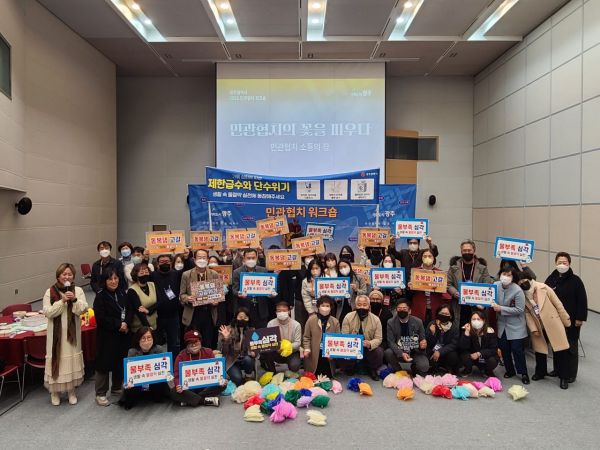
[Asia Economy Honam Reporting Headquarters Reporter Yoon Jamin] Gwangju Metropolitan City (Mayor Kang Ki-jung) announced on the 9th that it held the ‘2022 Gwangju City Public-Private Cooperation Workshop’ on the 8th at the Kim Dae-jung Convention Center to establish a foundation for strengthening autonomous capabilities through diverse participation and consultation with citizens and the local community.
The Gwangju City Public-Private Cooperation Council is composed and operated with 48 council members and 204 members across 9 subcommittees in accordance with the ‘Basic Ordinance on the Activation of Public-Private Cooperation in Gwangju Metropolitan City.’
The committee jointly cooperates between the private sector and Gwangju City to decide, implement, and evaluate policies for regional development and solving social issues.
This year, the council held 2 meetings, the steering committee held 3 meetings, and the subcommittees held 67 meetings. To prevent public conflicts in the region, 37 agenda items were proposed, achieving results by preparing reasonable measures through public-private cooperation.
This event was the first integrated workshop since the launch of the Public-Private Cooperation Council, attended by about 100 people including City Council member Ahn Pyunghwan, a member of the council, Park Mikyung, chairperson of the Gwangju Civic Group Council and chair of the public-private cooperation steering committee, Son Oksu, director of Gwangju Welfare Policy Division, and Hong Donseok, secretary for citizen participation of Gwangju City.
In particular, they reviewed the path walked together by the public, private, and political sectors, evaluated the operation of public-private cooperation in 2022, and discussed plans to revitalize public-private cooperation in 2023.
Additionally, the Public-Private Cooperation Council and subcommittees shared activities related to the ‘Citywide Water Conservation Practice Campaign Participation’ in response to the Dongbok Dam depletion crisis, which was approved at the previous council meeting, and decided to continue promotional activities.
Some members pointed out as a regret that the understanding of public-private cooperation varied, and the process mostly remained in the form where proposals were made mainly by the private sector and the administration decided on approval or disapproval.
Also, Ryu Hanho, former director of the Gwangju NGO Citizens Foundation and co-chairman, reported on the progress of the ‘Citizen Opinion Collection Plan for the Utilization of Jeonnam Ilsin Textile Site’ proposed and promoted by the administration through the Public-Private Cooperation Council.
Previously, the Public-Private Cooperation Council proposed to the administration that when forming a negotiation and mediation council for the utilization of the Jeonnam Ilsin Textile site, one external expert be recommended by the Public-Private Cooperation Council and that the business proposals submitted by the project operator be shared with citizens.
Meanwhile, Gwangju City plans to strengthen the effectiveness of the public-private cooperation committee by expanding and reorganizing the subcommittees in 2023, increasing expert and citizen participation, and establishing an internal administrative collaboration foundation.
© The Asia Business Daily(www.asiae.co.kr). All rights reserved.
![User Who Sold Erroneously Deposited Bitcoins to Repay Debt and Fund Entertainment... What Did the Supreme Court Decide in 2021? [Legal Issue Check]](https://cwcontent.asiae.co.kr/asiaresize/183/2026020910431234020_1770601391.png)