Concerns Over Chain Defaults of Developing and Poorest Countries Trapped in the Belt and Road Initiative
[Asia Economy Reporter Yujin Cho] According to a report by Bloomberg on the 8th (local time), heads of international economic organizations such as the International Monetary Fund (IMF) and the World Bank are expected to visit China, the largest creditor of developing and least developed countries, to pressure for debt restructuring.
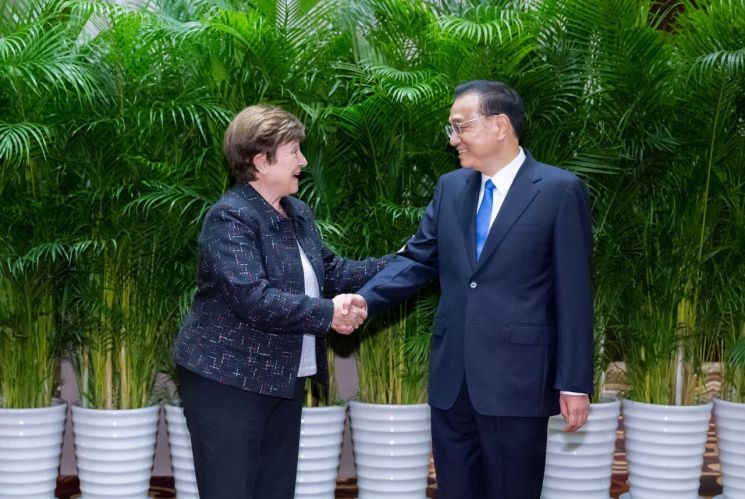
According to the report, IMF Managing Director Kristalina Georgieva and World Bank President David Malpass visited China on the same day and held talks with Premier Li Keqiang. They came to China to attend the so-called '1+6' roundtable meeting of the heads of six economic-related international organizations. This is their first visit to China since the COVID-19 pandemic.
During the meeting with Premier Li, the leaders discussed the excessive debt levels faced by developing countries. President Malpass requested China's cooperation to help developing countries and their banks, stating that the burden of interest repayments reduces spending on priority sectors such as health, education, infrastructure, and climate response.
Before visiting China, Managing Director Georgieva indicated at a press event that "(developing and least developed countries) are facing very serious and widespread debt problems," and expressed hope that China, as the largest creditor, would find better solutions, signaling that she would request China's cooperation in debt restructuring.
Premier Li promised to cooperate in creating policy measures with the Group of Twenty (G20) to restructure the debt of developing countries struggling with repayments. However, he did not specify what kind of policy coordination would follow regarding the debt issue.
The IMF and the World Bank have consistently warned about the global debt problem as monetary authorities worldwide raise interest rates to combat inflation. There are growing concerns that developing and least developed countries face a risk of cascading defaults as their external debts, including those owed to China, have grown to unsustainable levels.
Most developing and least developed countries struggling with debt repayments are key target countries of China's Belt and Road Initiative (一帶一路, land and maritime Silk Road).
Countries in Southeast Asia, Central Asia, and Africa have attracted massive Chinese capital while carrying out the Belt and Road projects, which involve building large-scale infrastructure such as roads, railways, and sea routes. Their debts have ballooned to unsustainable levels, and combined with the COVID-19 crisis and severe inflation, they have fallen into financial distress.
According to the World Bank, Chinese debt accounts for 40% of the total external debt held by least developed countries. Most of these countries already have debt levels exceeding their gross domestic product (GDP).
The countries with the highest debt ratios to China are Djibouti and Angola, where debt to China significantly exceeds 40% of their GDP. Sri Lanka, suffering from excessive debt due to the Chinese Belt and Road Initiative, declared default in April and officially entered a default status in May.
Despite being the world's largest creditor related to developing countries, China has been criticized for its lack of participation in international cooperation to alleviate developing countries' debt problems.
U.S. Treasury Secretary Janet Yellen has repeatedly stated that China is the biggest obstacle to progress on developing countries' debt issues. Speaking to reporters on the same day, Secretary Yellen said, "I appealed to China on the need for debt relief," adding, "There are no concrete plans to visit China immediately, but it could become a major agenda item in future talks."
© The Asia Business Daily(www.asiae.co.kr). All rights reserved.

















