'14-Year-Long Wish' Supply Price Linkage Law Passed
SME Sector Recognizes Ministry of SMEs and Startups' Contribution
Law Includes Key Raw Materials and Adjustment Requirements
Up to 50 Million KRW Fine for Evasion Violations
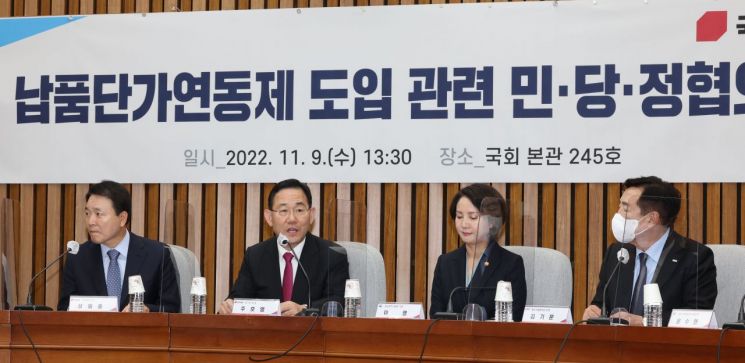
[Asia Economy Reporter Kim Bo-kyung] The delivery price linkage system, which small and medium-sized enterprises (SMEs) have been demanding for 14 years, will be fully implemented starting in the second half of next year. Once the delivery price linkage system is enforced, companies will pre-agree to adjust delivery prices according to the rise in raw material costs between companies, and if an actual price increase occurs, the agreed terms must be mandatorily fulfilled.
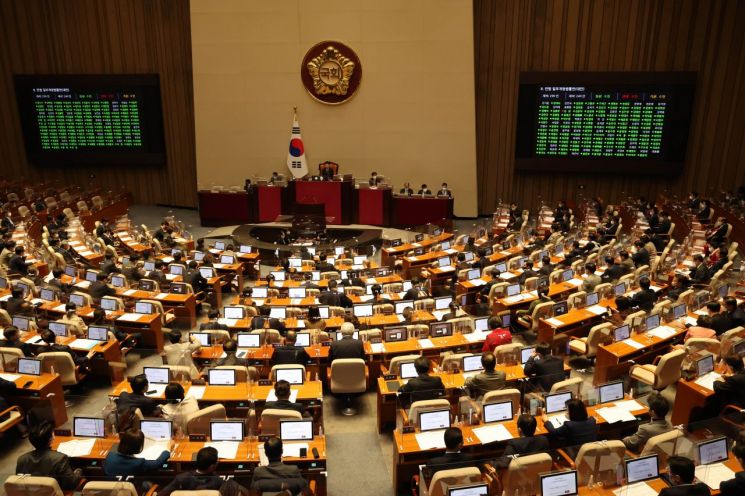
On the 8th, the National Assembly plenary session passed the amendment to the "Act on Promotion of Mutual Cooperation between Large and Small and Medium Enterprises (Mutual Cooperation Act)" which includes the delivery price linkage system. Until now, SMEs (consignees) trading with large companies (consignors) had to bear losses without being able to raise delivery payments even when raw material prices soared. Especially earlier this year, the sharp rise in raw material prices such as iron ore, crude oil, and pulp intensified the management difficulties of SMEs that process raw materials and supply them to large companies. Both ruling and opposition parties showed strong will to introduce the delivery price linkage system, resolving a long-standing issue for the SME sector.
The amendment passed by the National Assembly will be sent to the government, go through the Cabinet meeting, and then be promulgated. The promulgation is expected by the end of this month or early next month. Nine months after the promulgation date, obligations regarding delivery price linkage negotiation, recording of linkage details, and prohibition of illegal acts will be enforced. In other words, from around October next year, when large companies enter into or renew manufacturing consignment contracts with SMEs, they must reflect the increase in raw material prices in the delivery payments.
Minister Lee Young of the Ministry of SMEs and Startups posted on his Facebook on the day, "After 14 years of knocking, the door has opened. Personally, I am moved," and added, "We will establish a culture of fair and mutually beneficial transactions in Korea." SME entrepreneurs sent messages of encouragement and congratulations on the minister’s post. Kim Kyung-man, a member of the Democratic Party and former head of the Korea Federation of SMEs, praised, "The minister will be remembered for a long time as the one who passed the delivery price linkage system with strong passion for the SME sector." Choo Moon-gap, head of the Economic Policy Department at the Korea Federation of SMEs, lauded, "This marks a major milestone in SME history." Seok Yong-chan, president of the MainBiz Association, said, "I hope this becomes a new milestone for fairness and mutual growth between large and small companies."
Below is a Q&A on the main contents of the delivery price linkage system.
- What are the main raw materials linked to the delivery price, and what are the adjustment conditions?
▲ The main raw materials subject to linkage are those that account for 10% or more of the delivery payment. When the price of these raw materials fluctuates beyond a rate agreed upon between large and small companies within ±10%, the delivery payment must be adjusted. For example, if aluminum accounts for 50 won of a 200 won product, aluminum qualifies as a "main raw material" subject to delivery price adjustment. If companies set a 10% adjustment condition, an increase in aluminum price up to 53 won does not require linkage to the delivery payment. However, once it reaches 55 won, the large company must pay the SME 5 won more. If the price falls to 45 won, the delivery payment must also be adjusted accordingly. The amendment requires that details about main raw materials and adjustment conditions be recorded in the agreement and issued to the consignee.
- How have companies piloting the delivery price linkage system set the main raw materials and adjustment conditions?
▲ Since September, the Ministry of SMEs and Startups has been piloting the delivery price linkage system. Analyzing 334 delivery payment linkage agreements signed by 44 consignor companies and 317 consignee companies, about 54.2% (181 cases) designated one main raw material subject to linkage. Two raw materials accounted for 24.6% (82 cases), and three or more accounted for 21.3% (71 cases). The most common main raw materials were steel types such as iron scrap, rolled steel, and galvanized steel at 49.9%. Next were non-ferrous metals like copper and aluminum at 31.1%, followed by petrochemical raw materials such as synthetic rubber at 10.9%.
Regarding adjustment conditions, about half (48.6%) of the companies piloting the system set the adjustment threshold at 0%, meaning delivery payments are adjusted even if the raw material price changes by just 1 won. Including adjustment conditions up to 3%, the total rises to 64.1%. The law’s setting of the adjustment condition within 10% reflects some concession to the consignor companies. A Ministry official explained, "Consignees also expressed concerns about administrative burdens if adjustments occur too frequently."
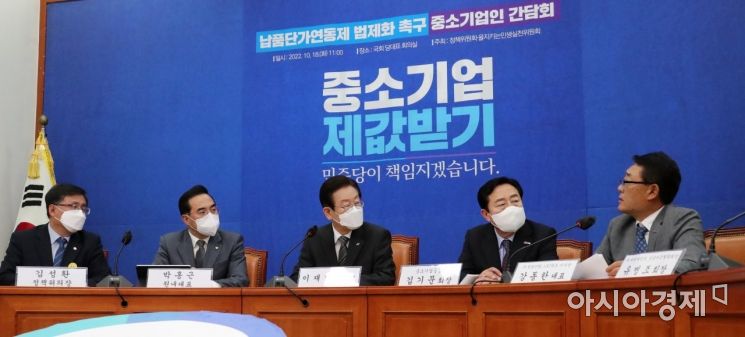 Lee Jae-myung, leader of the Democratic Party of Korea, is attending the 'Meeting with Small and Medium Business Owners Urging the Legislation of the Delivery Price Linkage System' and listening attentively to the remarks of business owners. Photo by Yoon Dong-joo doso7@
- How is the adjustment cycle for delivery price set?
▲ According to the Ministry of SMEs and Startups, the adjustment cycle is not regulated by law but is expected to be determined through agreements between companies. Among companies piloting the system, 39.6% (265 cases) set the adjustment cycle to "quarterly," which was the most common. However, this has a drawback. For example, if aluminum price starts at 50 won in January, spikes to 100 won in February, and falls back to 50 won in March, the delivery payment adjustment for the February increase is not possible because the adjustment is based on the start and end of the quarter.
Among the pilot companies, 29.7% (199 cases) set the adjustment cycle to "monthly." Some (1%, 7 cases) set it as long as "annually." Cases set as "as needed" (4.2%, 28 cases) adjust delivery payments whenever raw material prices fluctuate, during consignment sales where the consignor sells raw materials to the consignee, or at each delivery.
- What are the exceptions to the delivery price linkage system? What happens if a consignor uses its trading position to avoid applying the system?
▲ Exceptions to the delivery price linkage system include: when the consignor is a microenterprise, contracts under 100 million won, short-term contracts within 90 days, and cases where the consignor and consignee agree not to link delivery payments. If they agree not to link, the purpose and reasons must be explicitly stated in the agreement. The amendment prohibits consignors from abusing their trading position or using false or fraudulent methods to avoid applying the linkage system. Companies violating this will be fined up to 50 million won.
© The Asia Business Daily(www.asiae.co.kr). All rights reserved.



















