As expectations grow that the U.S. Federal Reserve (Fed) will slow the pace of interest rate hikes, foreign investment in domestic securities has seen net inflows for the second consecutive month.
According to the 'International Finance and Foreign Exchange Market Trends' report released by the Bank of Korea on the 9th, foreign investment in securities (stocks and bonds) recorded a net inflow of $2.74 billion last month. Applying the won-dollar exchange rate of 1,318.8 won as of the end of November, this amounts to approximately 3.6135 trillion won.
In September, foreign investment funds recorded a net outflow of $2.29 billion, but in October, there was a net inflow of $2.77 billion, and this trend continued through November.
By type of securities, foreign stock investment funds showed a net inflow of $2.1 billion. After a net outflow of $1.65 billion in September, there were net inflows for two consecutive months in October ($2.49 billion) and November.
Foreign bond investment funds recorded a net inflow of $630 million last month. After turning to a net inflow of $280 million in October for the first time in three months, the amount increased further.
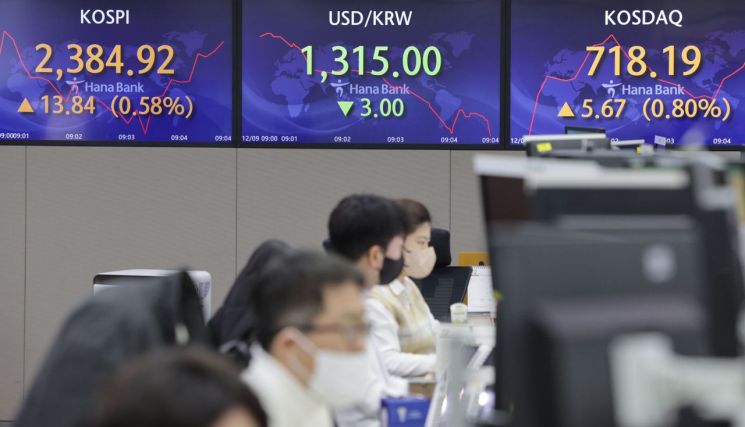 Dealers are working in the dealing room at the Hana Bank headquarters in Myeongdong, Seoul.
 [Photo by Yonhap News]
A Bank of Korea official explained the trend in foreign stock funds, saying, "The net inflow continued due to expectations of the U.S. Fed slowing the pace of rate hikes, China's easing of zero-COVID policies, and domestic and international major companies' earnings exceeding expectations."
The credit default swap (CDS) premium for Korean government bonds (based on the 5-year foreign exchange stabilization fund bonds) averaged 57 basis points (1bp = 0.01 percentage points) in November. This is higher than August (37bp) and September (40bp), but slightly lower than October (61bp).
Last month, the short-term and medium- to long-term borrowing spreads of domestic banks (based on eight banks including Kookmin, Shinhan, Woori, Hana, Nonghyup, Industrial, Export-Import, and IBK) rose compared to October. The short-term borrowing spread over LIBOR was 19bp in November, up 9bp from 10bp in October. The medium- to long-term borrowing spread increased from 66bp to 97bp.
The won-dollar swap rate, which indicates foreign currency liquidity conditions, was -0.98% as of the 7th of this month, up 13bp from -1.11% at the end of October.
© The Asia Business Daily(www.asiae.co.kr). All rights reserved.

















