Announcement Within the Year After Detailed Timing Discussion
Expansion of Winter Vaccination for Ages 12 to 17
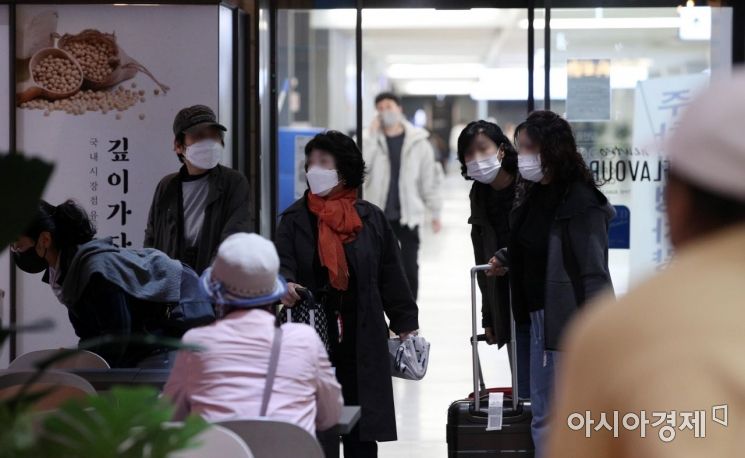
[Asia Economy Reporter Kim Young-won] The government has decided to shift the indoor mask-wearing mandate to a recommendation, while maintaining the mandate in essential facilities frequently used by high-risk groups, and has begun detailed discussions. Starting from the 12th, the bivalent vaccine vaccination for adolescents aged 12 to 17 will commence.
On the 9th, the Central Disaster and Safety Countermeasures Headquarters announced that they discussed the winter additional vaccination promotion performance and extension of the intensive vaccination period, the winter adolescent COVID-19 bivalent vaccine vaccination plan, and the adjustment direction of the indoor mask-wearing mandate.
Indoor Mask Mandate → Recommendation Direction... Announcement Within the Year
The Central Disaster and Safety Countermeasures Headquarters decided to transition the indoor mask-wearing mandate to a recommendation and voluntary wearing, while maintaining the mandate in essential facilities heavily used by high-risk groups.
The specific essential facilities will be determined through expert discussions. Kwon Byung-ki, head of the Central Disease Control Headquarters’ Prevention Support Team, said, "Looking at cases in major overseas countries, we are closely observing mandatory mask-wearing in medical facilities, social welfare facilities, and some cases such as public transportation."
Decisions will be made considering COVID-19 outbreak trends and quarantine capacity, and opinions will be gathered at an expert public forum scheduled for the 15th to specify the timing and measures for adjustment. The finalized roadmap for mandate adjustment will be announced after discussions at the Central Disaster and Safety Countermeasures Headquarters by the end of this month.
Kwon explained, "The main criteria for judgment include when the COVID-19 patient occurrence trend stabilizes after the winter peak, when the severe and death trends peak and begin to decline, and when the quarantine capacity is at a manageable level. We discussed that it is better to consider these comprehensively rather than setting individual criteria for each indicator."
Winter Vaccination Expanded to Adolescents... Extension of Intensive Vaccination Period
The winter additional vaccination target group has been expanded from those aged 18 and over to adolescents aged 12 to 17. Among this age group, those who have completed the second dose are eligible, and the authorities actively recommend vaccination for high-risk groups such as immunocompromised individuals and those with underlying conditions.
For winter vaccination of adolescents, Pfizer’s BA.1 and BA.4/5 bivalent vaccines authorized for those aged 12 and over will be used. For those who do not wish to receive mRNA vaccines, vaccination with the Novavax vaccine is possible. Pre-booking and same-day vaccination will be available from the 12th, and reservation vaccinations will begin on the 19th.
This decision considered that major countries such as the United States are also vaccinating adolescents with bivalent vaccines. The U.S. vaccinates those aged 5 and over, while the European Union (EU), the United Kingdom, Canada, and Japan vaccinate adolescents aged 12 and over with bivalent vaccines.
The winter intensive vaccination period, which the government has been operating since the 21st of last month, has been extended until the end of this year. Although it was scheduled to end on the 18th, it was decided to extend it considering the increase in COVID-19 confirmed cases. The goal of achieving a 50% vaccination rate among those aged 60 and over during the intensive vaccination period remains.
Lim Eul-gi, head of the COVID-19 Vaccination Response Promotion Team’s Vaccination Management Division, said, "In the past week, the proportion of severe and death cases among those aged 60 and over was 89% and 96%, respectively, accounting for the majority. The estimated reinfection rates among those aged 60 and over and in nursing hospitals and nursing facilities were 25% and 41%, respectively, significantly exceeding the average of 13%. High-risk groups must receive the bivalent vaccine to prevent reinfection."
© The Asia Business Daily(www.asiae.co.kr). All rights reserved.

















