Xi Jinping: "Saudi Arabia is an Important Force in the Multipolar System"
Strengthening Substantial Economic Cooperation While Also Wedge Against the US
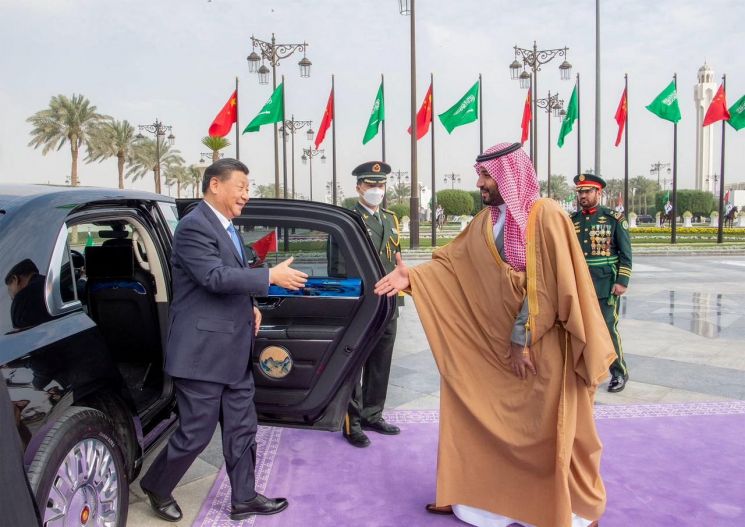
[Asia Economy Beijing=Special Correspondent Kim Hyunjung] The leaders of China and Saudi Arabia have agreed to meet regularly every two years, establishing an unprecedented friendly relationship. China, advocating a 'multipolar system,' has closely aligned with Saudi Arabia, a representative pro-American country in the Middle East, achieving practical economic cooperation in energy and trade sectors while simultaneously countering the United States.
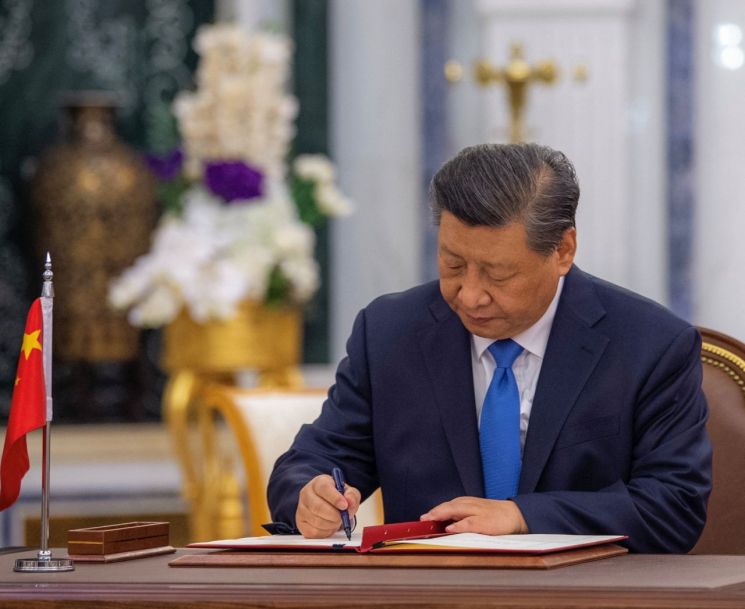
According to local media including China's state-run Xinhua News Agency on the 9th, Chinese President Xi Jinping and Saudi King Salman bin Abdulaziz Al Saud met at the Saudi royal palace the previous day to sign a comprehensive strategic partnership agreement and agreed that the two countries' leaders will hold regular talks every two years. President Xi's visit to Saudi Arabia thus marks not just a one-time event but the starting point of a sustained cooperative relationship.
◆ Investment agreements in 34 sectors including energy, logistics, and healthcare= During the talks, China and Saudi Arabia signed 34 investment contracts in fields such as green energy, transportation, logistics, healthcare industry, and construction. Additionally, the two countries agreed to expand human and cultural exchanges, according to Chinese local media. The state-run Global Times (GT) cited sources reporting that contracts aligning Saudi Arabia's 'Vision 2030' with China's Belt and Road Initiative would also be signed.
At the meeting, President Xi said, "I am pleased that the consensus reached between the two countries has been transformed into tangible cooperative achievements," emphasizing, "China regards Saudi Arabia as an important force in the multipolar system and attaches great importance to developing a comprehensive strategic partnership with Saudi Arabia." He added, "We are willing to continue strengthening communication, deepen cooperation in various fields, serve development interests, and safeguard world peace and stability." King Salman also responded, saying, "We have formed a consensus that China's interests are also Saudi Arabia's interests," and expressed a desire to benefit the friendly peoples of both countries through sustainable development.
During this visit, President Xi also received an honorary doctorate from King Saud University, Saudi Arabia's first university. The award ceremony was held at the Riyadh royal palace, attended by Crown Prince Mohammed bin Salman, who is known to have graduated from King Saud University's law department.
On the same day, President Xi expanded his diplomatic outreach to the Arab world by meeting consecutively with Egyptian President Abdel Fattah el-Sisi, Palestinian Authority President Mahmoud Abbas, Abdel Fattah al-Burhan, Chairman of Sudan's Sovereignty Council, and Kuwaiti Crown Prince Mishal Al-Ahmad Al-Jaber Al-Sabah.
Abdulaziz Al-Sager, Director General of the Gulf Cooperation Council, told The Times, "The relationship between China and Saudi Arabia is a good model that can be extended to other countries in the Middle East," emphasizing, "We will not interfere in issues between the United States and China, nor take the side of the United States." Regarding the agreements between the two countries, he also stressed, "The Belt and Road Initiative and Vision 2030 have many complementarities," and "They will open opportunities to forge stronger ties."
◆ China’s extensive coverage... "Arab countries prefer China over the US"= Within China, the outcomes of this meeting were widely reported, and a separate survey highlighted that Arab countries have greater expectations for China's role in the region than for the United States. The Times published the results of a survey conducted from last month’s 8th to 25th, targeting 5,100 respondents aged 18 to 70 from six Arab countries: Saudi Arabia, the United Arab Emirates (UAE), Qatar, Egypt, Jordan, and Algeria. The survey was jointly conducted by The Times and the Arabic Department of Beijing Foreign Studies University.
The Times reported, "76.7% of respondents from the Arab world believe that China's development will bring opportunities to the Arab world, while only 1% mentioned China's cultural, economic, and regional security influence as a threat," adding, "71% of respondents expressed expectations for deeper relations with China in the future." Regarding regional governance, the survey emphasized favorable sentiments toward China compared to the United States. When asked which country they want to play a role in regional issues, 46.9% chose China, while only 23.7% selected the United States, about half as many.
Optimistic prospects for increased mutual investment and trade from an industrial perspective also poured out within China. According to Xinhua News Agency, the scale of bilateral direct investment between China and Arab countries reached $27 billion (approximately 35.4564 trillion KRW) last year, a 2.6-fold increase compared to ten years ago. Total trade volume rose 1.5 times to $330.3 billion, and this year has already surpassed last year's annual trade volume, expanding to $319.3 billion.
© The Asia Business Daily(www.asiae.co.kr). All rights reserved.


















