Sudden Volatility Minutes Before Delisting... Investment or Gambling?
'Ultra-Short-Term Trading' Among Retail Investors... Extreme Fluctuations
Debate Over Whether It's Value Investing or Speculative Trading for Quick Profits
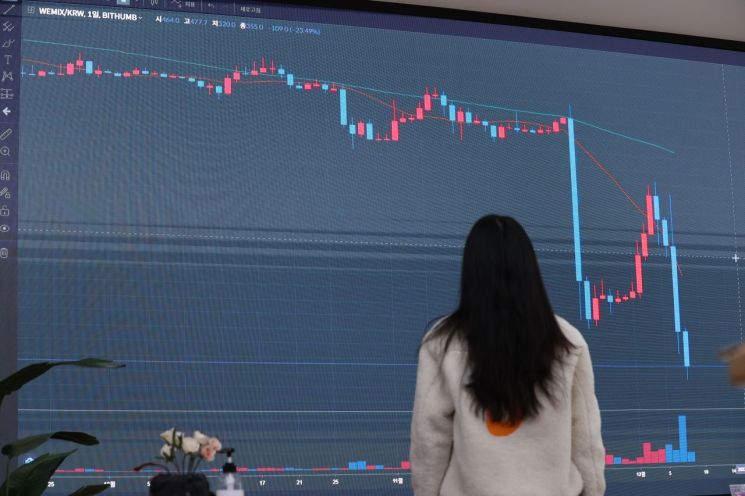 Wemade's cryptocurrency 'Wemix' ceased trading on major domestic virtual asset exchanges on the 8th. The photo shows the Wemix price displayed on the electronic board at the Bithumb Customer Center in Seocho-gu, Seoul on the same day. [Image source=Yonhap News]
[Asia Economy Reporter Han Seung-gon] "The heart of a beast, going in now." , "We're just waiting for a bigger fool to come in."
As WEMIX, a cryptocurrency (coin) facing delisting, experiences ultra-short-term trading, there is much debate among investors about whether this is sensible investing or gambling.
WEMIX ceased trading at 3 PM on the previous day (the 8th) across all four exchanges belonging to the Digital Asset Exchange Association (DAXA)?Upbit, Bithumb, Coinone, and Korbit. The price of WEMIX held steady around 1,140 KRW until 7:40 PM on the 7th, but immediately after news broke that Wemade's court petition to suspend the delisting decision was dismissed, the price plunged to 684 KRW at 7:50 PM.
After such a sharp drop, on the following day (the 8th), about 10 minutes before delisting (2:50 PM), the price suddenly showed repeated spikes and drops. On Bithumb, volatility of about 10% up and down occurred within less than 3 minutes. Among individual investors (retail investors), this was dubbed the "death ultra-short-term trade."
'Ultra-short-term trading' refers to the 'scalping' technique in stock or coin trading, where a trader buys a stock and sells it within minutes or even seconds to make a profit.
This is related to the "greater fool theory." This theory suggests that the price of a product or asset is formed not by its intrinsic value but by the irrational beliefs or expectations of market participants.
For example, in July 2020, the stock price of the American electric vehicle company Tesla surged about 130% over July and August, fueled by expectations that it would be included in the S&P 500 (one of the three major U.S. stock market indices, which groups the top 500 companies by market capitalization listed in the U.S.).
Investors accumulated Tesla shares despite overvaluation concerns, anticipating that inclusion in the S&P 500 would lead to inflows from passive funds tracking the index, which in turn drove the stock price up.
While such rapid price increases might seem beneficial to investors, in reality, they mostly lead to sharp declines. In this process, the "greater fool" emerges. For example, even if one is a "fool" who bought an asset at a high price (peak), if a "greater fool" appears who will buy at an even higher price, one can immediately sell the asset to realize capital gains. This is known among retail investors as "hot potato." In other words, a "WEMIX hot potato" situation occurred. During the Luna-Terra crisis in May, investors also continued buying after price crashes, hoping for a rebound. However, if no "greater fool" appears, investors could lose money. For this reason, stock-related communities sometimes call such investors "beasts with the heart of a beast."
The question is whether such situations can be considered normal investing. Some argue that it is essentially gambling. On the other hand, since stock or coin trading is ultimately for profit, some say there is no problem. The issue is that the methods are not sensible, but legally there is no problem.
A 30-something office worker and stock investor, Mr. Kim, who requested anonymity, said, "Ultra-short-term trading always happens with delisted stocks," adding, "This is not investing in the stock itself, but when many people rush in, the stock price inevitably rises, and if retail investors see this and come in, the price goes up further. At that moment, I sell the stock and exit?that is a legitimate trading technique."
On the other hand, another individual investor said, "Isn't this just fishing?" and added, "They're just waiting for new investors to come in. The biggest difference is that they don't analyze the company before investing."
Professor Sung Tae-yoon of Yonsei University's Department of Economics explained, "Investing in delisted stocks is still investing," and added, "We can easily see people investing in bankrupt or failed companies." He continued, "However, the investment risk is very high," and "Investors are aware of the risks and invest accordingly."
© The Asia Business Daily(www.asiae.co.kr). All rights reserved.


















