Resolution on the Delivery Price Linkage System
[Asia Economy Reporter Kwon Hyun-ji] Starting as early as June next year, the method of age notation in administrative and judicial fields will be unified to the "international age" system.
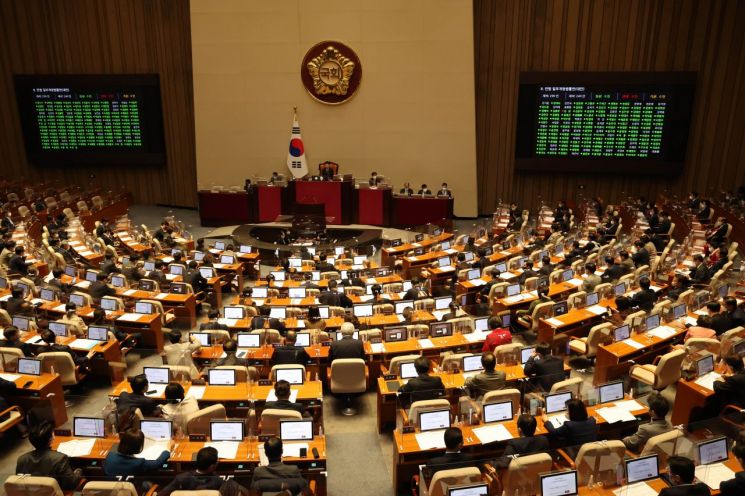
On the 8th, the National Assembly held a plenary session and passed partial amendments to the Civil Act and the Framework Act on Administration containing this content.
Currently, in daily life, the so-called "Korean age," which counts a person as one year old in the year of birth, is used, but most laws use the international standard "international age," and some laws related to military service use the "year age," calculated by subtracting the birth year from the current year, causing social confusion. The amendment aims to unify the age calculation and notation method to "international age" to resolve the side effects caused by mixed usage.
At the plenary session, a bill amending the Act on Promotion of Mutual Growth between Large and Small and Medium Enterprises, which introduces a delivery price linkage system, was also passed. According to the amendment, when raw material prices rise, the increase will be reflected in the delivery price without a separate adjustment request. The current law has a "delivery price adjustment consultation system" that allows subcontractors to request adjustment of delivery payments from the primary contractors when there is a change in raw material supply prices, but it has been pointed out that subcontractors find it difficult to request adjustments due to concerns about transaction suspension.
However, a proviso was included stating that the delivery price linkage system does not have to be introduced if agreed upon between contracting parties. If the primary contractor violates this, a fine of up to 50 million won will be imposed.
Additionally, a bill amending the Framework Act on Broadcasting and Communications Development to prevent the recurrence of the "Kakao blackout incident" caused by the SK C&C data center fire in October also passed the plenary session. According to the amendment, value-added telecommunications service providers such as Kakao must also establish a disaster management basic plan. This basic plan includes the distribution and diversification of servers, storage devices, networks, and power supply devices.
Other bills passed include ▲ the amendment to the Act on Aggravated Punishment of Specific Crimes to include excavator operators as subjects of aggravated punishment ▲ the amendment to the Waste Management Act stipulating the principle of treating household waste at the place of generation ▲ the amendment to the Act on Honorable Treatment and Support of Persons of Distinguished Service to the State to ensure equal treatment of children of national merit recipients ▲ the amendment to the Child Care Support Act to eliminate blind spots in care ▲ and the amendment to the Road Traffic Act specifying conditions for aggravated punishment of repeat drunk driving offenses.
The National Assembly passed a total of 107 agenda items, including 93 bills, on this day. Although 108 items were initially scheduled for the plenary session, the bill to increase the issuance limit of Korea Electric Power Corporation bonds (KEPCO bonds) up to six times was not passed.
© The Asia Business Daily(www.asiae.co.kr). All rights reserved.

















