Korea Institute for National Unification Analyzes North Korean Missile Launch Statistics
"80% Concentrated During Kim Jong-un's Rule"
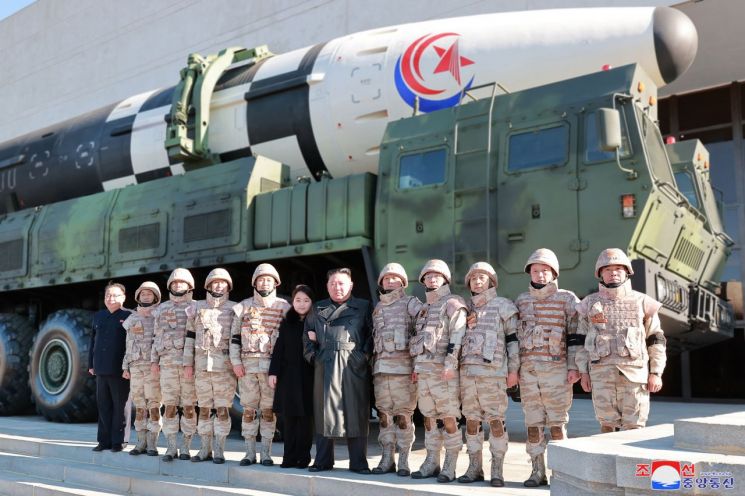
[Asia Economy Reporter Jang Hee-jun] Experts have analyzed that North Korea's missile activities have been the most active ever this year. In particular, since Kim Jong-un took power, the level of provocations, including military demonstrations, has gradually intensified.
On the 8th, Hong Min, head of the North Korea Research Division at the Korea Institute for National Unification, stated at a monthly seminar hosted by the institute on the topic "Analysis of North Korea's Nuclear and Missile Activities: Statistics, Patterns, and Strategy," "Nuclear and missile activities have become very frequent during Kim Jong-un's leadership."
According to the research, since official records began in 1984 until now, a total of 183 missile and nuclear test activities have been identified in North Korea.
The statistics include short-, medium-, and long-range ballistic missiles, submarine-launched ballistic missiles (SLBM), cruise missiles, and hypersonic missiles. Also included were the super-large multiple rocket launcher (KN-25) and new large-caliber guided multiple rocket launchers, which have ranges and destructive power comparable to short-range ballistic missiles (SRBM).
Counting multiple launches in a single event as one occurrence, missile and nuclear test activities by supreme leader were 8 times during Kim Il-sung's rule, 28 times under Kim Jong-il, and 147 times since Kim Jong-un took power. This means 80.3% of the total activities over 38 years were concentrated during Kim Jong-un's era.
Regarding this, Director Hong evaluated, "Nuclear and missile activities have become more frequent and the level has increased during Kim Jong-un's leadership," adding, "It is also distinguished from previous periods in terms of the diversity of missile types."
The year with the most activities was this year, recording 39 launches. As of the 8th, this averages to one missile launch every 8.8 days. Following this were 25 launches in 2016 and 18 in 2014.
So far, six nuclear tests have been conducted, with half of them (3) occurring in the autumn months of September and October.
Director Hong analyzed, "The Punggye-ri nuclear test site’s ground weakens when it rains, which can cause malfunctions in measuring equipment, inflow of rainwater, and release of radioactive contaminated water," adding, "Analysis of weather around Punggye-ri shows higher precipitation compared to other regions, making it climatically difficult to conduct nuclear tests in summer."
© The Asia Business Daily(www.asiae.co.kr). All rights reserved.

















