Park Hong-geun "Democratic Party's Unilateral Passage of Budget Cut Proposal"
Jung Jin-seok "Lee Jae-myung's Judicial Risk Holds Budget Hostage"
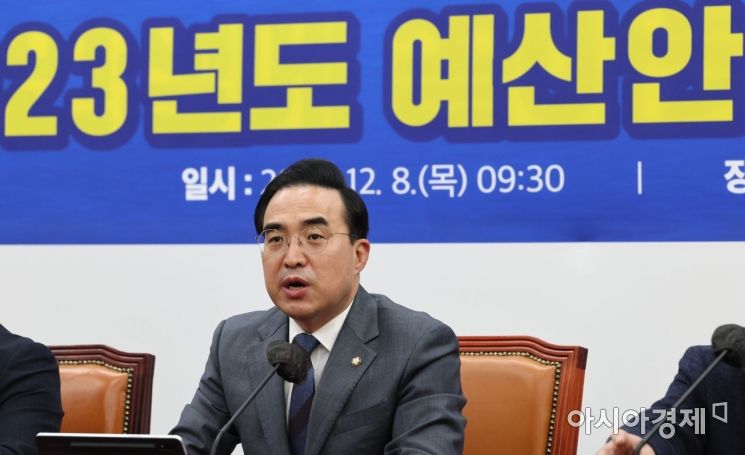 Park Hong-geun, floor leader of the Democratic Party of Korea, holds a '2023 Budget Proposal Press Conference' at the National Assembly on the 8th. Photo by Yoon Dong-joo doso7@
[Asia Economy reporters Naju Seok and Geum Bo-ryeong] The situation has become increasingly complicated. With next year's budget bill, the dismissal motion against Minister of the Interior and Safety Lee Sang-min, and the judicial risks surrounding Lee Jae-myung, leader of the Democratic Party of Korea, all overlapping, this year's budget negotiations are facing significant difficulties in unraveling the deadlock. As of the 8th, one day before the end of the regular session of the National Assembly, the ruling and opposition parties continued their standoff over the passage of next year's budget bill. The Democratic Party of Korea raised the pressure by threatening to submit a unilateral amendment focused on cuts, while the People Power Party launched an all-out offensive, accusing the ruling party of using the budget bill as leverage to deflect from Lee Jae-myung's judicial risks.
Park Hong-geun, floor leader of the Democratic Party, canceled the originally scheduled policy coordination meeting at the National Assembly that day and held an emergency press conference, warning, "If the government and ruling party ultimately reject our Democratic Party's 'final proposal' to 'withdraw the ultra-rich tax cuts and secure the maximum possible reduction to significantly increase the livelihood budget,' we will have no choice but to submit a 'unilateral amendment'."
Park said, "Negotiations continued late into last night, but due to the government's 'recklessness' and the ruling party's 'foot-dragging,' it is difficult to make any progress," adding, "Even in negotiations between the floor leaders and policy committee chairs of both parties, the government insists that the budget reflects unique revenue and expenditure characteristics different from previous years and almost refuses to acknowledge the National Assembly's constitutional right to reduce the budget."
Typically, the National Assembly secures budget funds through reduction reviews of the government's budget proposal and then increases the budget for projects deemed necessary by the Assembly. Since the right to review reductions lies with the National Assembly and the right to approve increases lies with the government, the budget is reviewed through a process requiring government consent for the funds secured via reductions. Park noted, "During the five years of the Moon Jae-in administration, when the base budget was smaller, the National Assembly reduced an average of 5.1 trillion won annually, excluding simple accounting transfers," and added, "Considering this common precedent, it is highly questionable whether the current government and ruling party are genuinely committed to passing the budget bill." Earlier, Joo Ho-young, floor leader of the People Power Party, explained at an emergency committee meeting, "This time, since the issuance of government bonds has been significantly reduced, there is no agreement because they say they cannot cut more than 3 trillion won."
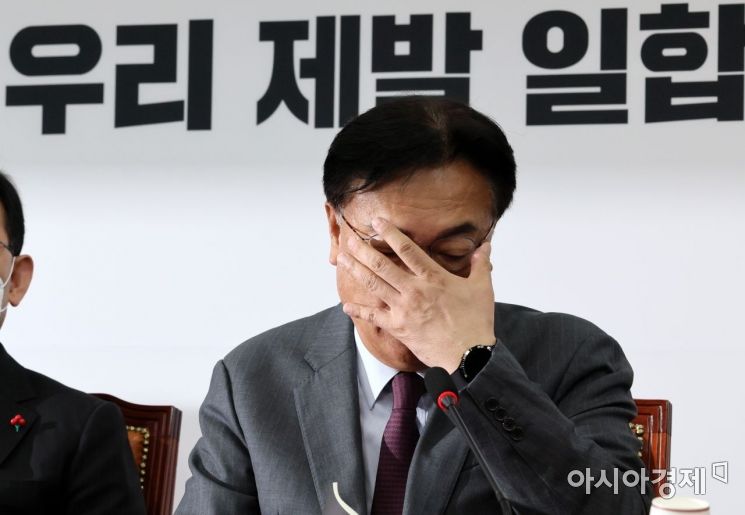 On the 8th, Jeong Jin-seok, the Emergency Response Committee Chairman of the People Power Party, is adjusting his glasses before speaking at the Emergency Response Committee meeting held at the National Assembly. Photo by Yoon Dong-joo doso7@
Regarding the timing of submitting a unilateral amendment if negotiations break down, he said, "After today's and tomorrow's party meetings, and tomorrow's supreme council and floor opinions are gathered, we may ultimately submit a unilateral amendment tomorrow morning." Since the current budget system requires government consent for increases, the Democratic Party has been preparing a unilateral amendment to cut the budget for problematic projects in the budget bill.
Regarding tax law, some consensus has been reached through negotiations between the ranking members of the Planning and Finance Committee, but since there remain significant differences on key issues, there is a possibility that it will not be passed within this session. The Democratic Party submitted a request for convening an extraordinary session to the National Assembly Secretariat the day before.
The People Power Party is protesting, saying, "They are holding the budget bill hostage for Lee Jae-myung's protective National Assembly." Chung Jin-seok, emergency committee chairman of the People Power Party, criticized at the emergency committee meeting held at the National Assembly that morning, "Economic agents are eagerly awaiting the National Assembly's passage of next year's budget bill today, but the budget bill is being used to deflect from Lee Jae-myung's business risks and to escalate political strife." Floor leader Joo Ho-young also blamed the Democratic Party at the meeting, saying, "Tomorrow is the deadline for the regular session, but the gap is still quite large, which is very worrisome."
© The Asia Business Daily(www.asiae.co.kr). All rights reserved.


















