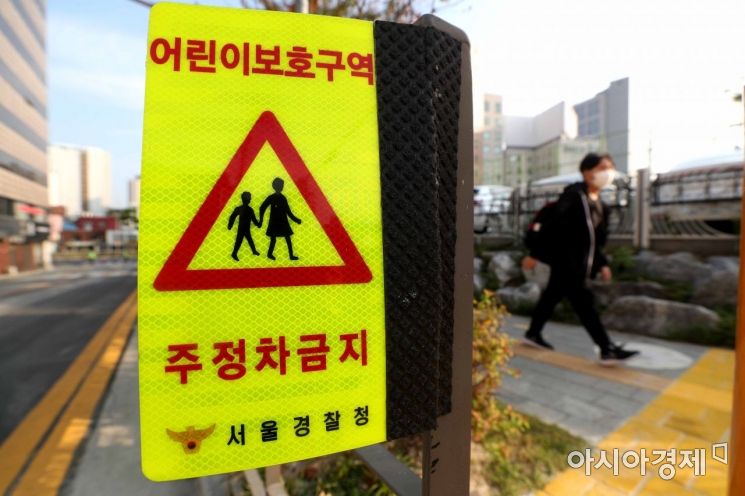
 On the first day of the revised Road Traffic Act, which includes no parking zones in child protection areas and mandates special traffic safety education for drivers who cause traffic accidents in these zones, students are going to school at an elementary school in Seoul on the 21st. Photo by Moon Honam munonam@
[Asia Economy reporters Seongpil Jo and Sehee Jang] On the 8th, it was confirmed that the decisive basis for the police not applying the 'hit-and-run' charge to a man in his 30s, Mr. A, who is accused of drunk driving in a 'Children Protection Zone (School Zone)' and fatally hitting a third-grade elementary school student, was a Supreme Court precedent. Based on this precedent, the police judged that Mr. A did not flee the scene after the accident and applied charges such as reckless driving causing death. However, some in the legal community argue that a broader investigation should be conducted on the premise of hit-and-run charges.
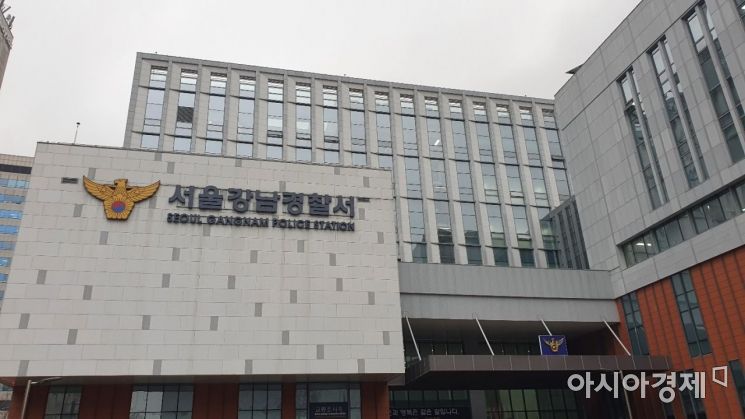
According to a summary of the investigation on the 8th, the Gangnam Police Station in Seoul applied charges after reviewing the Supreme Court precedent when requesting an arrest warrant for Mr. A. The precedent is a Supreme Court ruling from November 2002, which defined the meaning of 'flight' under Article 5-3, Paragraph 1 of the Act on the Aggravated Punishment of Specific Crimes (Aggravated Punishment for Drivers Who Flee the Scene). The police reportedly judged that Mr. A’s act of returning to the scene 43 seconds after the accident did not constitute fleeing, based on this ruling.
Reviewing the ruling, the Supreme Court defined fleeing under the relevant provision of the Special Act as "leaving the accident scene before carrying out rescue measures, causing a situation where the person who caused the accident cannot be identified." It also judged that rescue measures carried out by others, such as police or ambulance personnel, would not be problematic.
The police reportedly judged that applying hit-and-run charges was legally unreasonable, considering the ruling and the facts that Mr. A ▲ returned to the scene shortly after the accident ▲ rescue measures were taken at the scene when police and fire services arrived ▲ and he cooperated sincerely during the investigation.
According to CCTV footage and witness statements at the time of the accident, on the 2nd, near the back gate of Unbuk Elementary School in Cheongdam-dong, Mr. A, in a state of intoxication, hit 9-year-old third grader Mr. B while driving, then drove 21 meters to the entrance of his residence, parked, and returned to the scene within 43 seconds. Mr. A then asked the owner of a nearby flower shop to call 119 (emergency services). It was confirmed that the flower shop owner actually made the call. Considering the Supreme Court precedent, it was a situation where the perpetrator who caused the accident could be identified, and rescue measures were taken, making it difficult to regard it as fleeing.
However, the bereaved family of the victim opposes this, insisting that hit-and-run charges should be applied. Around 4 p.m. the previous day, Mr. B’s parents visited the Gangnam Police Station carrying about 4,000 petitions from local residents. In the legal community, there are also criticisms that the police applied charges too narrowly, inappropriate for an investigative agency. A lawyer, formerly a prosecutor, said, "As an investigative agency, it is proper to investigate on the premise of hit-and-run causing death. Since the suspect was not unconscious and left the scene without immediately providing rescue measures, hit-and-run charges could be applied, so the investigation should have been thorough on that basis."
The police, seemingly aware of such criticism, are reportedly reconsidering applying hit-and-run charges additionally. The police plan to send Mr. A to the prosecution as early as the 9th.
© The Asia Business Daily(www.asiae.co.kr). All rights reserved.


















