Start of Joint Operation Talks with the US
Strengthening Deterrence Amid Rising Security Crisis
Rebuilding Missile Defense System
1.5 Times Increase in Mid-term Defense Budget
Heightened Tensions with Neighboring Countries Including China
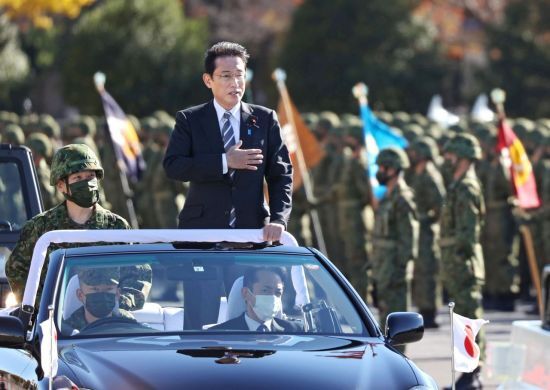
[Asia Economy Reporter Lee Ji-eun] The Japanese government has decided to possess a ‘counterstrike capability’ that enables preemptive strikes on enemy bases and plans to hold initial consultations with the United States on this matter, according to the Nihon Keizai (Nikkei) newspaper. To secure this counterstrike capability, the medium-term defense budget over the next five years will be expanded to 43 trillion yen (approximately 412 trillion won), 1.5 times the current amount. As Japan’s military power is expected to be significantly enhanced, military tensions with neighboring countries such as China are likely to intensify further.
On the 8th, Nikkei cited a senior Japanese government official saying, "The government will complete revisions to three major security documents, including the National Security Strategy, within this month and begin joint operational consultations with the U.S. military regarding the possession of counterstrike capabilities," adding, "Based on information collected by the U.S. military, the plan is to confirm whether the enemy has initiated an attack and to establish military plans for counterstrikes."
Previously, there had been ongoing controversy inside and outside Japan regarding the possession of counterstrike capabilities. Since Japan’s defeat in World War II in 1945, it has adhered to the principle of exclusive self-defense (allowing minimal self-defense only if attacked) under its pacifist constitution. However, possessing counterstrike capabilities would break this principle. The Japanese government had not previously specified the principles or targets for the use of counterstrike capabilities, raising concerns domestically that independent possession of such capabilities could provoke backlash from neighboring countries.
The Japanese government’s move to begin consultations with the U.S. for joint operation of counterstrike capabilities is interpreted as a step mindful of these domestic and international criticisms. Japan plans to compensate for its lack of intelligence gathering and reconnaissance capabilities through joint operation with the U.S. military. Nikkei explained, "The Japanese government is evaluated as lagging behind the U.S. in reconnaissance systems such as satellites that identify enemy targets and movements in other national domains," and "It inevitably relies on U.S. military cooperation in information collection and surveillance."
Going forward, Japan intends to strengthen cooperation with the U.S. to enhance military power for securing counterstrike capabilities. According to Nikkei, the Japanese government is reportedly considering purchasing up to 500 units of the U.S. cruise missile ‘Tomahawk.’ Once the Tomahawk purchase is completed, the two countries are expected to conduct joint training and establish procedures for joint operation plans of counterstrike capabilities, the Nihon Keizai reported.
Alongside this, the Japanese government plans to rebuild its missile defense system centered on the Integrated Air and Missile Defense (IAMD) system promoted by the U.S. to strengthen joint operational capabilities. The Kishida Fumio Cabinet has decided to include the establishment of IAMD in the security-related documents scheduled for revision this month.
To support this overall expansion of counterstrike capabilities, the medium-term defense budget is also expected to increase significantly. According to NHK, on the same day, the ruling coalition parties, the Liberal Democratic Party and Komeito, held high-level talks on securing defense funding and agreed to raise the medium-term defense budget to 43 trillion yen over the next five years. The plan is to secure funding with minimal tax increases.
To possess counterstrike capabilities, Japan’s missile range will also be greatly extended. The range, previously limited to 200 km based on the exclusive self-defense principle, is expected to increase to over 1,000 km. In this case, the entire eastern coast of China would fall within the missile range of the Japan Self-Defense Forces, which is expected to provoke strong opposition from China.
The U.S. government expressed a welcoming stance. Ned Price, spokesperson for the U.S. State Department, said at a press briefing that day, "We welcome Japan’s announcement to increase its defense budget," emphasizing, "Security challenges due to North Korea’s missile provocations have become more serious. We recognize the importance of defensive and deterrent measures and coordination with regional allies in the Indo-Pacific region."
© The Asia Business Daily(www.asiae.co.kr). All rights reserved.
![Clutching a Stolen Dior Bag, Saying "I Hate Being Poor but Real"... The Grotesque Con of a "Human Knockoff" [Slate]](https://cwcontent.asiae.co.kr/asiaresize/183/2026021902243444107_1771435474.jpg)











