Government Announces 'Rationalization Plan for Reconstruction Safety Inspections'
Structural Safety Evaluation Weight Reduced from 50% to 30%
Local Leaders Granted Authority for Appropriateness Review and Maintenance Zone Designation
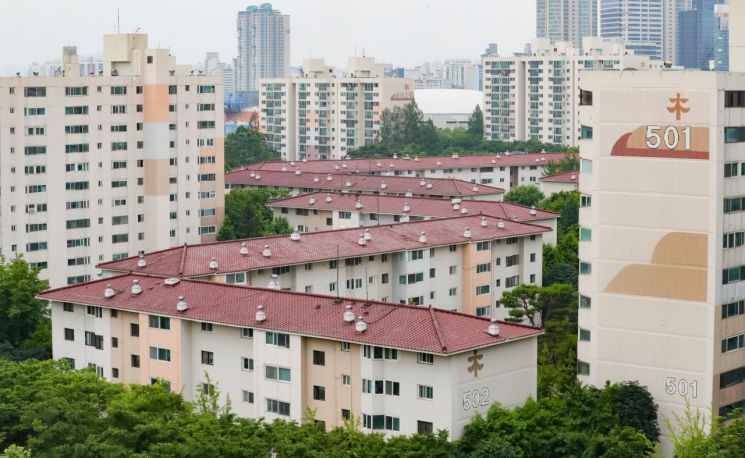
[Asia Economy Reporter Noh Kyung-jo] The 'safety inspection' criteria, considered the last regulatory hurdle in reconstruction maintenance projects, will be relaxed. The weight of structural safety in the safety inspection evaluation items will be lowered from the current 50% to 30%, and the secondary detailed safety inspection (appropriateness review) will be conducted restrictively by local governments delegated with authority.
On the 8th, the Ministry of Land, Infrastructure and Transport announced the 'Rationalization Plan for Reconstruction Safety Inspections' based on these details.
The relaxation of safety inspection regulations is one of President Yoon Seok-yeol's election pledges. The government had approached this cautiously, fearing it could fuel housing price increases, but decided to ease regulations promptly as the risk of a sharp downturn in the real estate market grew due to rising interest rates.
Accordingly, the current 50% weight of structural safety will be reduced to 30%. Instead, the weights for residential environment and building finishing & equipment aging will increase from 15% to 30% and from 25% to 30%, respectively. Safety inspection is the first gateway for reconstruction projects. It evaluates four weighted items: structural safety, residential environment, building finishing & design aging, and cost analysis, with a total score of 100 points. A score of 55 or below (grade D or lower) is required to proceed with reconstruction.
Previously, the Moon Jae-in administration significantly increased the structural safety weight from 20% to 50% in March 2018 and mandated appropriateness reviews by public institutions, strengthening regulations. Since then, reconstruction complexes in areas like Mok-dong, Yangcheon-gu, and Nowon-gu repeatedly failed the safety inspection threshold, leading to criticism that these regulations blocked the supply of new apartments through reconstruction.
The government also plans to adjust the score range for 'conditional reconstruction,' corresponding to safety inspection grade D, from the current 30 to 55 points to 45 to 55 points. This means the number of complexes judged as eligible for immediate reconstruction will increase.
The appropriateness review procedure by public institutions for 'conditional reconstruction' will only be conducted upon request by local governments, reducing time and costs. Local government heads can request an appropriateness review if there are clear errors or delays in supplementing supporting materials during the review of the primary safety inspection results.
Until now, the appropriateness review took longer (typically 7 months) than the primary safety inspection period (3 to 6 months). The cost was also significant: for a complex of 1,500 households, the primary safety inspection cost 260 million KRW, with an additional 100 million KRW for the appropriateness review.
Local government heads can also comprehensively review the housing supply and demand situation for complexes judged as 'conditional reconstruction' and adjust the timing of designating maintenance zones (establishing maintenance plans). Specific procedures will be stipulated to allow adjustment of maintenance zone designation on a yearly basis if market instability or rental difficulties are anticipated.
With this, the three major regulatory hurdles blocking reconstruction projects?price ceiling system, reconstruction excess profit recovery system (재초환), and safety inspection regulations?have all been improved. In June, the government allowed complexes subject to the price ceiling system to raise prices by up to 4.0% through the 'Rationalization Plan for Price System Operation.' In September, it announced the 'Rationalization Plan for Reconstruction Charges,' which raised the exemption threshold for reconstruction charges from 30 million KRW to 100 million KRW.
The revision of the safety inspection criteria (notification) is expected to be announced for administrative notice within this month and implemented in January next year.
© The Asia Business Daily(www.asiae.co.kr). All rights reserved.

















